From PLG to AI-LG: The New Revenue Playbook for Software Infrastructure Companies
Welcome to the age of AI-led growth: where data, AI, and automation combine to create an efficient sales flywheel.



Remember when product-led growth (PLG) was seen as the future of selling technical products? We do too, but some of the biggest success stories of recent years (think Wiz) stuck with something much closer to pure sales and brand building - with nary a free trial in sight. So should you go all-in on traditional enterprise sales?
In a changing buyer landscape, winning isn’t about a single tactic or GTM motion. Instead, it’s about orchestrating a holistic strategy to find, reach, and engage buyers at the right time.
This is the new age of AI-led growth - where emerging leaders are building efficient flywheels through the intelligent use of data, AI, and automation across the sales cycle.
The GTM Crisis
Speak to anyone in sales, BD, or marketing leadership and you’ll hear the same grumbling: what used to work in 2020 does not work in 2026. Indeed - both pure PLG and sales-led growth are becoming much more difficult to pull off. And while these trends are not entirely new, AI has brought two problems to the forefront:
1. The commoditization of software hurts PLG. When software products and features were time- and resource-intensive to build, it made sense to let them speak for themselves. So long as the barrier to entry is high, a cybersecurity solution or cloud cost optimizer will be unique enough to stand out on its own.
But in 2026, the barrier to entry has been lowered by AI. Now that it’s much easier to ship software infrastructure, enterprises are buying software less on the basis of specific features and more on the basis of security, scalability, maintenance overhead, stability, and their confidence in the team behind the product. These factors are hard to evaluate with a stripped-down Community Edition.
2. Outbound tactics have been abused to the point of ineffectiveness. Inboxes are stuffed to the brim with “personalized” cold email, the vast majority of which has been generated by an automated workflow and an LLM. Tactics which used to require a modicum of effort to execute have been automated to death, resulting in buyers who are so overwhelmed with sales messages that they simply stop listening. (Hitting the phone is not a magic bullet either: Apple now sends cold calls directly to voicemail.)
If PLG is ineffective and SLG is oversaturated, what’s left? Has software simply become impossible to sell? Not quite - but GTM organizations do need an OS update if they’re hoping to convince technical buyers to continue signing on the dotted lines.
A New Sales Motion for a New Age of Software
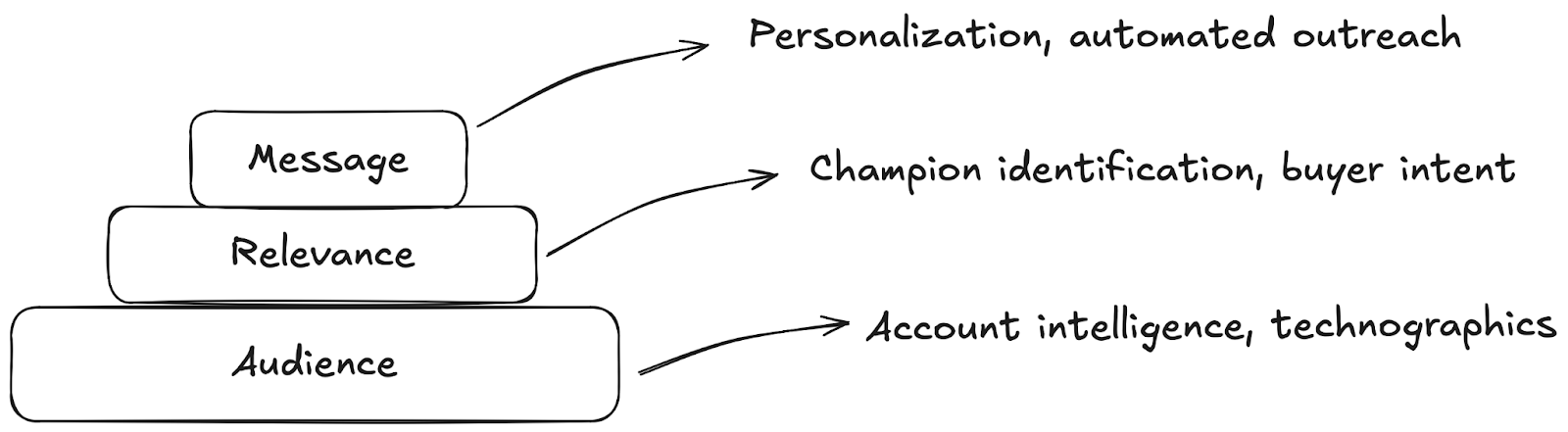
After speaking to 300+ revenue leaders, we learned that today’s most efficient revenue engines are built on three core pillars, each of which builds on the other:
- Audience: The ability to identify ICP-fit companies at scale (including accurate technographic data), and to pinpoint the right person in an enterprise account.
- Relevance: Prioritizing outreach based on intent signals - so your message is landing when the buyer is in market
- Messaging: Tailoring the message to the buyer’s pain and offering a compelling USP for their specific challenges.
Traditionally, this was very difficult to do at scale:
- Building an accurate picture of your audience meant buying lists from data providers that were outdated by the time you loaded them into your CRM. Technographic data - typically a crucial qualifier for technical buyers - was coarse, outdated, and frequently wrong. Reps could use it as a starting point, but needed to spend many hours of additional research to truly narrow down the list.
- Figuring out who in a 10,000-person enterprise actually had budget authority for your product? More LinkedIn sleuthing (or spamming every single engineer and hoping for the best).
- Once you found the right person, writing a message that addressed their specific situation required even more digging: reading earnings calls, scouring blog posts, piecing together a tech stack from job listings.
By the time a rep had researched, qualified, and crafted outreach for a single prospect, the window of intent had often already closed. PLG became popular because it offered to remove much of this toil, with the promise of leads that qualify themselves before even speaking to a rep. And while this vision never became a reality for most, advancements in AI offer a new way forward.
What AI-Led Growth Looks Like
In AI-led growth, AI is used to orchestrate high-impact GTM motions that address all three pillars. It enables organizations to build an accurate picture of the buyer, prioritize based on buying intent, and identify the true champion who can push a deal forward. Then,it gives BDRs an easy way to tailor outreach and address a buyer’s likely pain point.
With AI driving most of these processes, companies can eliminate 80-90% of the manual toil - freeing BDRs and AEs to build human-to-human relationships and apply creative sales approaches that AI cannot replace.
But while everyone is already on the AI bandwagon, only a select few are truly using it to actually drive efficient growth. Most companies are focusing on scaling volume: more sequences, more "personalized" subject lines, more AI-generated variations of the same generic pitch. This is easy to do, even with tools like ChatGPT; but it only addresses the very top of the pyramid, and will inevitably fail if layered on top of irrelevant audience data.
The real leverage comes from building a unified data layer where audience intelligence, intent signals, and messaging all inform each other. When your AI knows which accounts match your ICP based on accurate data, can pinpoint the specific engineer who is currently evaluating new technology, and can surface that context to a BDR in real time. That's a completely different motion than blasting 10,000 "personalized" emails.
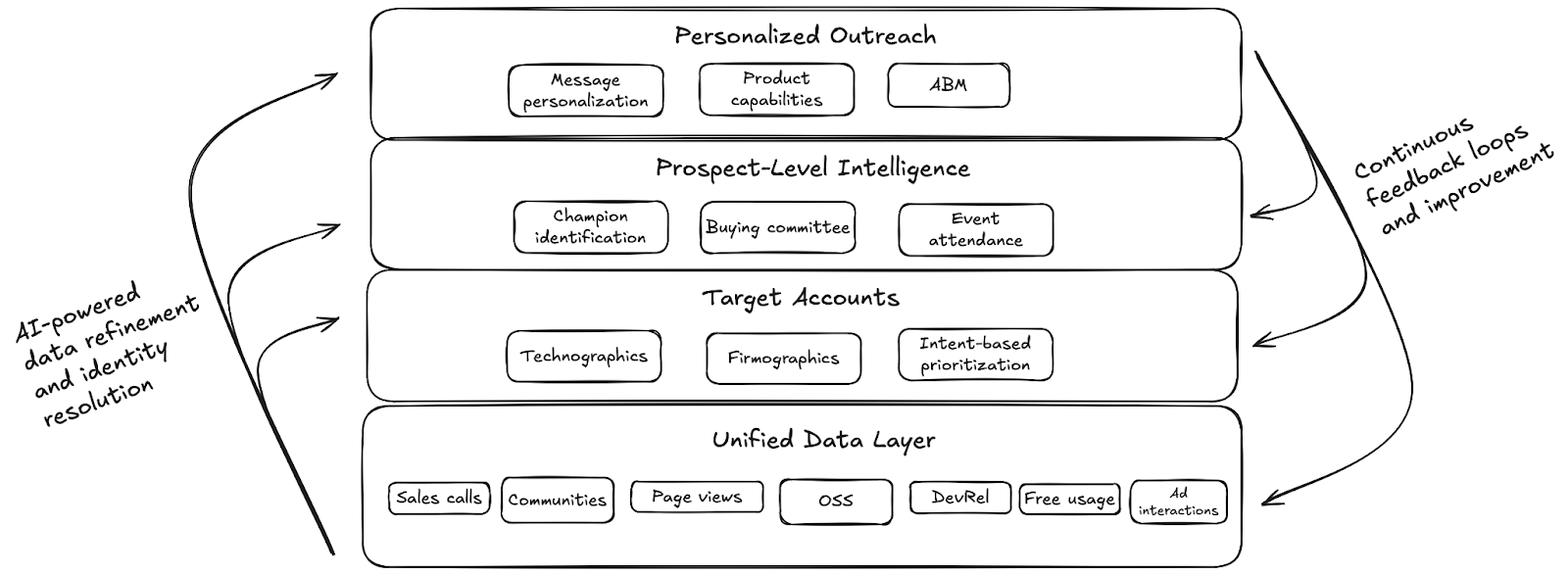
AI-LG doesn't replace PLG or ABM - it makes them work better together. A free-tier signup generates first-party usage data that feeds into your targeting model alongside third-party intent signals. A BDR reaches out to the highest-scoring accounts with context pulled from both sources, and the response (or lack thereof) feeds back into the model, sharpening it for the next round.
Each tactic - whether it's a product-led trial, an ABM campaign, or a targeted outbound sequence - becomes a data source that improves every other tactic. Over time, your GTM engine gets smarter with every interaction between your sellers and the market.
4 Keys to Effective AI-Led Growth
1. Clean first party data
It’s not breaking new ground to say that AI is only as good as the data you feed it, but the fact that you’ve probably heard this before doesn’t make it any less true. If you want to adopt AI-LG, you need high-quality data on website visits, social media engagement, and engagement with free / trial tiers (if you offer them).
And just as importantly, you need an AI that can combine your first-party data with third-party intent signals, such as posts in developer communities or GitHub activity, as it prioritizes leads for you.
2. Culture of experimentation
The organizations winning with AI-LG aren't the ones with the biggest tech budgets - they're the ones willing to continuously rethink their GTM during an age of rapid technological change. When a channel stops performing, they drop it and test something new. They treat their go-to-market strategy the way good engineering teams treat their codebase: something that should be iterated on constantly, not frozen and defended.
This mindset extends to tooling. Too many teams buy a platform and then restructure their entire sales process around its default workflows. That's backwards. Your AI tooling should be configurable enough to match the way your team already sells — and flexible enough to change as your strategy evolves.
3. Avoiding blind faith in AI
AI can accelerate bad decisions just as easily as good ones. If your lead scoring model is trained on a flawed ICP definition, AI will confidently prioritize the wrong accounts - and do it faster than any human could. If your intent signals are noisy or misinterpreted, your BDRs end up reaching out at the wrong time with the wrong message, except now they're doing it with a false sense of confidence because "the AI said so."
None of this means you should distrust AI. But you do need to stay close enough to the outputs that you can catch when something is off. Teams that succeed with AI-LG build feedback loops where reps can flag bad recommendations, and where those flags actually improve the model over time.
On that note, it helps when your AI sales tools aren't black boxes. After all, you can only verify that your tools are working well if they ground their decisions in evidence that you can verify. If a revenue intelligence platform gives you a prioritized list of leads, it should be able to point to the specific signals, such as free trials, forked repos, or Reddit posts, that qualify a given lead as “warm.”
4. Democratization of AI capabilities
If you want everyone in your organization to use AI, it needs to be usable. Legacy intent and ABM platforms can take weeks or months to configure, and require constant RevOps engagement. As a result, you end up paying for something your team will never use.
If BDRs have to spend hours fine-tuning workflows, they’ll likely stick with what they know. And who can blame them? It’s better for many to move slow and get results than to sink time into a new tool that may not deliver. AI-LG only works if even the least technical BDRs can take advantage of it.
Enable AI-Led Growth with Onfire
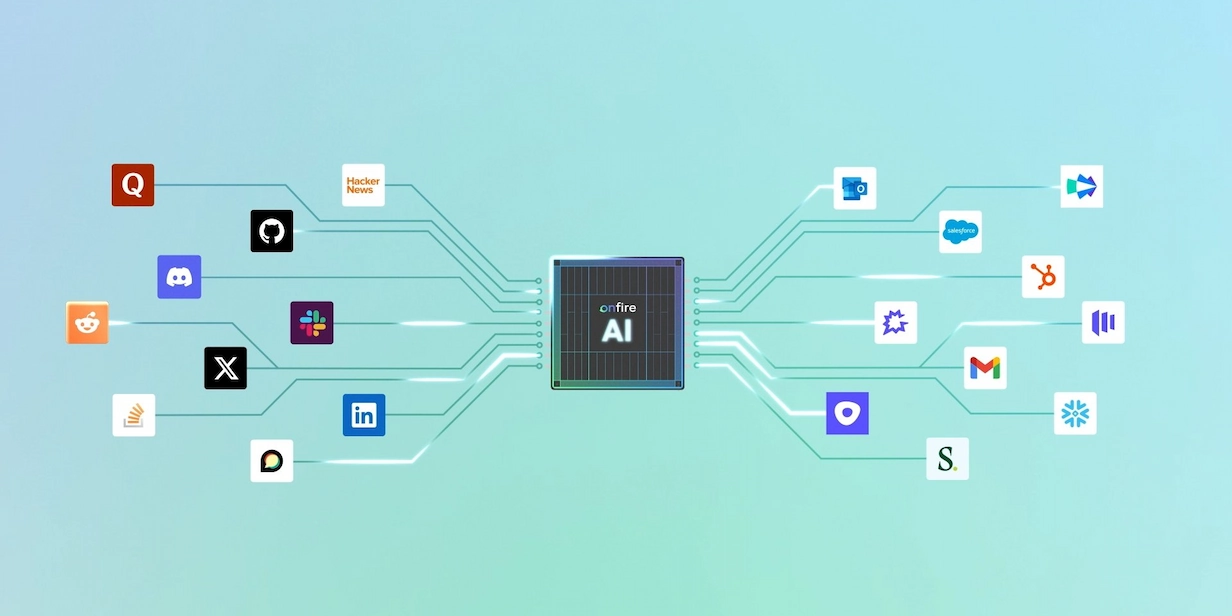
Onfire is the vertical AI platform built for software infrastructure companies. It combines first-party data with intent signals from over 100,000 developer communities to prioritize leads. Each Onfire customer gets a custom workflow designed to match their ICP, bringing AI-LG in reach for every BDR. See how it works.
.webp)








%20(1).webp)















































.webp)