Onfire vs. 6sense: Not All Intent Data is Created Equal
Find out which platform is the best choice for prospecting, reaching technical buyers, intent signals, and ABM.
.webp)


If you're comparing revenue intelligence platforms for your GTM team, you've likely come across 6sense. Known for its ABM capabilities and intent scoring, 6sense positions itself as the leader in helping B2B companies identify in-market accounts. But how does its intent data actually work, and how does it compare to Onfire?
The simple bottom line: when to choose which
Choose Onfire if you are selling to technical buyers and need accurate, prospect-level intent signals. Onfire tracks where technical buyers actually research (developer communities, GitHub, Stack Overflow, events) and identifies the specific person showing intent, not just the account.
Choose 6sense if you are running enterprise ABM campaigns for marketing teams and can work with account-level insights. 6sense offers native campaign orchestration that runs on its account and intent data, though the latter data relies mostly on IP tracking with known accuracy limitations.
The 20,000 foot comparison of 6sense vs. Onfire
More detailed information about each comparison factor can be found below.
See the difference for yourself: request a head-to-head comparison based on your use case
What each tools means by ‘intent data’
6sense’s call to fame is its promise to enable prioritization of ABM and sales efforts based on intent signals. Hence we should take a moment to understand what that term actually means in the way it’s used by different providers. Both 6sense and Onfire infer buying intent from signals collected in data, but there are fundamental differences in their approach.
6sense's approach: account-level IP tracking and third-party sources
6sense collects intent data primarily through IP address matching. When someone visits a B2B publisher site or content page, 6sense attempts to match that IP address back to a company. They also integrate with Bombora to track keyword research across B2B publisher networks, as well as scraping public sources such as job posts.
This approach has inherent limitations:
- VPN traffic and remote workers create significant blind spots, and IP matching becomes less reliable as work patterns shift away from corporate offices.
- Technical audiences are particularly averse to tracking of any kind, and are enthusiastic adopters of technologies such as VPNs and script blockers.
- 6sense only delivers account-level signals. You learn that "Acme Corp is researching cloud security" but not who at Acme is doing the research.
Onfire's approach: Building an accurate picture of technical buyers across first- and third-party data
Onfire infers intent based on multiple layers of data and AI that’s specifically focused on technical buyers:
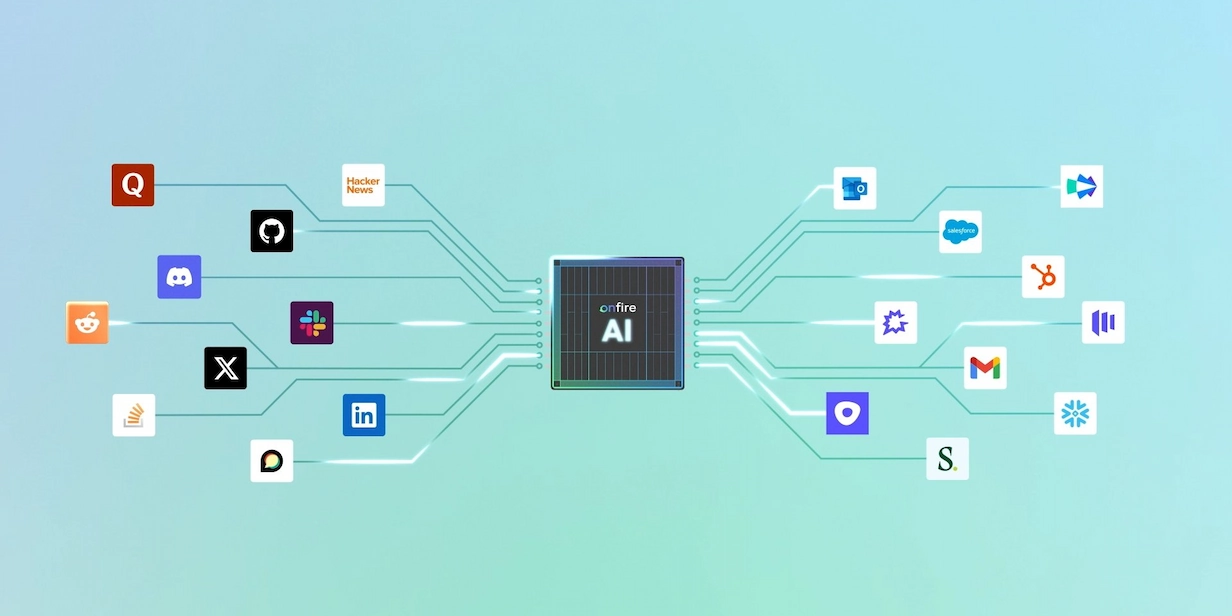
- Onfire monitors the places where technical buyers actually discuss and evaluate tools: GitHub, Reddit, Stack Overflow, Discord, Slack communities, Hacker News, and technical conferences. When an infrastructure engineer asks about observability platforms in a Slack community or contributes to a certain open source repository, Onfire will capture that data.
- Combining proprietary data collection with first- and third-party data: Onfire cross-references the data it collects with IP databases, first party data, and the same third party sources 6sense relies on to create a much more accurate picture of the accounts and prospects
- Data in Onfire is tied to specific prospects and personas. Onfire ties signals like event attendance, technographics, and job changes to a specific person, a specific company, and a specific set of technologies through its identity resolution technology.
Detailed breakdown
Technographics
Key takeaway: 6sense relies on front-end detection and job postings for tech stack data. Onfire captures signals from OSS adoption, community discussions, and actual developer activity.
Onfire builds its technographic data from sources that reveal what teams are actually using: GitHub activity, OSS contributions, community discussions, and technical hiring patterns. This means you can filter for specific technology combinations, like teams running Postgres on AWS who are evaluating monitoring solutions, with high confidence the data reflects reality.
6sense's technographic capabilities are similar to other IP-based platforms. They rely primarily on front-end script detection and job posting analysis. This works reasonably well for front-end technologies but provides limited visibility into back-end infrastructure, databases, and developer tooling.
Targeting and prospecting
Key takeaway: 6sense tells you an account is interested but not who. Onfire identifies the most relevant persona in the organization.
Both companies will offer firmographic targeting that lets you filter to accounts that broadly match your ICP in terms of company size, fundraising, number of engineers, or similar broad-strokes account data. The differences appear when you look at prospecting - where you’re looking to build lists of actual buyers to approach, not just accounts.
This is perhaps 6sense's most significant limitation for sales teams. Their intent data surfaces accounts, not people. When a "6QA" (6sense Qualified Account) comes in, sellers often face significant research to figure out who was actually doing the research. Looking at online reviews, many users state that the amount of work required to identify who was actually showing intent, only to frequently end up at the wrong person, is a frequent source of frustration.
Onfire is focused on personas, not just accounts and job titles. Onfire combines diverse data signals to identify 100+ technical personas - individuals who have the most impact on technical decisions around areas such as CI/CD or AppSec.
These personas combine Onfire’s technographic data, community signals, and proprietary AI and identity resolution that transform this data into highly specific findings tied to specific people within an account. This means that BDRs can prospect the teams and individuals that they should actually be selling to, rather than figure out which one of the hundreds of “senior software engineer” in a Fortune 500 they should be talking to.
Intent-Based Prioritization
Key takeaway: 6sense's intent scoring is account-level and often opaque. Onfire provides verifiable, prospect-level signals with source URLs.
We've covered the core differences in intent data above: Onfire’s approach provides much greater accuracy when targeting technical buyers, and works at the prospect level; 6sense is focused on highlighting the right accounts to focus advertising spend on.
Another point worth considering is explainability. With 6sense, intent scores can feel like a black box. An account might jump to "purchase stage" simply from hitting a campaign landing page, even when they're nowhere near ready to buy. With Onfire, every signal comes with a source URL. If a prospect discussed migrating from a competitor in a community thread or registered for a relevant conference, you see exactly what triggered the signal.
Contact Data
Key takeaway: 6sense provides contact data but it's not their core strength. Onfire uses a waterfall approach that combines multiple sources for better worldwide coverage.
6sense includes a contact database, although contact enrichment is not the platform's primary focus. User reviews frequently cite contact data accuracy as a pain point, and coverage can vary significantly outside major markets.
Onfire aggregates contact data through a waterfall enrichment process that checks across multiple sources, including many of the same databases that power other tools. This maximizes coverage and accuracy for both email and direct dial information.
CRM Integrations
Key takeaway: Both tools integrate with major CRMs. Onfire's prospect-level data enables more sophisticated routing and scoring.
6sense offers strong CRM integrations, particularly for marketing automation workflows. Their account-level data works well for campaign prioritization and basic lead scoring.
Onfire integrates bi-directionally with Salesforce and HubSpot, pushing prospect-level data that enables more granular workflows. For example, you can route leads based on the specific technology they work with, or prioritize PLG signups based on their buying authority for your product category.
AI Features
Key takeaway: 6sense focuses on predictive analytics for marketing campaigns. Onfire Agent combines first-party CRM data with third-party signals for deal-level intelligence.
6sense has invested heavily in predictive analytics, using AI to forecast which accounts are most likely to convert. This is useful for marketing teams planning campaign spend. The Onfire Agent is built for sales and BDR teams - fusing first-party CRM data with Onfire's external signals, answering questions like "Who is the real champion in this account?" or "Which closed-lost deals should I revisit?" The Agent can also trigger automated workflows: alerts, sequence enrollment, and CRM updates based on signals.
ABM Capabilities
Key takeaway: 6sense offers more streamlined ABM orchestration and integrations. However, those campaigns still run on IP-based, account-level data.
6sense offers stronger built-in ABM capabilities. This includes campaign orchestration, integrations with marketing automation tools, attribution reporting, and multi-channel coordination.
Onfire is not an ABM orchestration platform. To run ABM campaigns with Onfire data, you would export to external tools like HubSpot or your advertising platform.
The trade-off is data quality versus workflow convenience. 6sense makes it easy to run campaigns, but those campaigns are still built on IP-based, account-level intent data with the accuracy limitations that come with it. Onfire requires more workflow setup, but the underlying signals are more reliable if you’re dealing with technical audiences.
Implementation
Key takeaway: 6sense implementations are complex and resource-intensive. Onfire can be deployed in days with configuration handled by the Onfire team.
6sense implementations are notoriously involved. Online reviews consistently mention steep learning curves and the need for dedicated RevOps resources to configure the platform, build segments, and maintain integrations. Many organizations find they need to hire specifically for 6sense administration, or rely heavily on professional services.
Onfire is designed for fsat time-to-value. Most implementations are completed in days, with the Onfire team handling persona configuration based on specific target buyers and technology focus areas.
Pricing
Key takeaway: 6sense requires enterprise-level commitments with opaque pricing. Onfire offers accessible credit-based pricing.
6sense does not publish pricing, but aggregated data from users suggests annual costs typically range from $60,000 to well over $100,000, with some enterprise deployments exceeding $130,000 per year. Multi-year commitments are common. As we’ve mentioned above, the platform also typically requires dedicated RevOps resources to implement and maintain effectively, adding to total cost of ownership.
Onfire uses credit-based pricing, similar to how you pay for contact reveals or enrichment in other tools. This makes it more accessible for teams that want to start smaller and scale usage based on actual needs rather than committing to enterprise contracts upfront.
Need to make a decision? Take the data for a test drive
To reiterate: If you are running enterprise ABM campaigns and need native orchestration, and need a tool that’s built around marketing and ABM workflows, 6sense is worth evaluating, though you should be aware of the data accuracy limitations for technical audiences.
If you are selling to engineers, security professionals, or other technical buyers, and you need intent signals that identify actual people rather than opaque account scores, Onfire is the stronger choice.
See how the data compares: We know vendor claims can be hard to verify. That is why we offer head-to-head comparisons where you can test Onfire data against 6sense or any other provider using your actual target accounts and personas.
Schedule a demo to set up a comparison tailored to your GTM needs.
Frequently asked questions
Why look for a 6sense alternative?
The main question with intent data is whether the data is accurate and whether it actually helps your go to market motion. If the data you get from 6sense does not help you reach the right buyers at the right time - and this might be the case if you are looking for specific prospects, or more granular technology choices - then you should look for an alternative. Based on online discussions, some companies also wish to replace 6sense due to complex implementation and high costs.
Is Onfire the best alternative to 6sense?
“Best” is always dependent on your use case and goals. However, we are confident in saying that if you are selling to technical buyers, Onfire is the best alternative as it provides far more accurate prospect-level insights. No other data provider, including 6sense, collects the data that feeds into Onfire’s technographics and intent; and no other provider can tie these insights back to specific named prospects (e.g. to indicate “this is the person you should sell an AppSec solution to).
Can I use Onfire and 6sense together?
Theoretically yes, although you would be paying for the same features twice in both platforms. You would typically use Onfire to replace prospecting and sales workflows managed in 6sense; you might want to keep 6sense around if you have a large investment in ABM programs and require deep integrations with advertising channels.
Is there a cheaper 6sense alternative with the same features for technical buyers?
There are many affordable alternatives to 6sense. Onfire is the best alternative if you’re looking to reach technical buyers, and offers a credit-based model that’s based on the number of prospects you want to reach - rather than complex enterprise plans with lengthy implementation cycles and upfront fees.
.webp)














%20(1).webp)