Who Are the Top 11 B2B Intent Data Providers in August 2026?
Understand what intent actually means in different GTM platforms, learn how AI agents are changing the market, and compare the leading providers.



If you're struggling to reach your buyers at the right time, intent data should help. As part of your lead generation process, intent data helps you identify the people interested in your product when they're actually ready to buy. In this article, we break down the key features of the top 11 B2B intent data providers in the agentic era.
Key Takeaways
- Intent data reveals buying signals before prospects fill out forms or contact sales, enabling earlier engagement and more relevant outreach.
- Most providers deliver account-level signals, but some (including Onfire) offer prospect-level granularity that identifies specific individuals showing interest.
- For companies selling to technical buyers - developers, DevOps teams, security engineers - Onfire monitors OSS activity, developer communities, GitHub, Reddit, and technical events that generic platforms miss entirely.
- Pricing varies dramatically, from around $99/month for website visitor identification tools to $100K+ annually for enterprise ABM platforms with full intent suites.
- The most actionable intent data comes from sources aligned with your buyers' actual research behavior - whether that's B2B publisher networks, software review sites, or (for technical audiences) community forums and open-source projects.
What Is B2B Intent Data (And Why It Matters in 2026)
Intent data is any information that reveals that a company (or individual) is actively showing interest in a product. It can come in the form of content consumption, search queries, or website visits - or in the case of technical buyers, posts on Reddit, GitHub forks, or Stack Overflow contributions.
With accurate intent data, you can reach out to the right person at the right time - like when an engineer asks a question about your product on a Discord channel. Traditionally, you could only gauge intent with first-party intent data: direct user behavior on your own website. However, modern B2B intent data providers track third-party signals from across the web. In the best case, that makes it possible to reach out with a personalized message while the prospect is still researching.
There's a catch, though: most intent data was built for broad B2B audiences. If you're selling infrastructure software, security tools, or developer platforms, signals from generic publisher networks may miss the places where your buyers actually spend time. Technical buyers don't browse the same B2B content sites as procurement teams. They're on GitHub, Hacker News, Discord, and niche Slack communities - places that traditional intent providers don't monitor.
(That's why we built Onfire to track over 100,000 engineering-centric sources and capture signals that conventional providers simply cannot see.)
Why intent data still matters in AI-native GTM
If you’re reading this in 2026, you may be wondering how the rise of AI agents changes the intent data landscape. The answer: the way GTM teams access and consume intent data may have changed, but the need for intent data has not. If anything, it’s grown more acute.
Say you’re running much of your GTM prospecting and outreach work through Claude Code (or another agentic workflow). While it’s true that you can offload plenty of tedium to your agent, the results will only be impactful if you provide them with the right data. If your agent can’t tell who is on a buying committee, which engineers are frustrated with their current solution, or where your champion is moving, you’ll be automating the same poor targeting as your competitors.
And because that information is often hard to find on the public web, you’ll still need to connect your agent to an intent platform to give it the insights it needs.
How B2B Intent Data Providers Differ
The insights you'll get from B2B intent data platforms vary significantly based on their sources, freshness, and granularity. Here are the main differences between solutions:
Data sources
Intent providers pull signals from different places, and this fundamentally shapes what they can tell you. Some focus only on third-party data, such as web content consumption from networks of B2B publishers (Bombora's cooperative spans 5,000+ sites).
Others track engagement on their own platforms. For instance, G2 monitors activity on its software review marketplace, while LeadIQ observes prospect behavior on LinkedIn.
While third-party data is important, it doesn’t show you the full picture. Did prospects from a target account visit your site? How many prospects have engaged with the freemium tier of your product? To answer those questions, you need first-party data that only you have access to.
Onfire was built to track data sources relevant to your niche, across both first-party and third-party sources, so you get a complete picture of your buyer.
MCP / AI agent integrations
For many GTM teams, AI agents are becoming essential partners in B2B prospecting. That means MCP servers, which allow agents to connect to other tools, are now must-haves for any serious intent platform. With an MCP server, a non-technical BDR can easily connect their agent of choice to an intent platform and automate much of the prospecting work that eats up their workday. Without it, you need to wait for a developer to implement a manual integration before you can put your agent to work.
Signal freshness
Intent data decays quickly. A company researching solutions today may have made a decision by next week. Yet providers differ in how often they refresh data: some deliver weekly topic scores and others provide near-real-time alerts.
Freshness determines whether you can act on signals while they're still relevant. Batch updates on a weekly cadence may work for long sales cycles, but for competitive deals, same-day or next-day signals can create a meaningful timing advantage.
Granularity (prospect vs account-level intent)
Account-level intent tells you a company is researching a topic, but it won't tell you which employee is doing the research. You still need to identify the right contact and hope they're the one looking. Prospect-level intent identifies the specific individuals that show interest in a product, allowing sales teams to reach the right people.
Native activation vs integrations
Some platforms are pure data providers that feed signals into your existing stack (Bombora is designed this way). Others are full ABM platforms with built-in advertising, orchestration, and engagement tools (6sense and Demandbase). Meanwhile, a third category combines intent data with prospecting workflows. For example, Onfire pushes prioritized accounts and enriched contacts directly into Salesforce, HubSpot, Outreach, or Salesloft.
The right model depends on your tech stack and whether you want a standalone intent signal or an end-to-end solution.
Top 11 B2B Intent Data Providers
"Intent" means different things across different platforms. Some providers track research behavior on publisher networks, others identify website visitors, and others monitor trigger events like job changes. Below, we explain the specific intent signals each platform tracks so you can evaluate which sources align with your buyers' behavior.
1. Onfire: buyer-level intent signals for technical audiences
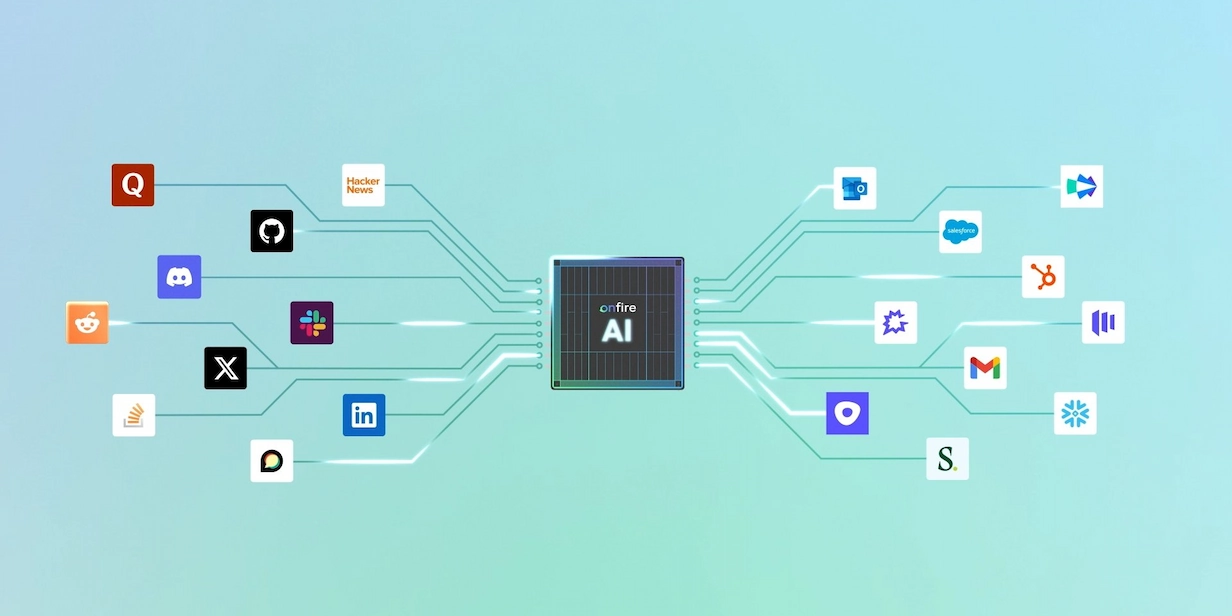
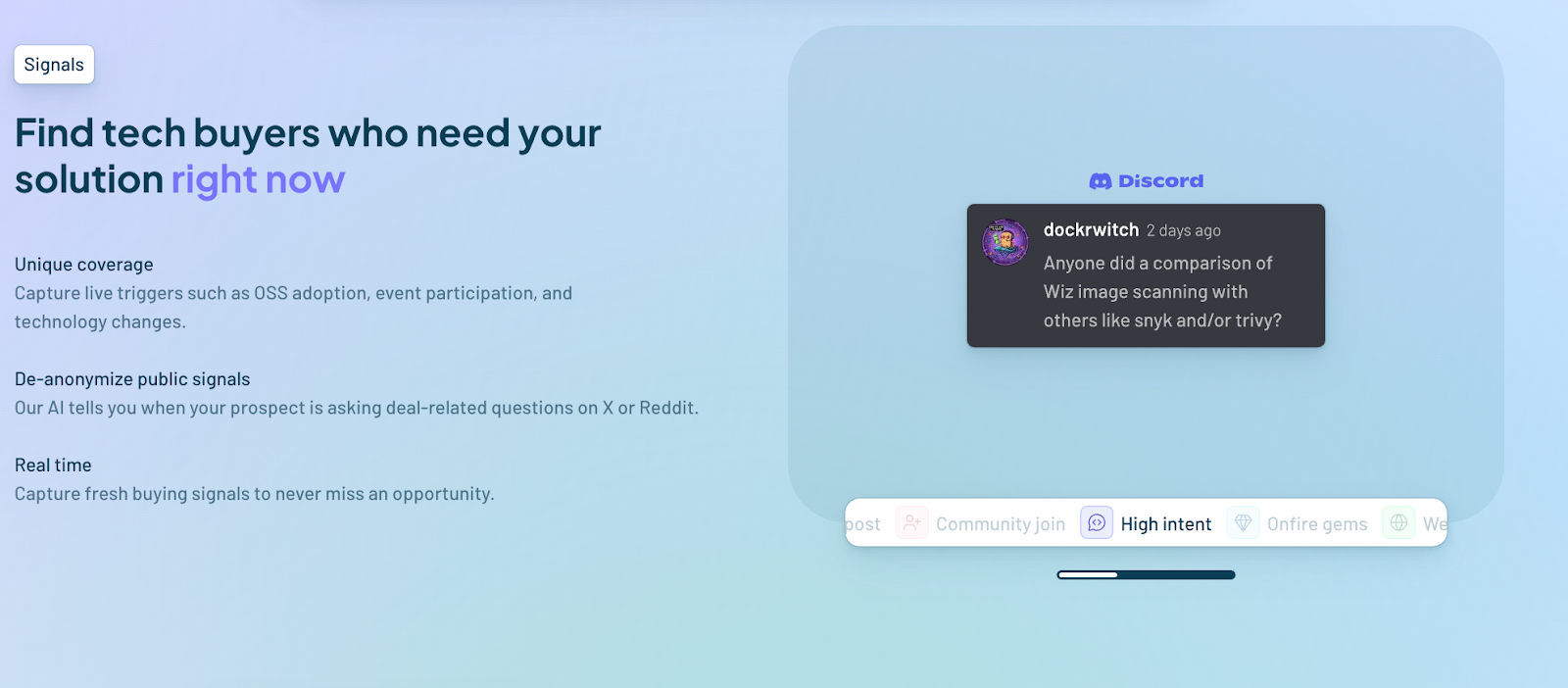
Onfire tracks intent signals from where technical buyers actually research: GitHub activity, Reddit discussions, Hacker News threads, Discord and Slack communities, Stack Overflow, open source contributions, and tech conferences like KubeCon, RSA, and AWS re:Invent. When someone posts in a public Slack community asking for alternatives to their current vendor, Onfire surfaces that signal - with the specific person attached.
Unlike most providers that stop at account-level signals, Onfire's identity resolution links public activity to specific individuals, which enables sales teams to target specific buyers rather than working through endless lists. Customers report 3x higher reply rates because they're reaching the right people at the right time with the right context.
Intent signals tracked:
- Developer communities (GitHub, Stack Overflow, Reddit, Slack, Discord, Hacker News), OSS activity, and tech conferences
- Uses entity resolution and NLP to de-anonymize activity and link to specific individuals
- Incorporates signals from your first-party data via CRM integration
- Prospect-level buying intent
Best for: Software infrastructure companies selling to developers, DevOps, security teams, and technical decision-makers.
Pricing: Credit-based model based on the number of prospects revealed through the platform. No implementation fees.
2. 6sense
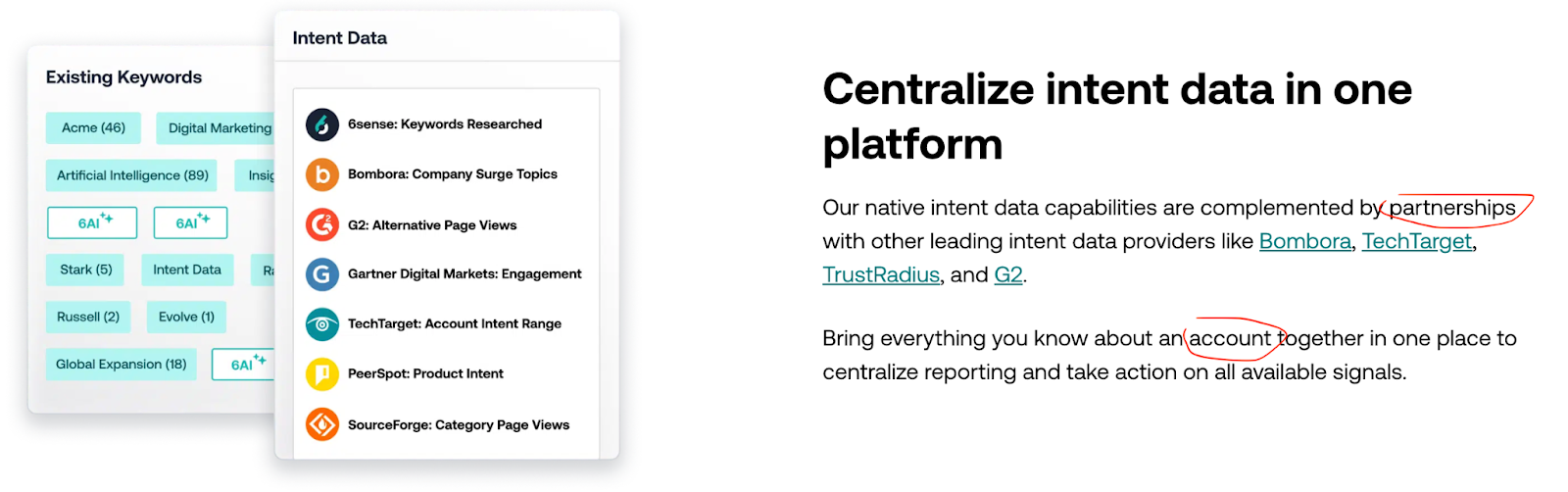
6sense is an ABM platform that combines intent data with predictive analytics and account orchestration. It tracks keyword searches across its network of B2B web domains and uses machine learning to score which accounts appear to be in-market.
The platform identifies anonymous website visitors, assigns buying stage scores, and coordinates multi-channel campaigns. However, it only offers account-level intent data, and users note a steep learning curve and high price point.
Intent signals tracked:
- IP-based tracking and keyword searches across B2B web domains
- Machine learning scores accounts based on research activity patterns
- Account-level only
Best for: Account-level targeting across longer-term sales and marketing efforts; established companies with a lot of in-house expertise to throw at the problem.
Pricing: Custom quotes; typically $55,000–$130,000+ annually depending on features and scale (based on information available online).
3. Bombora
Bombora operates a large B2B intent data cooperative, which is a network of 5,500+ B2B media websites that share anonymized content consumption data. Its methodology compares recent research activity to a baseline to flag "surge" topics - when an account consumes significantly more content on a topic than usual.
As a data provider rather than a platform, Bombora integrates with most major ABM, CRM, and sales engagement tools. Many other providers (including Cognism and Demandbase) license Bombora's data. The account-level signals require additional tools to identify specific contacts.
Intent signals tracked:
- Content consumption data from 5,500+ B2B publisher cooperative sites
- Compares recent activity to historical baselines to flag "surge" topics
- Account-level only
Best for: Organizations that want to use buyer intent data to feed into existing platforms.
Pricing: Typically $25,000–$300,000+ annually; varies by data volume and topics tracked.
4. Demandbase
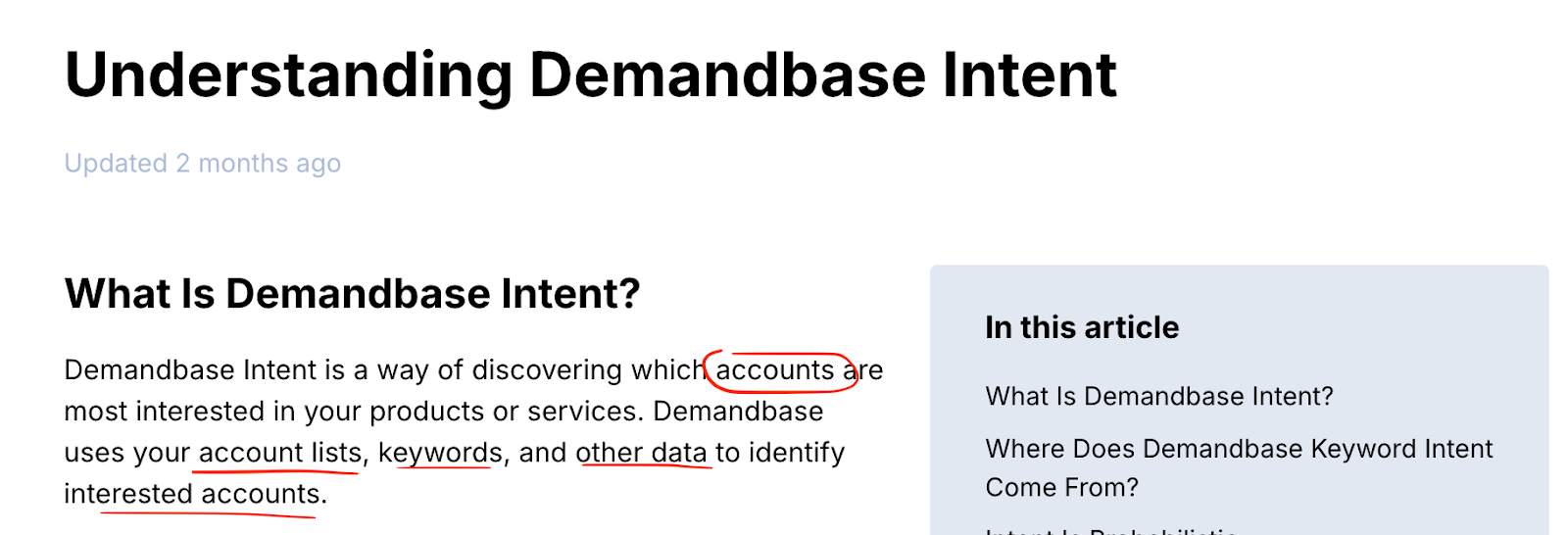
Demandbase is an ABM platform combining account identification, intent data, and campaign orchestration. Its intent engine analyzes content consumption across B2B websites using natural language processing to parse context around keywords.
The platform offers 650,000+ intent keywords across 133 languages and can aggregate third-party intent from Bombora, G2, and TrustRadius. Like 6sense, intent data is typically limited to the account level; and also like 6sense, implementation complexity and cost can be significant.
Intent signals tracked:
- Content consumption across B2B websites, parsed with NLP for keyword context
- Aggregates third-party intent from Bombora, G2, and TrustRadius
- Account-level only
Best for: Mid-market and enterprise companies looking for a broader ABM solution, based on account-level targeting.
Pricing: Custom quotes; enterprise pricing.
5. ZoomInfo
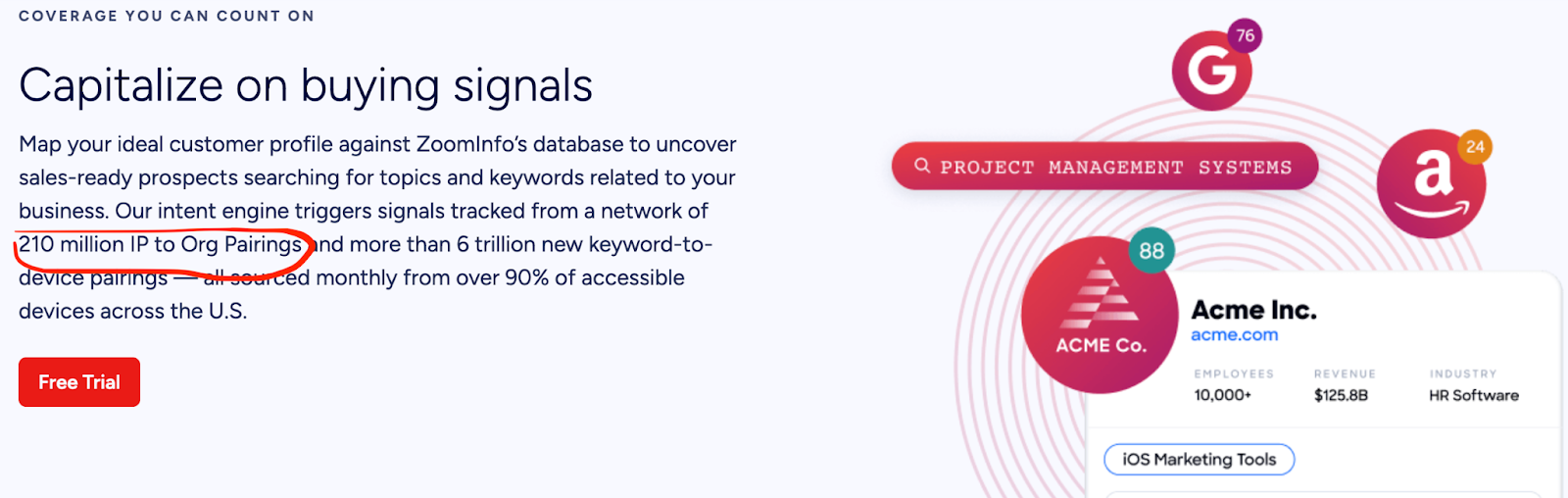
ZoomInfo is primarily a B2B contact database, with buyer intent data available as an add-on to its SalesOS and MarketingOS platforms. Intent signals come primarily from its Bombora partnership and bidstream data, flagging accounts with increased research activity.
The intent add-on combines intent signals with ZoomInfo's contact data. However, its technographics have limited accuracy and are mostly sourced from IP data and job postings.
Intent signals tracked:
- Bombora's publisher cooperative data combined with bidstream signals
- IP-based website tracking
- Account-level only
Best for: Sales teams who are looking to "cast a wide net" by targeting large volumes of prospects across different industries and roles.
Pricing: Intent is an add-on to ZoomInfo subscriptions; base plans start around $15,000/year, with intent features requiring Advanced or Elite tiers ($25,000–$40,000+/year minimums).
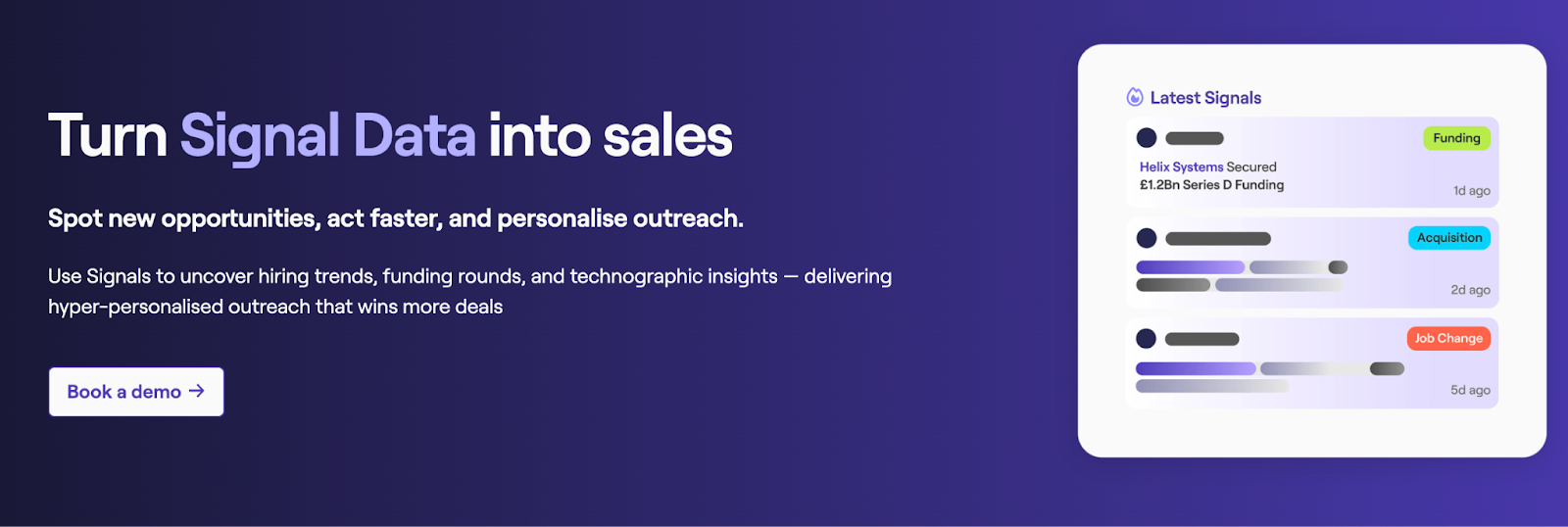
6. LeadIQ
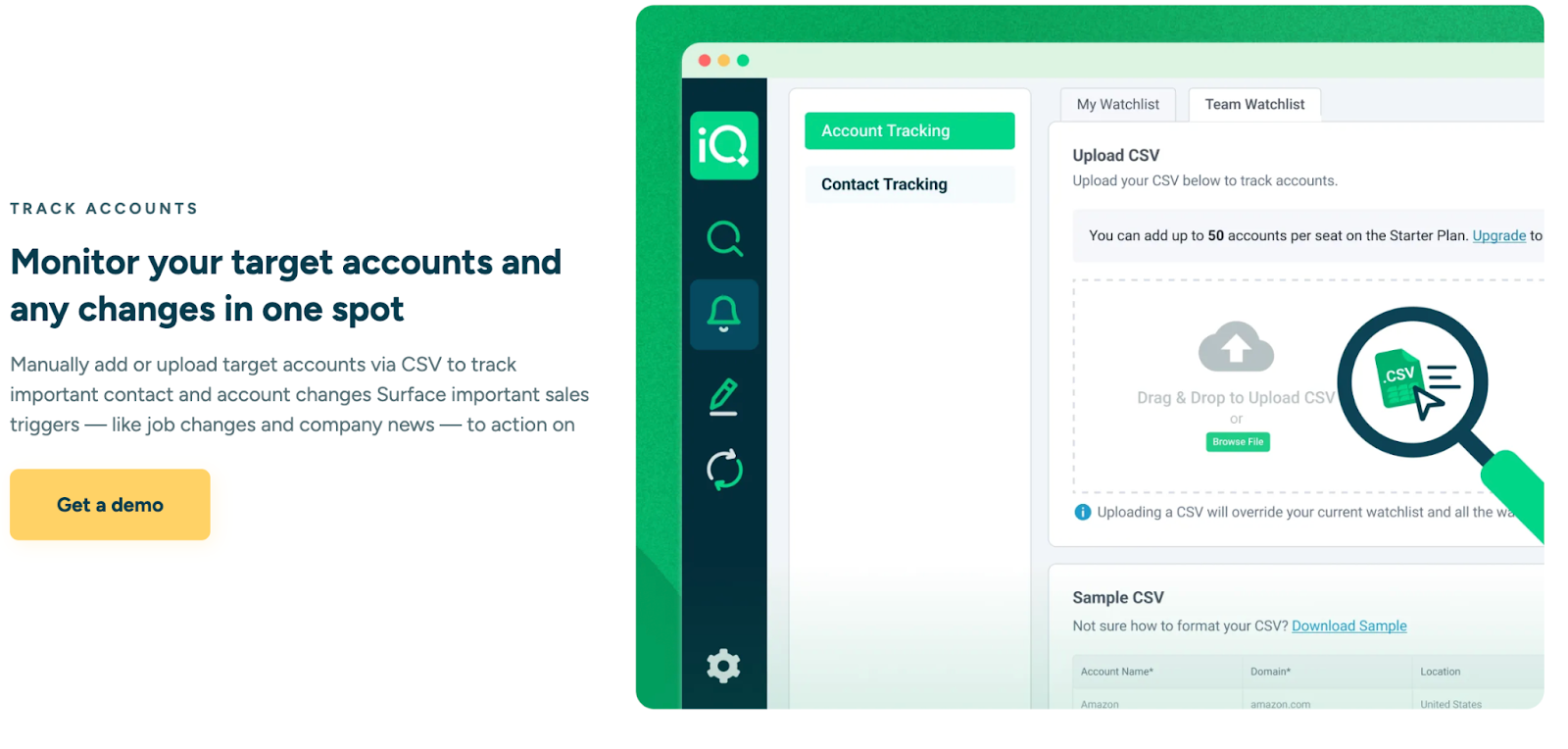
LeadIQ is a prospecting platform that combines contact data capture with buying signals. It tracks job changes, company news, and engagement patterns to help sales reps identify timely outreach opportunities.
The platform integrates directly into LinkedIn Sales Navigator and syncs captured contacts to CRMs and sales engagement tools. Intent signals are more limited than dedicated providers, and are focused on trigger events rather than topic-based research activity. It works best as part of an outbound workflow rather than a standalone intent solution.
Intent signals tracked:
- Job changes, company news, and LinkedIn engagement patterns
- Trigger-based signals rather than topic-based research activity
- Focuses on timing events
Best for: Sales teams in non-technical verticals focused on outbound prospecting who want trigger-based signals alongside contact capture.
Pricing: Free tier available; paid plans start around $39/user/month.
7. G2
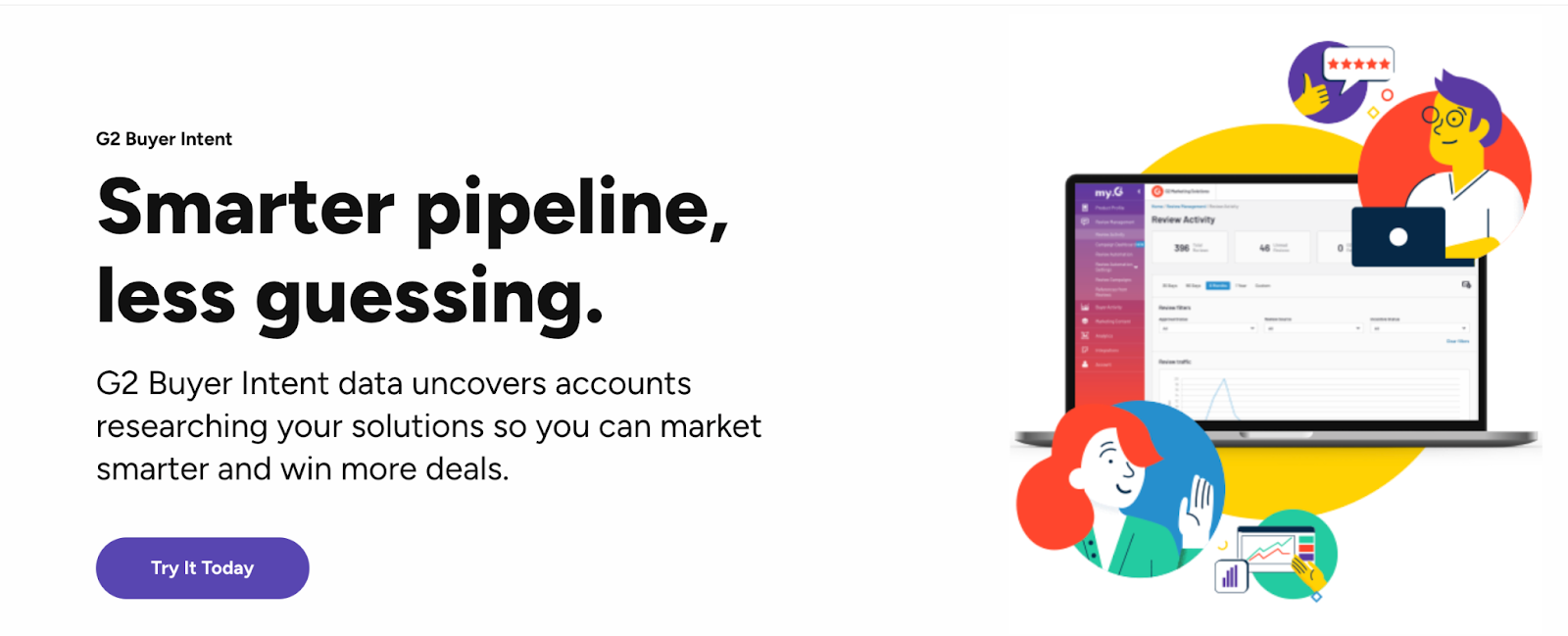
G2 is a software review marketplace, and its Buyer Intent product shows which companies are researching your product category, viewing competitor profiles, or comparing solutions on the platform.
The signals are inherently purchase-related because people on G2 are evaluating software. However, G2 provides company-level activity only; individual contact data requires third-party enrichment. Coverage depends on whether your category has meaningful G2 traffic, and some users find the pricing high relative to signal volume.
Intent signals tracked:
- First-party activity on G2's review marketplace
- Views of your product category, competitor profiles, and comparison pages
- Signals from active software evaluators; company-level only
Best for: Software vendors in categories with strong G2 presence.
Pricing: Add-on to G2 seller plans; Core starts around $10,000/year, Buyer Intent typically adds $22,000–$36,000/year.
8. Cognism
Cognism is a sales intelligence platform known for phone-verified contact data and European market coverage. It partners with Bombora to provide buyer intent data alongside its contact database.
The platform combines Bombora's account-level intent signals with Cognism's verified mobile numbers. Intent data is an add-on rather than a core feature, so teams primarily focused on intent signals may find the bundled approach less efficient. That being said, Cognism's GDPR compliance and EMEA data quality are important strengths.
Intent signals tracked:
- Bombora's B2B publisher cooperative data (content consumption across thousands of sites)
- Surge topic detection when accounts research at elevated rates
- Account-level only
Best for: Sales teams targeting European markets or prioritizing phone outreach.
Pricing: Access fees + per-user pricing, contract based. The Grow plan typically starts at $15,000/year + $1,500 per user; Elevate (with intent) starts at $25,000 + $2,500 per user.
9. Dealfront (Leadfeeder)
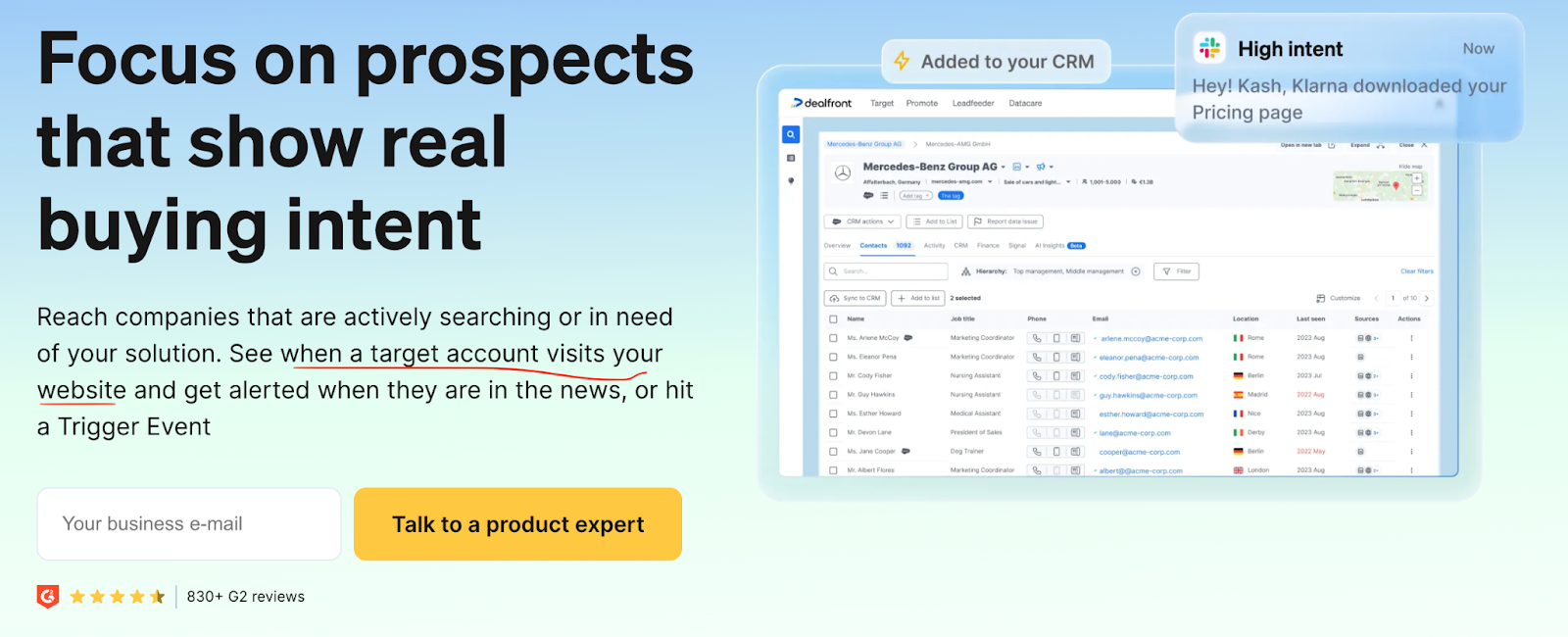
Dealfront (formed from the merger of Leadfeeder and Echobot) identifies companies visiting your website by matching IP addresses to firmographic data. This captures first-party intent signals - companies actively looking at your site - rather than third-party research behavior.
The platform scores visitors, shows page-level engagement, and integrates with CRMs. It's more affordable than enterprise intent platforms but limited to your own web traffic. Company identification accuracy varies, and individual contact details require additional enrichment.
Intent signals tracked:
- IP matching on your own website to identify visiting companies
- First-party website visitor identification only
- Shows who visits your site, not what they research elsewhere
Best for: B2B companies wanting to identify and prioritize website visitors.
Pricing: Starts at $99/month; scales based on unique companies identified.
10. TechTarget
TechTarget tracks what registered members read and download across its network of 220+ B2B tech publications. Because that behavior is directly observed on properties users have opted into, it delivers contact-level intent, showing you the named prospects doing the research, not only the company they work for.
The platform ranks accounts by buying stage and ICP fit and integrates with Salesforce, HubSpot, and Marketo. Coverage is deep in IT and enterprise software but limited to research happening within TechTarget's own network, so it captures nothing outside those properties. Users also note that accuracy varies, and it works best paired with enrichment and outreach tooling rather than as a standalone system.
Intent signals tracked:
- First-party content consumption across TechTarget's publisher network (articles read, whitepapers downloaded)
- Contact-level signals showing named individuals researching, not just companies
- Website and banner engagement on your own properties, blended with third-party topic intent
Best for: Enterprise IT and technology vendors targeting named buyers with active research signals.
Pricing: Custom, sales-led quotes; enterprise-style contracts with no public list price.
11. Apollo.io
Apollo.io bundles buying intent signals directly into its contact database and prospecting workflow, so intent-flagged accounts sit alongside the verified emails and phone numbers needed to act on them. Note, however, that its intent data is sourced through third-party partners including LeadSift (a Foundry company) for multi-source signals and Bombora for topic surge.
The platform captures buying intent at the company level across 1,600+ topics, refreshes signals weekly, and lets you filter by intent right inside Search and the Chrome extension. On the plus side, this gets you actionable intent without forcing you to stitch together a separate intent provider, engagement tool, and database. However, the result is that intent is a lighter feature here than on dedicated ABM platforms, and signals are company-level rather than contact-level.
Intent signals tracked:
- Third-party topic surge via Bombora across a B2B publisher network
- Multi-source signals via LeadSift (public web, social, events, hiring, technology installs)
- Company-level buying intent scored across 1,600+ topics, refreshed weekly
Best for: SMB and mid-market teams wanting intent bundled with contact data and outreach in one platform.
Pricing: Included on all plans (including free); paid tiers run $49–$119/user/month on annual billing.
When Intent Data Won't Help You
Intent data isn't universally valuable. Before investing in a provider, consider whether these conditions apply to your business:
- Your buyers don't leave trackable signals. Some audiences simply don't research online in ways that intent providers can capture. For instance, very senior executives often delegate research to their teams, and buyers in heavily regulated industries may avoid public forums entirely. If your prospects aren't consuming content, posting questions, or engaging with review sites, there's nothing for intent tools to track.
- Your sales cycle is too short. Intent data creates value in the gap between research and purchase. If your buyers go from problem to decision in a few days, signals may arrive after the deal is already won or lost. Intent works best when there's a meaningful window to intercept.
- You can't act on the signals. If your sales team is already at capacity, or you lack the outbound infrastructure to respond quickly to alerts, intent data will pile up in dashboards rather than convert to pipeline. You'll have to fix your capacity before signing up for an intent platform.
- Your ICP is too narrow. Intent providers work on volume. If you're targeting a handful of named accounts or a hyper-specific niche, even accurate signals may surface only a few prospects per quarter - not enough to justify platform costs. At that scale, manual research and relationships often outperform automated signals.
If none of these apply, intent data can meaningfully accelerate your pipeline. Here's how the leading providers compare.
Choosing the Right Intent Provider for Your GTM Motion
If you sell to broad B2B audiences that research on publisher networks and review sites, platforms like Bombora, 6sense, or G2 will surface the intent you’re looking for. If, however, you’re selling to technical buyers, you need an intent platform that tracks where they spend their time.
Onfire is the revenue intelligence platform built specifically for technical buyers. To see how it automates manual research for the most elusive prospects, book a demo and see what it finds for you.
FAQ
What is the difference between intent data and traditional lead data?
Traditional lead data tells you who someone is: their contact information, job title, and company details. Intent data tells you what they're doing: researching solutions, comparing vendors, or engaging with relevant content. Combining both reveals who to contact and when they're most receptive, shifting from cold prospecting to timely engagement with buyers already in-market.
Is third-party intent data still reliable in 2026?
Reliability depends entirely on the source. Intent data from consent-based publisher cooperatives (like Bombora's), Slack channels (like Onfire's), or first-party platforms (like G2) tends to be more accurate than signals inferred from IP tracking or bidstream data. The key question is whether the data source aligns with how your specific buyers actually research.
How do sales teams actually use intent data day-to-day?
Sales teams typically use intent data to prioritize outreach by focusing on accounts showing active research rather than working through static lists alphabetically. Reps check for intent signals before calls to personalize messaging around topics the prospect cares about. Intent alerts trigger timely follow-ups when target accounts engage, and the data helps identify which opportunities are heating up or going cold.
Can intent data improve outbound conversion rates?
Yes, when used correctly. Reaching out to prospects already researching your category produces meaningfully higher response and meeting rates than pure cold outreach. The impact varies, but intent data amplifies good outreach rather than fixing broken messaging or poor targeting fundamentals.
How long does it take to see ROI from intent data platforms?
Most teams see initial results within 1-2 days, but some offer time to value in a handful of days. That being said, enterprise solutions can require teams to invest significant resources into workflow setup, building playbooks around high-intent scenarios, and optimizing which topics and accounts to prioritize.
.webp)













%20(1).webp)















































.webp)