The 23 Best AI Sales Tools for Startups by Use Case



AI has become a major part of sales, and there are now hundreds of tools in this space, with dozens ine each sub-category - promising to automate prospecting, transcribe calls, enrich data, manage your pipeline, and more. Figuring out which tools are actually worth it can be incredibly frustrating, and mistakes can be costly for startups with limited budgets and even more limited time.
This guide will help you navigate the exciting and confusing world of AI sales tools for startups. We've looked at 23 tools across four major categories - GTM data providers, AI SDRs, call transcription, and CRMs - to break down what each actually does, what it costs, and whether it will be a good fit for startups that need to move fast and get results, without breaking the bank.
Key Takeaways
- AI sales tools promise startups the speed and efficiency they need to make the most of limited human resources.
- We looked at 23 AI sales tools across revenue intelligence, automated outreach, conversation intelligence, and CRMs.
- Onfire is the best revenue intelligence tool for teams selling complex software infrastructure because it was built specifically for these difficult verticals.
- Rather than implementing a handful of tools at once, start with your most pressing use cases, trial a new tool, and expand from there.
Revenue Intelligence: Account + Intent Data Platforms
The quality of your sales data determines everything downstream - from whether your BDRs waste time on wrong-fit accounts to whether your marketing spend generates pipeline or just noise. Data providers promise to solve this by giving you firmographics, technographics, contact details, and increasingly, intent signals that reveal which accounts are actually in-market.
The category has splintered into distinct flavors: vertical AI platforms (Onfire), traditional contact databases (ZoomInfo, Lusha, Apollo), enrichment-focused tools (Clearbit), and workflow engines that aggregate multiple sources (Clay). Each approaches the data problem differently, and the right choice depends on your sales motion, ICP complexity, and budget constraints.
What to look for when evaluating tools in this category:
- Data accuracy: Bounced emails and wrong numbers destroy productivity. Ask about verification methods and accuracy guarantees.
- Coverage depth for your specific vertical: Do they have the contacts and companies you actually sell to? Note that there can be large based on the types of prospects you’re looking to reach - many general-purpose providers will only have limited data on technical buyers.
- Technographics quality: If you sell to specific tech stacks, generic keyword-based technographics won't cut it.
- Intent signals: Account-level surges are less useful than prospect-level buying behavior.
- Pricing and credit systems: Most of these tools are priced based on credits, which would translate into the number of contacts you use for list building / prospecting. Understand exactly what consumes credits and how quickly you'll burn through them.
- CRM integration: Data that doesn't flow into your workflow creates friction.
Onfire
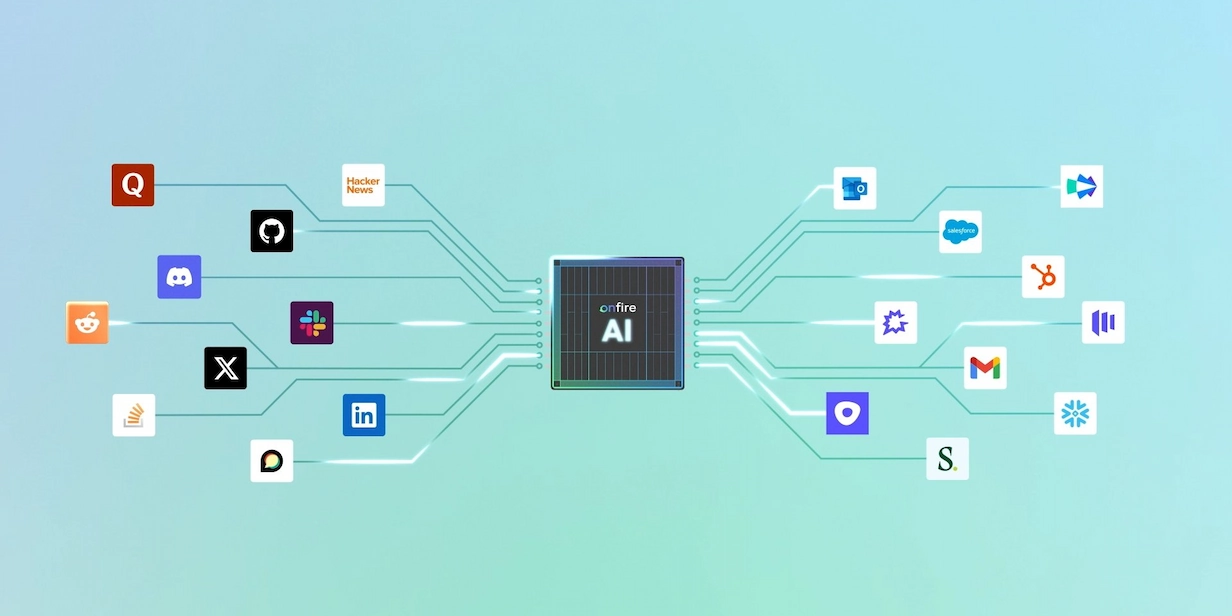
Onfire is an AI revenue intelligence platform built for selling to technical buyers: engineers, security teams, DevOps leaders, and IT decision-makers. Onfire monitors developer communities, open source activity, technical forums, and events to surface prospect-level buying signals that horizontal tools miss entirely.
Onfire is designed specifically for software infrastructure companies selling to technical buyers - if that's not your ICP, the vertical specialization won't help. But for teams struggling with inaccurate technographics and vague intent scores from generic tools, Onfire addresses the core data quality problem that makes other platforms underperform.
Key features include:
- Account Intelligence Graph tracking 50 million engineers across 100K+ sources
- Technographics covering 91% of companies globally, verified through actual technical activity
- Prospect-level intent signals from Reddit, Discord, GitHub, Stack Overflow, and community discussions
- De-anonymization that links public signals to specific individuals and accounts
- Prospecting platform and Chrome extension that fits into existing SDR flows (such as LinkedIn Sales Navigator)
- AI agent that combines first-party CRM data with Onfire's external signals
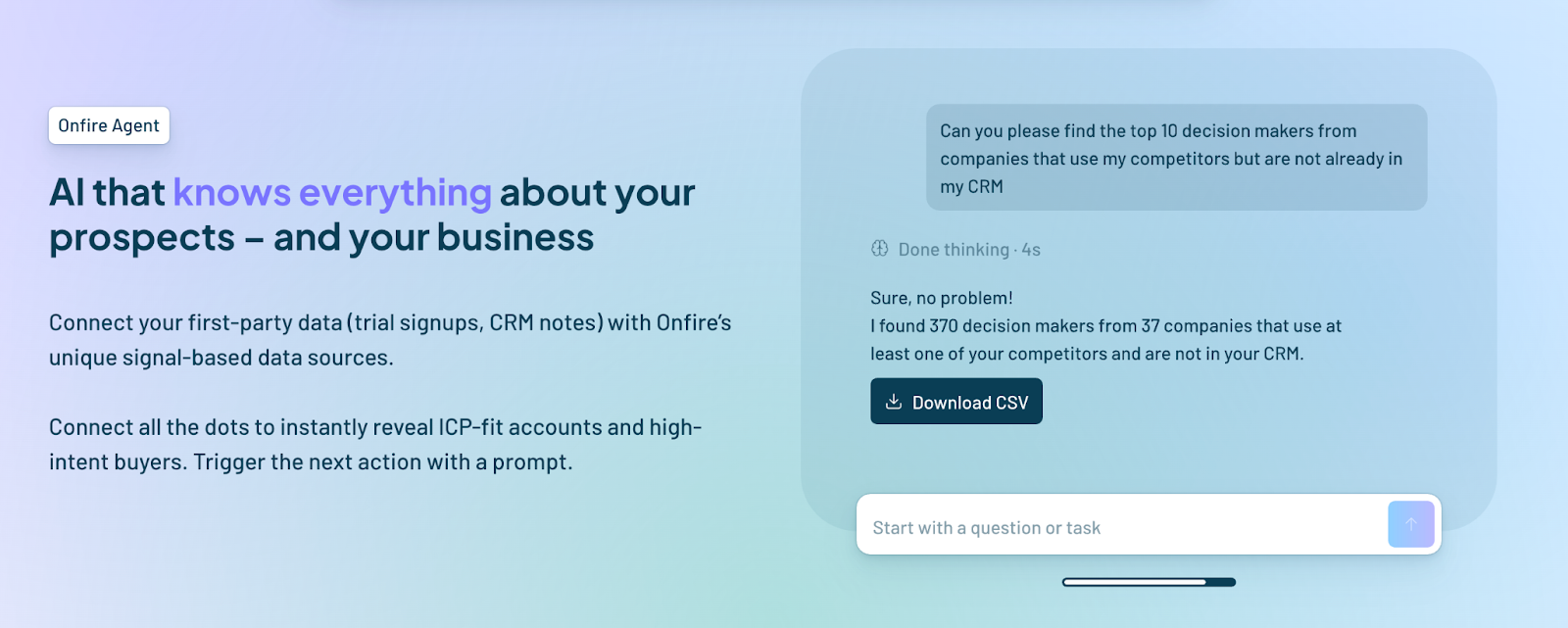
Pricing: based on credits and number of contacts, with volume discounts available.
Apollo.io
Apollo.io combines a B2B contact database with built-in outreach tools, positioning itself as an all-in-one sales platform. The database includes over 210 million contacts and 35 million companies, with email sequencing, call tracking, and CRM integration baked in.
Key features:
- Extensive filtering with 200+ search criteria
- Built-in email sequences and engagement tracking
- Chrome extension for LinkedIn prospecting
- AI-powered lead scoring and recommendations
- Native integrations with Salesforce, HubSpot, and Outreach
Pricing: starts free with limited credits, then a three-tier system, Basic/Professional/Organization, kicks in at $49 / $79 / $119 a month when billed annually, or $65 / $99 / $149 billed monthly. The Basic tier gets you 30,000 credits per year, while Professional includes unlimited emails and 48,000 credits. The Organization tier, meanwhile, has a 3-seat minimum and provides 72,000 credits and 12 intent topics. [updated August 2026]
ZoomInfo
ZoomInfo remains a popular choice for B2B data, offering what's arguably the broadest contact database available - 70 million direct dial phone numbers, 174 million verified emails, and extensive firmographic data. The platform has expanded through acquisitions to include conversation intelligence (via Chorus) and workflow automation.
Key features:
- Massive database with strong coverage of enterprise accounts
- Good phone and email coverage in North America
- Large user community and ecosystem
- Robust API for custom integrations
Pricing: quote-based and not publicly disclosed. According to information available online, you can expect to pay $15,000–$25,000/year minimum for small teams, scaling to $40,000+ for enterprise tiers. Annual contracts are standard, and negotiation is expected - users report achieving 30–50% discounts.
Lusha
Lusha built its reputation on a simple, lightweight Chrome extension that reveals contact information while browsing LinkedIn. It's evolved into a broader sales intelligence platform with prospecting tools, but the core value proposition remains quick, easy access to business emails and direct dials.
Key features:
- Browser extension for instant LinkedIn data enrichment
- Database of 160+ million business contacts
- CRM integrations with automatic data sync
- Job change alerts on higher tiers
- Team management and usage controls
Pricing: credit-based. The free plan offers 40 credits/month, with four paid tiers above that: Starter ($37.45), Pro ($52.45), Premium ($299.95), and Scale (Custom). (All prices quoted at annual billing rates.) Within the Pro and Premium tiers, you can pay up to about three times more for additional credits and features. For example, the default Pro tier comes with 2 seats and 7,200 credits, while the “max” Pro tier offers 24,000 credits and 2 seats. [updated August 2026]
Clearbit (acquired by HubSpot)
Clearbit pioneered real-time data enrichment, taking minimal inputs (an email or domain) and returning rich firmographic and demographic profiles. HubSpot acquired Clearbit in late 2023, rebranding it as Breeze and integrating it deeply into the HubSpot ecosystem.
Key features:
- Real-time enrichment with 100+ data attributes per record
- Website visitor identification (company-level deanonymization)
- Form shortening that auto-fills known fields
- Continuous data refresh to keep records current
Pricing: tied to HubSpot's platform and requires a HubSpot subscription as well as credits. After the free tier, the HubSpot Starter tier costs $9 per user per month for the software subscription and additional costs for credits , with larger packs at higher tiers. One credit equals one enriched record.
6sense
6sense positions itself as an account-based marketing platform rather than a traditional data provider. Its core value proposition is intent data - identifying accounts showing buying signals before they fill out a form or talk to sales. As we’ve covered elsewhere, the accuracy of these signals is not consistent, and for technical personas it can be quite limited.
Key features:
- Predictive analytics identifying accounts by buying stage
- Intent keyword tracking across 40+ languages
- Account-based advertising with dynamic audience segmentation
- Integration with Bombora, G2, TrustRadius, and other intent sources
Pricing: A limited free tier exists with 50 credits/month for basic exploration. After that, pricing is enterprise-focused. According to information available online, most companies pay $60,000–$100,000+ annually. Implementation costs can also be an issue. Altogether, the cost and complexity make it impractical for startups .
Clay
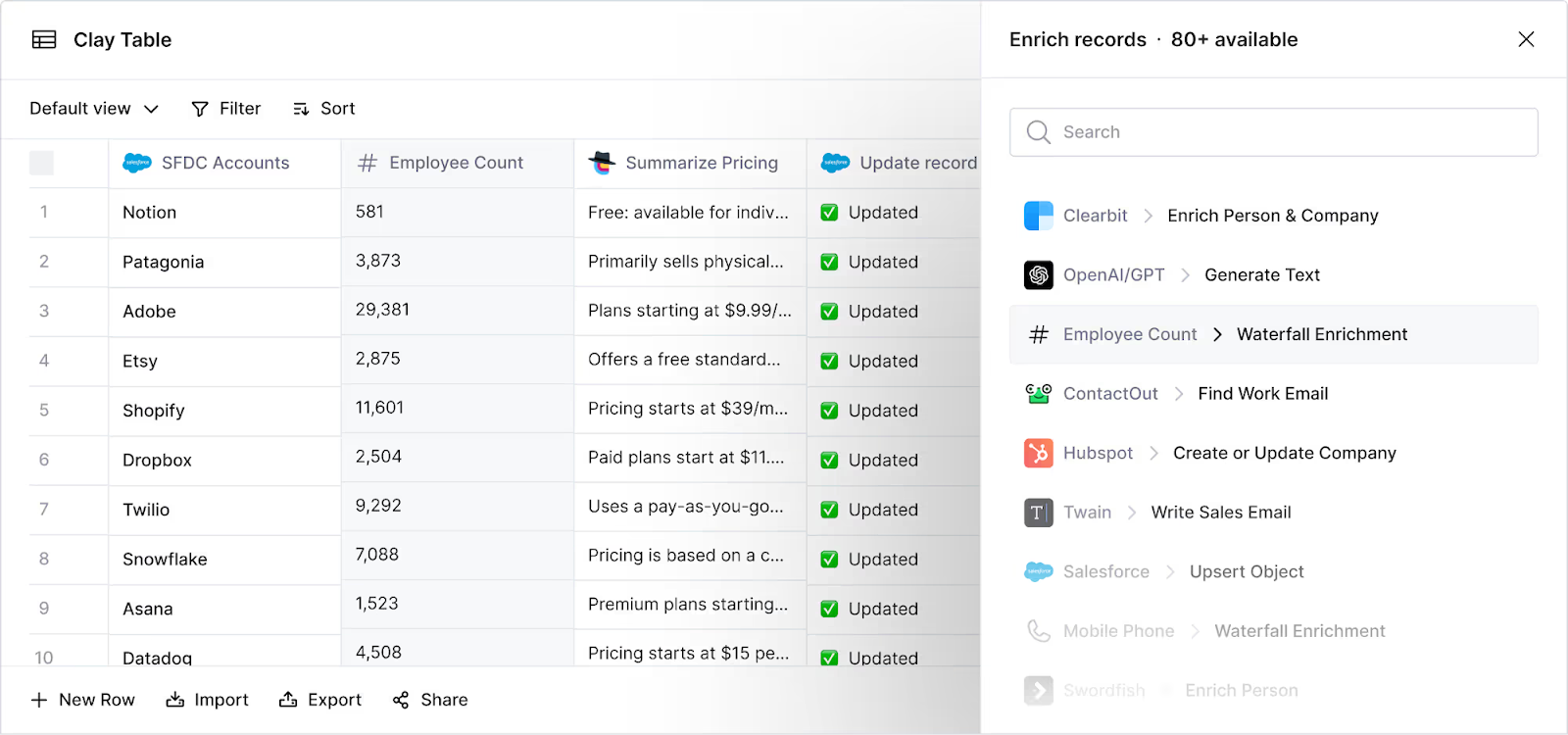
Clay aggregates 100+ data providers through a single interface, allowing users to query multiple sources as well as bring their own data. The platform combines this with workflow automation, making it a flexible tool for complex revenue operations such as automated outreach, account research, or CRM enrichment. .
Key features:
- Access to 100+ enrichment providers without separate subscriptions
- Claygent AI agent for web scraping and research tasks
- Drag and drop interface for building custom workflows
- Native sequencer and CRM integrations
Pricing: Clay restructured its plans in March 2026, replacing Starter, Explorer, and Pro with two self-serve tiers: Launch ($185/month, or $167 billed annually) and Growth ($495/month, $446 annually), plus a free plan and custom Enterprise pricing. All plans include unlimited seats, so you pay for usage, not headcount.
That usage now splits into two pools: Data Credits for enrichment lookups and Actions for workflow operations, which makes the credit math harder to forecast than a single balance. Note that Clay charges Data Credits for enrichment attempts even when no result comes back, so lists with poor source data burn through an allocation faster than expected. [updated August 2026]
Recommendation for startups
For startups selling software infrastructure, Onfire solves the data accuracy problem that makes other tools frustrating. Its vertical focus on developer and technical communities delivers the granularity that generic providers can't match, and that specificity translates directly to higher reply rates and less wasted outbound effort.
Apollo.io offers the best value for general B2B prospecting. It has broad coverage, built-in outreach tools, and transparent pricing that won't break an early-stage budget. The free tier is genuinely usable for testing. However, if you're selling to technical buyers (developers, security teams, data engineers), Apollo and other horizontal tools might fall short.
Automated Outreach and AI SDRs
AI SDRs promise to automate the entire outbound prospecting cycle: finding leads, personalizing messages, following up, and booking meetings. The ideas is that you could replace a $70K–$100K SDR with a $500–$1,000/month tool that never sleeps. Sounds pretty compelling, but the reality is… messy.
While some respected industry voices have reported seeing great results with AI SDRs, there are a lot of reports of these projects failing to deliver value. This is still an emerging category, and currently most tools should be viewed as augmentation rather than replacement.
What to look for when evaluating tools in this category:
- Personalization quality: Does the AI produce messages that sound human, or are they obviously templated?
- Autonomy level: Some tools let you review every message before sending (co-pilot mode); others run fully autonomous.
- Reply handling: Can the AI respond intelligently to objections, or does it hand off at the first reply?
- Contract flexibility: Annual lock-ins are common. Monthly billing gives you room to test and pivot.
- Deliverability infrastructure: Email warm-up, domain rotation, and spam monitoring are table stakes.
- CRM integration: Bi-directional sync with Salesforce or HubSpot is essential for tracking activity.
Top AI SDRs for Startups:
11x.ai
11x.ai builds what it calls "digital workers,” or AI agents designed to operate as autonomous team members. Its flagship agent, Alice, handles outbound prospecting across email and LinkedIn, while Julian manages inbound phone qualification.
Key features:
- 24/7 autonomous prospecting with multi-channel outreach (email, LinkedIn, phone)
- AI-driven personalization based on prospect research and CRM data
- Native CRM integration with automatic activity logging
- Enterprise-focused with white-glove onboarding
Pricing: starts around $5,000/month with annual commitments. Best suited for mid-market and enterprise teams with large TAMs who can absorb the cost and contract risk.
Artisan
Artisan develops Ava, an AI BDR that claims to automate 80% of outbound tasks. The platform includes a built-in B2B database of over 300 million contacts and handles prospecting, email sequences, and LinkedIn outreach.
Key features:
- End-to-end outbound automation with personalization waterfall
- Built-in email warm-up and deliverability management
- Human-in-the-loop option for message review before sending
- Integrations with HubSpot, Salesforce, and Slack
Pricing: varies based on volume, with the “Intern” plan starting at $280/month for 12,000 credits/month. The employee plan costs $660/month for 30,000 monthly credits. [updated August 2026]
AiSDR
AiSDR focuses on personalized outreach across email, LinkedIn, and SMS. It pulls from over 700 million contacts and uses signals to prioritize prospects showing buying behavior.
Key features:
- Multi-channel sequences with AI-generated voice notes and personalized videos
- Support from GTM engineers
- Prospect tracking across LinkedIn, job boards, and website activity
Pricing: The solo plan costs $250/month with no contract, and $200/month when billed annually. Moving up, the Explore plan now requires a quarterly commitment paid in advance, and costs $900/month when paid quarterly or $720/month when paid annually. Scale, the largest plan, costs $2,5000 a month (or $2,000/month on an annual plan). [updated August 2026]
Agent Frank (Salesforge)
Agent Frank runs inside the Salesforge ecosystem, handling prospecting, email sequences, and meeting booking. It offers two modes: auto-pilot (fully autonomous) and co-pilot (human review before sending).
Key features:
- Native integration with Salesforge's email infrastructure (warm-up, domain rotation)
- Multilingual support across 9+ tonalities
- Dedicated account manager for setup and optimization
Pricing: starts at $599/month billed quarterly, with two free months when billed annually. For this reason, Agent Frank is a solid option for startups and agencies looking for AI-assisted outbound without enterprise pricing. Note, however, that email infrastructure is separate and starts at $33 a month. [updated August 2026]
Taplio
Taplio is an AI-powered LinkedIn tool for content creation, scheduling, and engagement tracking. It's designed for founders and professionals building personal brands rather than running cold outreach.
Key features:
- AI content generation trained on 500+ million LinkedIn posts
- Post scheduling with performance analytics
- Lead database with 3+ million professional contacts
Pricing: starts at $39/month, but that comes with no AI credits. For AI post generation, hook drafting, carousels, and copilot, you need the Growth plan, which starts at $49/month billed annually or $69/month billed monthly.
Our recommendation for startups
There's no clear winner in AI SDRs - the category is still maturing, and results vary widely based on ICP, messaging, and how much time you invest in training the AI. If you're testing autonomous outreach, Agent Frank offers the lowest financial risk with its $499/month entry point.
Conversation Intelligence: AI Call Transcription and Analysis
Call transcription is no longer a nice-to-have. When Gong trailblazed this niche, sales orgs still slogged through manual review and analysis. Now, everyone is using AI, and call transcribers have upped their game and are looking to add value with features such as automated insights, CRM integrations, and broader platform plays.
There’s a lot of overlap between tools, and most will offer the same basic set of features. That being said, you should test each tool according to your specific circumstances - e.g., if a tool consistently fails to recognize your brand name, it can become a major annoyance.
What to look for when evaluating tools in this category:
- Pricing: Because differences between tools are subtle, cost is an important consideration.
- Transcription quality: Does the tool identify acronyms, technical terms, and brand names correctly?
- Multi-language support: Mostly relevant for startups that sell internationally.
- Searchable transcripts: Essential, and a table stakes feature that most tools will offer.
- Integrations: You want your call transcription to natively work with your CRM and other parts of your sales stack.
- Automated insights: Does the tool surface new learnings from your sales calls? Do these insights go beyond the obvious?
- Export options: Call transcripts can be a goldmine for further analysis. Does the tool allow you to easily export transcripts? Are APIs available on lower tiers?
Top Conversation Intelligence Tools for Startups
Chorus (now ZoomInfo)
Now part of ZoomInfo, Chorus captures and analyzes customer calls and meetings (and emails). It then syncs with CRMs to help centralize your account intelligence.
Key features:
- Proprietary machine learning built on 14 technology patents
- Records and analyzes calls to highlight competitor mentions, feature requests, and likely next steps
- Out-of-the-box & customizable integrations with video conferencing, sales engagement, and CRM software
- Share full recordings and snippets with your team to bring attention to important info
Pricing: Chorus charges a flat fee of $667 for three seats, plus $100 per additional seat per month - and there’s a two-year minimum.
Gong
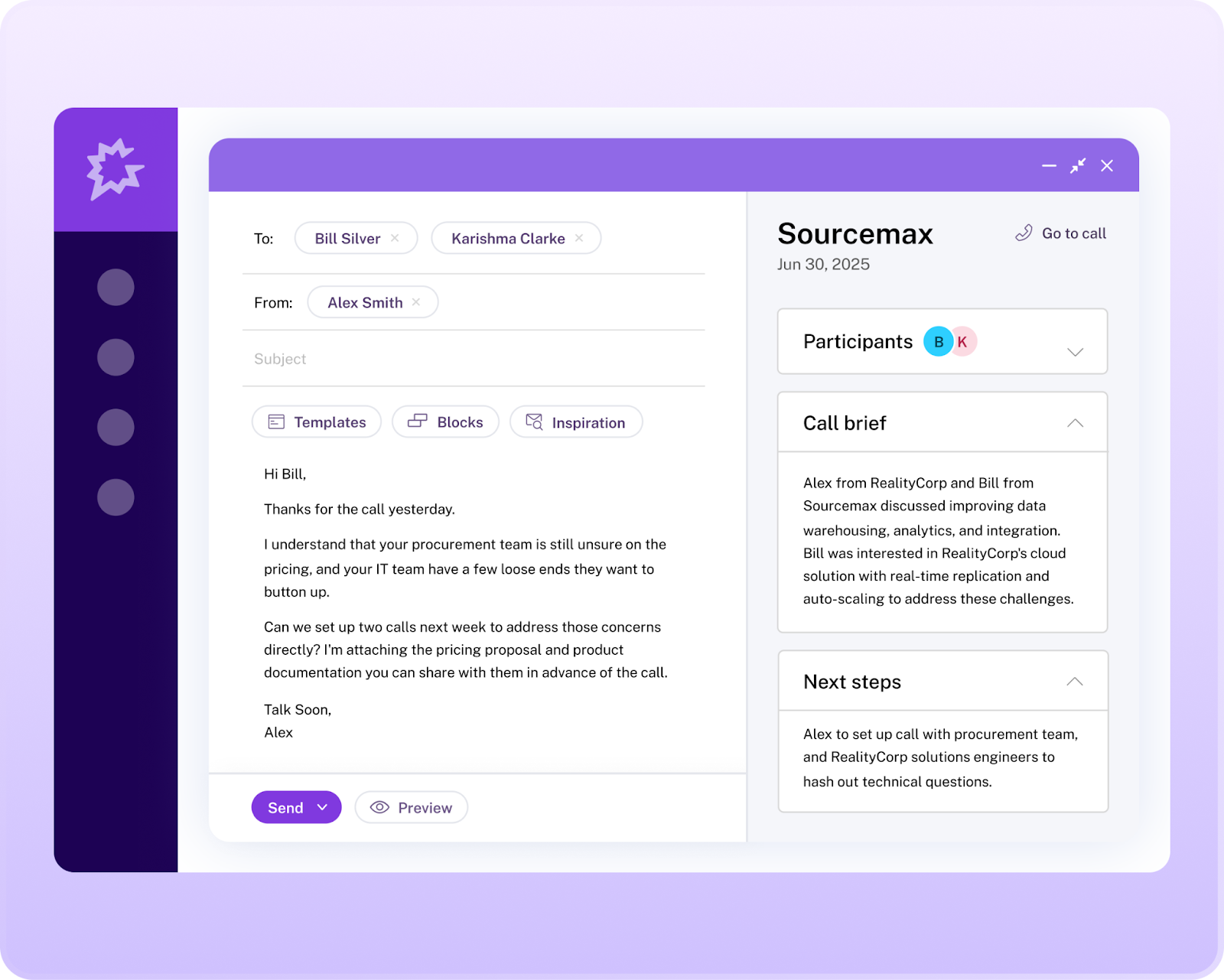
Gong offers an “AI Operations Platform,” but we’re going to focus on its widely used call transcription software. It’s doing a lot more than just transcribing: you can use it to identify, store, and replicate winning plays, personalize next steps, or get real-time performance feedback.
Key features:
- Detailed call analysis that tells you what your reps are saying - and what they’re leaving out
- Searchable call records that can be used as a knowledge base for new reps
- Syncs with CRM so you can access buyer info in one place
- Call summaries that you can use as meeting prep for yourself, or for other reps
Pricing: Gong charges about $125/user/month for the Foundation tier, which jumps to about $175/user/month for Foundation+Engage, which includes AI email personalization and sales engagement. Users pay a similar price for Foundation+Forecast, which provides AI-powered revenue forecasting. [updated August 2026]
Clari Copilot
Clari Copilot is a conversation intelligence tool that’s now merged with Salesloft. The AI-powered Copilot feature transcribes, integrates call info into revenue processes, and delivers live battlecards to inform your conversations.
Key features:
- Battlecards that use real-time transcriptions to guide reps in real time by suggesting plays
- AI-generated summaries, notes, action items, suggestions, and follow-up emails
- Copilot can be used separately, but it can also be used in tandem with Clari, a revenue orchestration platform that connects Copilot data to your pipeline, forecasts, and execution
- Gametapes highlight winning moments to help ramp up new sales reps
Pricing: Clari Copilot charges $60 per user per month for its “Growth” package, aimed at startups. [updated August 2026]
Fireflies.ai
Fireflies claims to be the industry leader in transcription accuracy, with a 95% accuracy rating. Its transcription software works in over 100 languages, and it can automatically detect languages in real time. In addition to a notetaker and meeting prep, it offers AI summaries and action items.
Key features:
- The AskFred AI chat makes it simple to ask questions about your meeting
- Fireflies offers in-house apps to generate emails, write reports, and create scorecards for sales reps
- AI Feed, a personalized feed of key topics and risks surfaced during recent conversations
- Note-sharing, task assignment, and a wide variety of collaboration tools
Pricing: Fireflies offers a free tier for individuals, and its pro plan for small teams costs $10 per user, per month. However, for features like conversation intelligence and video recording, you’ll need the $19 user/month Business plan.
Granola
Granola is an AI notepad built for people who have back-to-back meetings. It transcribes meetings and allows you to take notes yourself, but it then enhances those notes with information from the call. Unlike some software, it transcribes computer audio directly, so there’s no meeting bot on the call.
Key features:
- Local recording from your desktop or mobile device (no meeting bots or notetakers)
- Customizable note templates for different needs, including customer discovery, pitches, and standups
- Built-in AI for email drafting, transcript searching, and action items
- “Recipes,” or pre-written prompts, are refined by Granola experts to speed up everyday tasks
- An iPhone app built for on-the-go users
Pricing: Granola’s Basic plan is free, and its Business tier costs $14 per user per month. Note that free users have a 25-note lifetime cap.
Fathom
Fathom is an AI notetaker that generates call transcripts, analyzes them to summarize calls, and recommends action items. Its free tier has unlimited recordings and transcription, but limits on advanced AI summaries. Fathom’s chat feature allows you to surface insights from calls, and it integrates with everything from Slack to Notion.
Key features:
- AI copilot that summarizes account information, brings up info from past calls, and recommends plays
- Automatic CRM updates enrich your contacts with highlights from call summaries
- Built-in AI can draft follow-up emails, highlight competitor mentions, and alert you to risks
- AI Scorecards grade sales reps against your methodology to drive evidence-based performance improvement
Pricing: Fathom’s free tier is generous, but caps advanced AI summaries at five calls a month. After that, the Premium plan costs $16 for an individual, while the Team plan is $15 per user per month. For CRM field sync and custom data retention, you’ll need $25 per user per month for the Business tier with a two-user minimum. All prices are given for the annual subscription; add about 25% for month-by-month billing. [updated August 2026]
Our recommendation for startups:
Gong and Clari Copilot have the most functionality, but might be too expensive until you have a full sales team and budget to match. Fathom wins for its free tier - with unlimited recordings & transcription, it’s hard to beat. That being said, Granola is a wildcard choice for those who don’t want an awkward AI bot signing into their meetings and prefer keeping recording local - just remember that in many jurisdictions you’ll still need to get consent from the other party!
AI-Powered CRMs
Your CRM is the backbone of your sales operation, and for startups, it's often the first major software decision that sticks. Pick wrong, and you'll spend months migrating data or working around limitations. Pick right, and you'll have a foundation that scales with you. It is also a very natural place to implement AI capabilities that interact with your organization’s critical sales and marketing data.
The legacy players (Salesforce, Microsoft Dynamics) remain powerful but come with enterprise complexity and pricing that might not be startup-friendly. In response, a new generation of CRMs has emerged, purpose-built for startups and small teams who need flexibility without the overhead. These modern tools prioritize speed of setup, intuitive interfaces, and the ability to adapt as your sales process evolves.
What to look for when evaluating tools in this category:
- AI features: Lead scoring, data enrichment, and automated task creation are increasingly standard - but implementation quality varies widely.
- Free tier or affordable entry point: Startups need to test before committing. A generous free plan or low starting price lets you validate fit without budget risk.
- Ease of setup: Complex onboarding kills adoption. The best CRMs get you productive in days, not weeks.
- Customization flexibility: Your sales process will change. The CRM should adapt to you, not force you into rigid workflows.
- Data model: Can you create custom objects and fields? Modern CRMs let you model your business exactly as it works.
- Integrations: Native connections to your email, calendar, and outreach tools are table stakes.
Top AI-powered CRM Tools
Attio
Attio is a next-generation CRM built for startups who find traditional systems too rigid. Its Notion-like interface and flexible data model let you create custom objects and workflows without code, making it adaptable to everything from sales pipelines to fundraising to recruiting. Some users mention that Attio’s reporting system requires more manual configuration than some competitors.
Key features:
- Fully customizable data architecture with unlimited custom objects and fields
- Automatic contact enrichment from email, calendar, and web sources
- Real-time collaboration with simultaneous editing and shared views
- AI-powered research agent for prospecting and lead qualification
- Browser extension for quick data capture from LinkedIn and company websites
Pricing: Attio’s free tier costs nothing for the first 3 users and 50,000 records. Next, the Plus plan starts at $35/user/month, and the Pro plan costs $79/user/month, both billed annually. Attio also offers a dedicated startup program. [updated August 2026]
Folk
Folk takes a contact-first approach to CRM, positioning itself as an intelligent shared address book rather than a deal-tracking system. It's particularly popular with agencies, recruiters, and partnership teams who manage relationships across multiple contexts.
Key features:
- Spreadsheet-like interface that feels familiar and requires minimal training
- One-click contact import from LinkedIn, email, and other sources with automatic deduplication
- Built-in email sequences and AI-powered outreach personalization
- Flexible pipelines that adapt to sales, recruiting, or partnership workflows
- Integration with Gmail, Outlook, Slack, and 6,000+ apps via Zapier
Pricing: starts at $24/user/month (Standard plan), though you'll need to upgrade to Premium ($48user/month) for deal management and email sequences. (Prices move to $30 / $60 when billed month-to-month.) There's no free tier, but a 14-day trial gives you access to all features.
Pipedrive
Pipedrive is a sales-focused CRM that centers everything around visual deal pipelines and activity management. It is well-suited for teams with defined sales processes who want to track opportunities at a glance.
Key features:
- Drag-and-drop Kanban boards with unlimited customizable pipelines on all plans
- Email integration with open and click tracking
- Workflow automation for follow-ups, task creation, and deal movement
- AI-powered sales assistant for deal recommendations and performance insights
- Meeting scheduler built into the platform
Pricing: starts at $14/user/month (Lite plan) with a 14-day free trial. The Growth plan ($39/user/month) adds full email sync and automation. Pipedrive does not offer a free tier and requires add-ons for features like lead generation, email campaigns, and project management.
Close
Close is built for inside sales teams who live on the phone and in their inbox. Unlike CRMs that treat communication as an integration, Close builds calling, SMS, and email directly into the platform.
Key features:
- Built-in VoIP calling with power dialer and call recording
- Native SMS messaging and email sequences from a unified inbox
- Workflow automation for follow-ups and lead routing
- Detailed call analytics and team performance tracking
- Fast setup with one-click migration from other CRMs
Pricing: starts at $35/user/month (Essentials plan), with the Growth plan at $99/user/month adding full automation and the power dialer. There's no free tier, only a 14-day trial. Close can be a great fit for high-velocity outbound teams but costs more than alternatives and lacks marketing automation entirely - you'll need separate tools for anything beyond sales communication.
Freshsales
Freshsales from Freshworks combines traditional CRM functionality with AI-powered lead scoring and built-in communication tools at an aggressive price point. It's designed for small to mid-sized teams who want sophisticated features without enterprise complexity.
Key features:
- /78Freddy AI for lead scoring, deal insights, and next-best-action recommendations
- Built-in phone, email, and chat with automatic activity logging
- Visual pipeline management with deal forecasting
- AI chatbots for lead capture and qualification
- Product catalog for tracking what you're selling
Pricing: starts at $9/user/month (Growth plan) with a free tier for up to 3 users. The Pro plan ($39/user/month) adds advanced automation and AI features.
HubSpot CRM
HubSpot offers a free tier, and the platform offers many options to scale across marketing, sales, and service as you grow.
Key features:
- Built-in email tracking, meeting scheduling, and live chat
- A free tier for up to 2 users, 1 pipeline, and about 1,000 stored contacts
- Breeze AI assistant for content generation, lead research, and automated tasks
- Native marketing automation (at paid tiers)
- Extensive integration ecosystem with 2,000+ apps
Pricing: The free CRM includes basic marketing, sales, and service tools. Paid plans start at $20/user/month, or $15/user/month when paid annually, though promos do cut into that substantially. HubSpot for Startups offers up to 90% off for eligible companies, although these offers are time-bound. Professional plans run $890+/month for marketing automation with 3 seats, as well as a one-time onboarding fee of $3,000. [updated August 2026]
Our recommendation for startups
Attio wins for teams who want maximum flexibility and a modern interface without the legacy baggage. Its Notion-like customization means your CRM adapts as your business model evolves - which happens constantly in early-stage companies. The free tier is generous enough to test extensively, and the startup program helps with costs.
7/7
HubSpot remains the safe choice if you need marketing automation alongside sales, or if you're part of an accelerator with deep discounts. Just be realistic about the lock-in: once your processes live in HubSpot, migration becomes painful.
For sales-first teams making lots of calls, Close delivers the best built-in communication tools. And if budget is the primary constraint, Freshsales offers surprising depth at its $9/user/month entry point.
Help us keep this list up-to-date!
We hope this guide saves you some of the time we spent digging through pricing pages, LLM research, Reddit threads, and G2 reviews. If we missed something or got something wrong, please let us know - we'll aim to keep this list updated and accurate.
A note on pricing: We've done our best to provide accurate numbers, but pricing changes frequently, especially for tools with quote-based models. Treat the figures here as directional rather than definitive, and always confirm with vendors before signing.
FAQs
What's the difference between an AI sales tool and a traditional sales tool?
Now that nearly every legacy tool has bolted on AI features, the practical difference is what the tool decides. Traditional tools store and execute: you build the sequence, they send it. AI tools make judgment calls about which accounts are in-market, which prospect you should prioritize, and what the email should say. That shift makes evaluation harder, because you're assessing the quality of judgment, not a feature checklist.
How much should an early-stage startup budget for AI sales tools?
Less than most vendors imply. A functional starter stack, including a CRM, call transcription, and a data source, should run roughly $100 to $300 per month for a team of three to five, and close to nothing if you lean on free tiers. Costs jump sharply at two thresholds: AI SDRs start around $250 to $900 per month, and enterprise data platforms carry effective floors of $15,000 or more per year.
Which AI sales tools are worth adopting first for a small team?
Start with the CRM. It's the system everything else feeds into and by far the hardest to migrate later. Add call transcription second because the free and near-free tiers deliver value immediately with almost no setup cost. Data and prospecting tools come third, once you know your ICP well enough to judge coverage. Leave AI SDRs for last: they’re the most expensive, least proven, and the easiest to waste money on.
How do startups avoid tool sprawl when adopting multiple AI sales tools?
Sprawl usually comes from buying overlapping tools, not too many tools. Before adding anything, check whether something you already pay for covers it. For instance, most data platforms include sequencing, and most CRMs include email. Keep the CRM as the single system of record so your data doesn't fragment across three places, then audit credit-based tools quarterly.
.webp)











%20(1).webp)













































.webp)