Comparing Account Intelligence Tools, Intent Data Providers, and Onfire's Revenue Intelligence
If you’re selling to technical folks, your GTM stack might be failing at the one job that matters: helping you reach the right people.



"Do we really need another GTM tool?" is a question we sometimes hear, and it’s fair to ask. Sales and marketing teams are already drowning in software: ZoomInfo for contacts, 6sense for intent, Gong for call analysis, Outreach for sequencing, Salesforce holding it all together (sort of)... and this list could go on and on.
But if you're selling to technical teams - developers, data engineers, security professionals - your "stack" is almost certainly failing at the one job that matters: helping you find and reach the right people.
What You Need to Sell to Technical Buyers
Before evaluating vendors, it helps to define what you're actually looking for. We won't go into the weeds of every single feature in this article - but thinking in terms of capabilities, you should be looking for tools that support:
1. Account and prospect-level targeting data: This includes finding ICP-fit companies based on technographics and firmographics; pinpointing the right person to talk to within the organization; and closing the loop with accurate contact data (emails and phone numbers).
2. Intent signals: Identifying when buyers are in-market. With technical products, this is often a convergence of organizational factors (e.g. digital transformation initiatives, budget allocation) and technology preferences (e.g. a preference to buying software rather than building in-house).
3. Operationalizing data:Putting the data you get to use, either through built-in capabilities or via integrations with systems like outbound sequence builders, CRM systems, and AI platforms.
We'll now look at how existing solutions address these requirements, and how Onfire's approach is different. Spoiler alert: as we've mentioned before, the answer comes back to the data layer - which is the greatest weakness with existing solutions and the main reason we built Onfire.
Account and Prospect-Level Targeting: Onfire vs. Account Intelligence Tools
Summary for busy readers
- The current generation of account intelligence tools handle basic firmographics but struggle with technographics.
- Data on technologies used is often a semi-educated guess based on stale sources.
- Most tools will provide prospect-level data, but typically not much more granular than the job title level.
- Onfire tracks actual technical activity across communities and OSS to identify what tech accounts really use - and which specific people drive adoption decisions
Account intelligence tools (AKA data providers, data enrichment tools) such as ZoomInfo and Apollo are solid when it comes to firmographic data. Employee counts, company industries, number of engineers, open job positions - if that's the type of information you're after, they’ll have you covered. They can also supply contact information (emails and phone numbers) for the prospects you want to reach out to, at varying degrees of accuracy.
The problems start with technographics and prospect-level intelligence - which happen to be two of the most important data points for selling software infrastructure.
Account-level technographics - broadly available, but is the data accurate?
Knowing which technology a target account is using is absolutely essential for technical sales. If you're selling a database migration tool, you need to know whether a prospect uses PostgreSQL, MySQL, or MongoDB - often having the ‘wrong’ stack will render the entire discussion moot. Most data platforms will claim they can provide technographic data; but if you’ve ever tried to sell any type of backend technology, you’ll know that the accuracy is absolutely not there. There’s a reason for this…
Account intelligence tools typically infer technographic data from sources such as job descriptions, front-end code scraped from company websites, and various third-party repositories. All of these produce the same fundamental problems: the data is stale (job posts might be months old), and it's often wrong ("PostgreSQL experience preferred" doesn't mean the company uses PostgreSQL in production - they might be evaluating it, phasing it out, or just hedging their bets in the hiring market).
Onfire sources technographic data through an AI-driven process that correlates factors like OSS contributions, social media discussions, and community activity. When an engineer at Company X is actively contributing to a PostgreSQL extension on GitHub, or troubleshooting replication issues in a developer forum, that's a much stronger signal than the keyword appearing in a hiring portal.
Prospect-level data beyond ‘senior software engineer’
Here you’re looking for the actual person in the organization who will evaluate your solution, has budget influence, and can champion your product internally. In other words, the person you should be trying to reach in your sales and marketing efforts.
Account intelligence tools struggle when it comes to pointing sellers to the specific buyer. Their data is typically based on easy-to-find sources such as job titles and LinkedIn bios. In a larger engineering org this doesn’t get you very far: there might be hundreds of "senior software engineer" and dozens of "engineering managers".
Onfire builds detailed profiles that reveal the exact person who is likely to adopt new tech, has influence in technology buying decisions, and who could potentially be the champion that can move a deal forward inside the organization. We start with the same sources our competitors use, but layer additional 'relevance signals' such as activity across technical communities, conference attendance, and OSS contributions.
The result is that you're not just targeting "every senior engineer at company X" - you're identifying the specific person who (for example) manages the CI/CD pipeline, or who is in charge of a DevSecOps initiative.
Learn more: see our detailed comparison between Onfire and ZoomInfo
Intent Signals: Onfire vs. Intent Data Providers
Summary for busy readers
- Most intent platforms miss technical buyers entirely because they track the wrong channels.
- These companies use IP-based models that capture website visits and ad engagement - but technical buyers research in semi-anonymous communities where traditional tracking doesn't work.
- Onfire built infrastructure specifically to monitor these channels, with identity resolution that connects anonymous activity back to real prospects
ICP fit gets you halfway there. But 95% of your target market isn't in-market at any given moment. Particularly for outbound sales, you want to reach people actively seeking solutions, rather than spending months "educating" prospects who won't buy for another year.
Most data providers offer some version of intent signals. Tools like 6sense and Demandbase have built the core of their businesses around it - offering enterprise ABM platforms that help sales and marketing teams identify and engage in-market accounts. But here too, is the data accurate? A cursory glance at what users are saying suggests otherwise.
Existing intent solutions have limited value for technical audiences
Intent platforms rely heavily on IP-based tracking and web activity monitoring. They detect when someone from a target company visits vendor websites, downloads content, or engages with ads. The underlying data comes from IP databases (which have well-documented accuracy issues) combined with behavioral tracking across ad networks and corporate websites.
However, technical buyers don't behave like your textbook enterprise SaaS buyer: they're not downloading whitepapers from vendor websites or clicking through to product pages from display ads (which they will make every effort to block). The places where they are active, such as communities and meetups, are often harder to reach; collecting and understanding data from these sources is not part of the business model for horizontal GTM platforms.
Onfire is purpose-built to find intent signals that others aren’t tracking
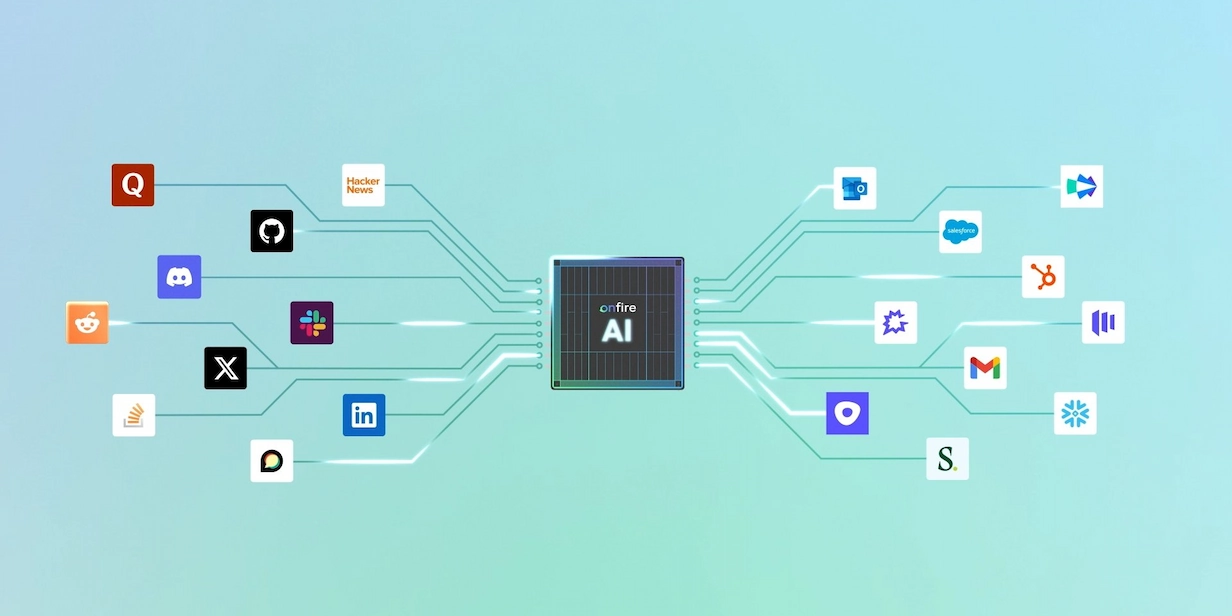
Onfire monitors over 100,000 sources where technical buyers actually communicate, often anonymously (or pseudonymously): GitHub, Stack Overflow, Reddit, Quora, Hacker News, Discord, Slack communities, X, and more. We have spent years collecting and refining this data, as well as developing battle-tested AI models that can sift through it effectively.
Of course, anonymous community activity isn't useful without connecting it back to real people and companies - which is where our identity resolution capabilities come in. When we see an engineer asking questions about competitors or expressing frustration with their current tools, our AI models can de-anonymize that activity and map it to specific prospects at specific accounts.
Thanks to this difference in approach, our intent data reflects genuine buying signals, which are aligned with the reality of technical buyers. And it’s never a black box - you can drill down to see the actual technical problems being discussed, and the people who need to solve them.
Learn more: Onfire vs. 6sense for intent data
Tools to Operationalize Data: Onfire vs. AI-Native Marketing Automation
Summary for busy readers
- AI automation tools and data providers are solving different problems, so this is somewhat of an apples-to-oranges comparison
- AI-native tools like Clay let you build sophisticated automations on top of existing data
- Neither solves the underlying data quality problem for technical buyers
- Onfire provides both accurate source data and built-in agentic AI capabilities
Once you have the data, your platform should support turning raw intelligence into actions - enriching CRM records, triggering sequences, routing leads, or building automated workflows. The bare minimum here will be integrations with CRM and marketing automation platforms - and pretty much every major platform will offer it.
A newer category of AI-native tools, led by Clay, is gaining popularity among RevOps teams. These platforms don't typically collect their own data - instead, they let you build AI-driven automations on top of existing data sources. For example, you might use these tools to create a workflow where an LLM researches an inbound lead's company website, then automatically enriches Salesforce records based on what it finds.
AI automation tools are not replacing the data layer
The new generation of tools are DIY platforms, designed for "GTM engineers". They are not meant to be self-service tools for sales teams; and what’s more, they don't solve the core problem of finding difficult-to-detect signals across the public web. They help you do more with data you already have - but if that underlying data is wrong or incomplete, the automations just amplify the problem.
Using Onfire data as an input to these workflows significantly increases your chances of success. When Clay or n8n is working with accurate technographics and genuine intent signals from technical communities, the entire automation chain produces better results.
Onfire also includes built-in agentic AI capabilities through the Onfire Agent, which combines your CRM data with our Account Intelligence Graph. You get the automation benefits without needing to become a prompt engineer or build complex workflows from scratch.
Learn More About the Onfire Difference
The problem with most GTM tools isn't insufficient AI or poor integrations. It's that they're working from a broken data foundation - especially when it comes to technical buyers.
Onfire rebuilds that foundation from the ground up. We track the channels where technical buyers actually spend time. We resolve identities across the distributed web. We combine third-party signals with your first-party data to create an Account Intelligence Graph that reflects reality, not guesswork.
If you're selling to developers, data engineers, or security teams, the stack you have today is probably wasting 80% of your budget on irrelevant outreach. It's time to fix the data layer.
Ready to see the difference? Read customer case studies or get access to the platform by booking a demo.
.webp)














%20(1).webp)

















































.webp)