Top 10 B2B & B2D Technographic Data Providers for 2026



Key Takeaways
- Traditional technographic providers excel at company-level tech stack intelligence but miss prospect-level signals from technical communities where developers research and evaluate solutions.
- The best B2B & B2D technographic data provider is Onfire. The platform captures buying signals from technical communities that horizontal tools don't access.
- Over 50% of high-impact B2B tech purchases are replacement-driven, making technographic indicators like outdated tools critical buying signals.
- Organizations using technographics exceed revenue goals by 50%+ through better targeting accuracy and shorter sales cycles.
- Vertical AI platforms track technical buyers in developer communities. GitHub, Discord, Stack Overflow capture buying signals that horizontal tools miss entirely.
What Is Technographic Data?
Technographic data identifies the technologies companies use to run their businesses: software applications, hardware systems, cloud platforms, development tools, security solutions, and infrastructure components. Unlike firmographic data (company size, industry, revenue) or demographic data (job titles, locations), technographics reveal how an organization operates technically. (For company size, industry, and revenue, see our comparison of firmographic data providers.)
For GTM teams, this matters because technology choices signal buying intent, compatibility opportunities, and competitive vulnerabilities. A company running legacy on-premise infrastructure shows different readiness than one using modern cloud-native tools. An organization heavily invested in AWS presents different opportunities than a multi-cloud environment spanning AWS, Azure, and GCP.
The technographic data market has evolved beyond simple tech stack lists. Modern providers layer behavioral signals (content consumption, community engagement, job postings for specific skills) onto installation data. 75% of B2B marketers now use technographic data for personalization, addressing real technology challenges rather than generic pain points.
Traditional technographic data sources were designed for generic B2B sales. They track what's installed in a company's environment, not which engineers are actively evaluating alternatives. Understanding what drives technical buyers' research and evaluation requires signals from where developers actually discuss solutions, not just CRM fields.
How GTM Teams Use Technographic Data in Practice
Account Selection and Prioritization
Sales and marketing teams use technographics to identify accounts matching their ideal customer profile beyond surface-level firmographics. Instead of targeting "all companies with 500+ employees in SaaS," they target "companies using MongoDB at scale who recently posted job openings for database engineers." That's a signal indicating infrastructure challenges.
Organizations using technographic data for lead scoring spot qualified prospects 40% faster because technology fit predicts purchase readiness better than company size alone. An account using complementary tools in your ecosystem converts at higher rates than one requiring complete infrastructure overhaul.
Message Personalization at Scale
Generic outreach dies in technical buyers' inboxes. Technographics let SDRs reference specific tools prospects use, acknowledge integration requirements, and demonstrate product compatibility without manual research. A message that opens with "I noticed you're running Postgres 12. Here's how we handle migrations from older versions" outperforms "We help companies with databases."
Marketing teams build segment-specific campaigns addressing technology-specific challenges. Content targeting AWS users discusses cloud-native architecture. Content for on-premise infrastructure buyers addresses hybrid deployment models. This personalization drives 50%+ higher revenue goal achievement because messaging addresses actual technical environments, not assumed problems.
Opportunity Timing and Competitive Displacement
Over half of high-impact B2B tech purchases are replacement-driven. That makes "what they currently use" a more powerful buying signal than intent topics. Technographics identify accounts running outdated tool versions, nearing license renewals, or showing technology stack misalignment.
Competitive displacement opportunities emerge when technographics reveal accounts using competitors' older product lines, posting job openings that suggest migration planning, or expanding into use cases where current tools underperform. Timing outreach to these windows (rather than random cold outreach) improves conversion by meeting prospects when they're already considering change.
For account-based marketing strategies, technographic triggers activate campaigns at the account level: when a target company adopts a complementary tool, deprecates a legacy system, or shows infrastructure expansion signals.
Top Technographic Data Providers for B2B & B2D
1. Onfire
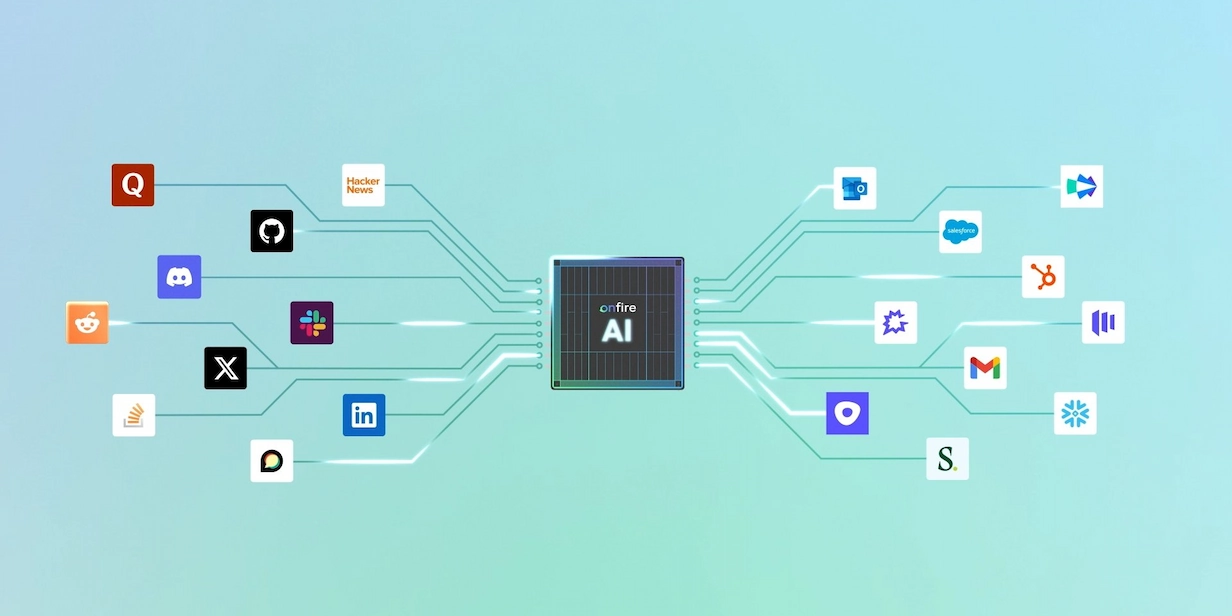
Onfire delivers AI revenue intelligence for technical-buyer GTM through its Account Intelligence Graph™, connecting data from 50M engineers' public footprints across GitHub, Discord, Reddit, Stack Overflow, and technical conferences. Unlike horizontal technographic providers tracking company-level tech stacks, Onfire identifies prospect-level signals from technical communities where developers actually research and evaluate solutions.
Key Features:
- Account Intelligence Graph™ processing 5M signals daily from 100K technical data sources
- Prospect-level precision that identifies which specific engineers at target accounts are active in technical communities
- Technical buyer de-anonymization where AI identifies prospects asking deal-related questions on social platforms even without real names
- Vertical AI purpose-built for software infrastructure companies selling to developers and engineers
- Real-time tracking of GitHub activity, Stack Overflow questions, Discord discussions, and conference participation
Best For: Software infrastructure companies selling to developers, engineers, and IT decision-makers. Teams that struggle with traditional marketing because technical buyers ignore email but are highly active in specialized communities.
Unique Differentiator: While traditional providers answer "what tools does Company X use," Onfire answers "which engineers at Company X are evaluating alternatives right now, and where are they discussing challenges." The platform captures buying signals from technical communities that horizontal tools don't access. Conversations on Discord about migration pain.
GitHub contributions to competing open-source projects. Stack Overflow questions revealing infrastructure challenges.For a detailed comparison of how account intelligence differs from traditional intent data providers, Onfire's vertical AI approach captures signals that generic B2B platforms miss entirely.
2. ZoomInfo
ZoomInfo dominates the enterprise B2B intelligence market with comprehensive company and contact data unified with technology tracking across 30,000+ products. The platform combines technographics with intent signals from content consumption and web traffic patterns.
Key Features:
- Tech stack data covering 30,000+ software and hardware products
- Integration with sales engagement, CRM, and marketing automation platforms
- WebSights™ for website visitor identification
- Chorus conversation intelligence integration
- Intent data from Bombora partnership (Company Surge®)
3. 6sense
6sense applies AI-driven predictive analytics to technographic data, identifying accounts showing buying signals across anonymous website traffic, intent topics, and technology changes. The platform excels at orchestrating multi-channel campaigns based on predictive account scores.
Key Features:
- Predictive account scoring combining technographics with intent
- Anonymous visitor identification and de-anonymization
- Multi-channel campaign orchestration (email, display, social)
- Integration with major ABM platforms
- AI-powered recommendations for next-best actions
4. Demandbase
Demandbase pioneered the ABM category and integrates technographic intelligence into account-based advertising, website personalization, and sales intelligence workflows. The platform emphasizes orchestration across the entire customer lifecycle.
Key Features:
- Account Intelligence with technology install data
- B2B advertising platform with account-level targeting
- Website personalization based on visitor's company tech stack
- Sales intelligence alerts for technology changes
- Integration with Salesforce, Marketo, Eloqua, and major MAPs
5. Bombora
Bombora operates the largest B2B data co-op, tracking content consumption across 5,000+ B2B websites to identify intent topics. While not exclusively a technographic provider, Bombora's Company Surge® data reveals when accounts research specific technologies.
Key Features:
- Company Surge® intent data from proprietary B2B data co-op
- Technology topic tracking across cloud, security, infrastructure, and software categories
- Integration with major ABM, MAP, and sales intelligence platforms
- Weekly data updates maintaining signal freshness
- GDPR/CCPA compliant data collection
6. Cognism
Cognism provides international contact data and technographic intelligence with strong GDPR compliance for European markets. The platform emphasizes phone-verified mobile numbers alongside tech stack data.
Key Features:
- Technographic data across 10,000+ technologies
- Diamond Data® phone-verified mobile numbers
- Intent data integration (Bombora partnership)
- Browser extension for prospecting workflows
- European data coverage with GDPR compliance
7. RollWorks
RollWorks (a NextRoll company) offers mid-market accessible ABM with integrated technographic data, display advertising, and CRM workflows. The platform emphasizes ease of use for smaller ABM teams.
Key Features:
- Account-based advertising across web and social channels
- Technology install data for targeting and personalization
- Salesforce native integration
- Journey stage tracking combining technographics with engagement
- Self-service platform options
8. Terminus
Terminus focuses on multi-channel ABM orchestration with technographic data supporting account selection and campaign personalization. The platform emphasizes coordinated experiences across advertising, web, email, and chat.
Key Features:
- Account-based advertising across display, social, and video
- Technology install data for account segmentation
- Website personalization and chat playbooks
- Email signature marketing (Sigstr integration)
- Analytics tracking engagement across channels
9. Leadspace
Leadspace applies graph technology and machine learning to unify technographic data with firmographic, intent, and engagement signals. The platform builds unified customer data profiles across disparate sources.
Key Features:
- LX Graph™ connecting technographic, firmographic, and behavioral data
- Machine learning for predictive scoring
- Data enrichment for CRM and MAP records
- Integration with Salesforce, Marketo, Eloqua, HubSpot
- Custom audience building combining multiple signal types
10. SalesIntel
SalesIntel provides human-verified contact data and technographic intelligence with emphasis on data accuracy over volume. The platform employs researchers to verify information quarterly.
Key Features:
- 95%+ accuracy on contact data through human verification
- Technographic data across 18,000+ technologies
- Intent data integration
- Salesforce and CRM native integrations
- VisitorIntel™ for website visitor identification
Evaluation Criteria for Technographic Data Providers
Data Freshness and Update Frequency
Technology environments change constantly. Companies migrate to cloud, adopt new tools, deprecate legacy systems. Stale technographic data produces false positives (targeting accounts that already switched) and missed opportunities (ignoring accounts showing new buying signals).
Best-in-class providers update data weekly or more frequently, using automated scraping, API integrations, and behavioral signals to detect changes. Monthly update cycles create blind spots for time-sensitive opportunities. Quarterly updates (still common among smaller providers) essentially provide historical data rather than actionable intelligence.
Verify update frequency during evaluation:
- How often does the provider refresh install data?
- What triggers real-time alerts (technology additions, upgrades, competitive switches)?
- Can you access historical trends showing technology adoption timelines?
For technical-buyer intelligence specifically, freshness matters even more. A developer asking migration questions on Reddit today represents immediate opportunity, but only if your data captures it before they've already made a decision.
Coverage Depth and Breadth
Coverage trades off between the number of technologies tracked (breadth) and the depth of intelligence about each technology (install details, version numbers, deployment scale, integration patterns).
Enterprise platforms like ZoomInfo track 30,000+ products but often provide only binary install data ("Company X uses Tool Y"). Specialized providers track fewer technologies but include deployment details: version numbers, usage intensity, integration patterns that reveal specific use cases and pain points.
For technical-buyer GTM, depth often outweighs breadth. Knowing an account uses Kubernetes matters less than knowing they're running outdated versions, struggling with scaling challenges (evidenced by job postings), or evaluating service mesh options (evidenced by GitHub research).
Questions to ask during evaluation:
- How many technologies does the provider track in your specific category?
- What details beyond binary install data are available?
- Can you segment by version, deployment type, or usage intensity?
- Does coverage include open-source tools where technical buyers often start?
Compliance and Data Privacy
90% of businesses prioritize GDPR/CCPA compliance when selecting data providers because regulatory violations create legal and reputational risk. Technographic data collection must respect privacy regulations, particularly in Europe.
Compliant providers:
- Document data sources and collection methods
- Provide data processing agreements (DPAs)
- Honor opt-out requests and data deletion
- Maintain certifications (SOC 2, ISO 27001)
- Avoid scraping private networks or unauthorized systems
Public data from technical communities (GitHub, Stack Overflow, Reddit) remains accessible under most regulations because it's voluntarily published. Providers must still respect platform terms of service and avoid identifying individuals who use pseudonyms unless consent is established.
Red flags during evaluation:
- Vague explanations of data sources ("proprietary methods")
- Resistance to providing DPAs or compliance documentation
- Collection from sources requiring authentication or bypassing access controls
- Inability to explain how they handle European data under GDPR
Integration and Workflow Compatibility
Technographic data delivers value when it reaches sales and marketing teams in their existing workflows, not siloed in separate platforms requiring manual exports. Integration depth determines whether technographics inform daily decisions or become reference data checked occasionally.
Native CRM integrations (Salesforce, HubSpot, Microsoft Dynamics) enrich account records automatically, so SDRs see tech stacks without platform-switching. Marketing automation integrations (Marketo, Eloqua, Pardot) enable segmentation and personalization based on technographic triggers. Sales engagement integrations (Outreach, SalesLoft, Apollo) surface technology intelligence during prospecting sequences.
Evaluate integration beyond "yes, we integrate":
- What data fields sync automatically vs. requiring manual export?
- Can technographic triggers activate workflows ( alert when target account adopts a complementary tool)?
- Does the integration support bi-directional sync (updating technographic intelligence based on CRM activity)?
- Are APIs available for custom integrations if pre-built connectors don't exist?
For comparing account intelligence tools and intent data providers, integration architecture determines whether intelligence systems complement each other or create data silos.
FAQ
How accurate is technographic data for buying intent?
Accuracy varies significantly by provider and signal type. Company-level install data from web scraping achieves 70-85% accuracy but doesn't predict buying intent. It shows current state, not readiness to change. Intent signals derived from technographics (job postings for specific skills, technology upgrades, competitive tool adoption) correlate more strongly with purchase timing.
Combining technographic install data with behavioral signals improves prediction. For technical buyers specifically, prospect-level signals from developer communities indicate intent more reliably than company-level tech stacks alone.
Can technographic data be used for outbound GTM?
Yes. Technographics excel at identifying accounts matching your ICP beyond firmographic criteria. Technology install data enables precise targeting ("companies using X who would benefit from Y"), message personalization ("here's how we integrate with your current stack"), and competitive displacement ("companies using outdated versions of Z"). Technographics alone don't provide contact information.
They must combine with contact data providers. For outbound to technical buyers, technographic triggers (adopting complementary tools, posting jobs for specific skills) time outreach better than random cold prospecting.
How often should technographic data be refreshed?
Weekly updates represent the minimum for actionable intelligence. Daily or real-time updates capture time-sensitive opportunities. Technology environments change constantly through cloud migrations, tool additions, version upgrades, and vendor switches. Monthly or quarterly updates create blind spots where accounts change states between refreshes.
For technical-buyer signals specifically (developers asking questions on Stack Overflow, engineers contributing to GitHub projects) daily tracking matters because conversations happen in real-time. The cost of stale data (missed opportunities, false positives) typically exceeds the cost of more frequent updates.
Is technographic data GDPR compliant by default?
No. Compliance depends on collection methods, data sources, and provider practices. Technographic data from public sources (company websites, job postings, technical communities with public profiles) generally complies with GDPR when collected without circumventing access controls. Data requiring authentication or scraping private systems raises compliance concerns.
Providers operating in Europe must maintain DPAs, honor data subject requests, and document lawful bases for processing. Organizations using technographic data must verify their provider's compliance certifications (SOC 2, ISO 27001) and review DPAs before deployment, particularly when targeting European accounts.
How do technographics support technical buyer targeting?
Technographics identify which technologies target accounts use, revealing product compatibility, integration requirements, and competitive displacement opportunities. But company-level tech stacks don't identify which specific engineers evaluate alternatives or where they research solutions.
For technical buyers who ignore traditional marketing, tracking prospect-level signals from developer communities captures buying intent that company-level data misses. Vertical platforms purpose-built for technical-buyer GTM combine tech stack data with community engagement signals to identify ready-to-buy prospects, not just accounts using relevant technologies.
.webp)














%20(1).webp)
















































.webp)