Lead Quality for Developers: What We Learned from Top Devtools Companies
If you’re selling to developers, your MQL definitions might need an update. Learn how to get it right.



We work with dozens of devtools companies on their revenue intelligence. Lead quality is a persistent issue - and especially the gap between website conversions and actual pipeline, which leads to BDR cycles burned on users who were never going to buy. Let’s look at where lead quality often goes wrong for devtools company, and what you can do to get it right.
Key Takeaways
- Developers are notoriously reluctant to talk to sales, so lead qualification in devtooling is both very difficult and very important - you don’t want to waste cycles on people who don’t want to be contacted.
- Your most active freemium user is probably not your best lead.
- To improve your lead quality, you need to connect third-party and first-party data and build a deep understanding of your target accounts.
What Makes a High Quality Developer Lead?
Whether you're running BANT, MEDDIC, or your own homegrown framework, the question is the same: does this person's organization have a problem we solve, and are they moving toward fixing it?
Yet though the question is generic, each company should answer it in its own way. A self-serve API at $99/month has a short path - the developer using it might also be the buyer. But an enterprise platform with six-figure contracts is a different story: the actual decision maker is a VP of Engineering who'll never touch your free tier. In other words, what "qualified" means depends on your GTM motion.
Ideally, your lead qualification system should give you a clear answer in the form of MQLs, SQLs, PQLs… whatever naming convention you’ve adopted is meant to separate a qualified opportunity from a curious individual. A developer evaluating your SDK for a team project with a deadline and a budget is a fundamentally different lead than one tinkering over the weekend. But in your CRM, these two might look identical.
The problem typically starts with the signals that sales and marketing teams rely on for MQL qualification - form fills, email engagement, cookie-based attribution - which in many cases are either missing or misleading. Aggressively chasing every developer lead risks annoying your potential customers for no real material gain. That "just checking in!" email gets screenshotted and posted in a community Slack channel, and suddenly your brand is a punchline.
Why Lead Qualification Is Tricky When Selling to Developers
Developers are privacy-conscious, self-sufficient, and skeptical of vendors. This makes them nearly impossible to qualify through traditional RevOps. Here, three problems compound on each other:
You can't see how they found you.
Developers disproportionately use ad blockers, privacy-focused browsers, and VPNs. A developer might discover your product through a Hacker News thread, read three blog posts, watch a conference talk, and sign up directly - and your attribution dashboard shows "direct traffic" with zero prior touchpoints. Your multi-touch model is working with massive gaps.
You can't tell who they are.
When a developer signs up with dave.k47@gmail.com, your enrichment tools have nothing to work with. No corporate domain, no firmographic match, no LinkedIn profile. Developers routinely use personal emails for work evaluations. By the time you figure out that dave.k47 is a Staff Engineer at a Fortune 500 company, they've already picked your competitor.
They won't help you figure it out.
Developers don't volunteer information. They'd rather read your docs, clone your repo, and figure things out themselves. If they do fill out a form, they'll give you fake titles, burner emails, and intentionally vague company names.
Your Most Active User Probably Isn't Your Best Lead
You’re probably familiar with the challenge that free tiers pose for revenue teams: a flood of product signups that look like pipeline, but mostly aren't.
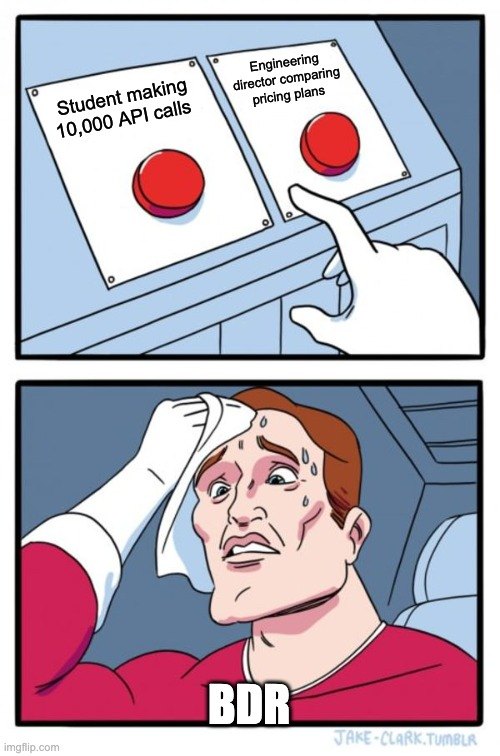
Say a developer racks up 10,000 API calls in your sandbox. Your SDRs might pounce on this 'hot lead,' only to discover it's a 19-year-old building a weather app for a university project. Meanwhile, the actual buyer - a Director of Platform Engineering comparing three vendors for a Q3 rollout - signed up last Tuesday, ran one test, and hasn't logged in since. Her team's been reading comparison articles and sitting in vendor webinars for a month, but none of that shows up in your product analytics.
But again, there is no one-size-fits-all lead quality formula. Instead, quality is dependent on your GTM strategy:
- For PLG: High usage from non-buyers isn't necessarily waste. You want developers building habits and creating internal advocacy, trusting that some will eventually pull your product into a paid account.
- Top-down enterprise: Heavy individual usage might be noise. Your buyer is a senior engineering leader who evaluates based on a proof of concept and a vendor comparison, not by spending weekends in your sandbox.
Most devtools companies are running some mix of both, which can create a lot of noise for RevOps and Sales teams.
How to Improve Developer Lead Quality
Here’s how you can improve lead quality, no matter what motion (or combination thereof) you’re running.
Combine First-Party and Third-Party Data
Remember the Director of Platform Engineering from earlier? In your product analytics, she's a dead lead. But layer in third-party signals and the picture changes: her company has been reading comparison articles in your category for three weeks. Two of her engineers attended a competitor's webinar. The team just posted a job listing for a role that maps directly to the problem your product solves. That's an account in active buying mode - and your product data alone would never have told you.
Product usage shows what someone did inside your walls. External intent signals - content consumption, job postings, technology adoption, review site activity - show what's happening at the organization level. Combining the two lets your team prioritize accounts that show real buying behavior, not just individual activity.
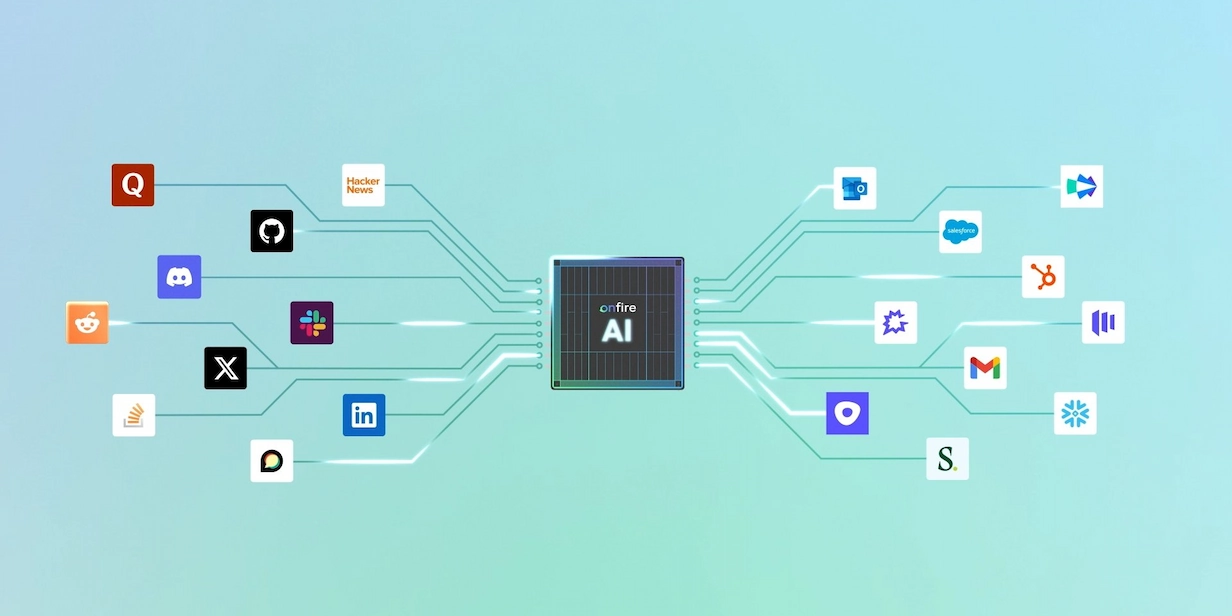
This is what Onfire was built to do. We track signals that standard data providers miss - developer community activity on Stack Overflow, Reddit, and Discord; open source contributions on GitHub; conference attendance at events like re:Invent and KubeCon. Our AI ties these signals back to specific accounts and people, then fuses them with the first-party data already in your CRM. The result is that your team sees which accounts are in buying mode right now, and who to talk to.
Understand Your Target Accounts
Go back to dave.k47@gmail.com. Your enrichment tools can't tell you who he is. But zoom out to the account level: maybe two other engineers from the same company are also in your funnel, the company's engineering blog just published a post about migrating off a competitor, and the VP of Platform has been engaging with content in your category.
Your best path to a deal often runs through people who'll never touch your free tier - the engineering manager frustrated with the current solution, or the platform architect evaluating alternatives. What most devtools companies are missing is the connective tissue: which individuals belong to the same organization, who has buying authority, and what's the right message for each.
Dave's free-tier signup isn't the lead - it's one signal among many. The lead is the account, and Dave is evidence that the account is active. The data to connect these dots is often already in the funnel; it just needs to be stitched together at the account level.
The Missing Link: Building Familiarity Across Touchpoints
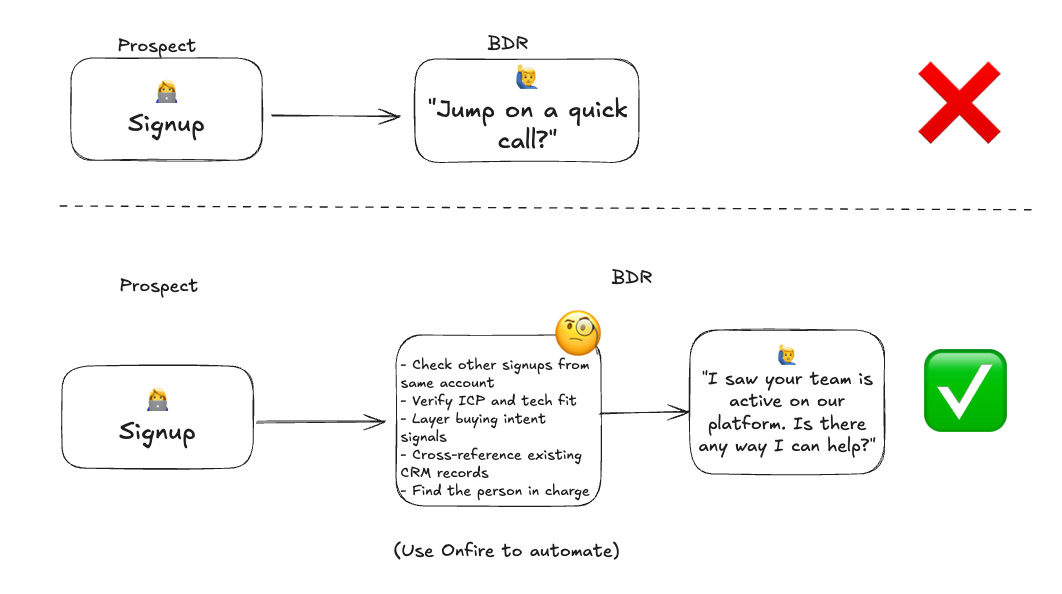
Ask any BDR who's tried cold-emailing developers about their response rates, and you'll get a grimace. Developers respond to brands they already know. If the first time someone hears from you is a "saw you were active on our platform" email, the conversation starts at a deficit. But if they've seen your team at KubeCon, read a useful post from your blog, or chatted with your DevRel in a community Slack, that same outreach lands differently.
The companies with the best developer lead quality treat devrel and community as the top of the funnel for an audience that refuses to enter a traditional marketing sequence. Sponsoring meetups, running workshops, and contributing to open source doesn't have a direct attribution line to pipeline, and that's fine. When a developer at a target account starts evaluating tools, yours is already on the shortlist. And when you can connect that developer to the Director now running a formal evaluation at the same company, your BDR's outreach is no longer cold.
Stop Guessing, Start Seeing
Onfire is a revenue intelligence platform built specifically for companies selling to technical buyers. We combine the community signals, open source activity, and conference data that your current tools miss with the first-party data you've already collected - and use AI to surface the accounts and people that matter right now. See how it works.
.webp)











%20(1).webp)
















































.webp)