How to Build a Target Account List for Technical B2B Sales
You can target accounts with precision without the tedium. Here’s how.



BDRs are caught between a rock and a hard place. On the one hand, many are sending thousands of messages only to get a single “thanks, not interested.” On the other, they’re stuck scouring LinkedIn and job posts trying to figure out who to reach out to. In the end, both approaches are dragging GTM efficiency and draining team morale.
To help your teams spend more time in conversation with people who actually need your products, you need a way to research and prioritize accounts without the manual tedium. In this article, we’ll show you how to use AI to build a precise target account list (TAL) that gives BDRs a clear direction.
Key Takeaways
- Technographics are the single most important factor for targeting in technical sales. Firmographics will get you a long list, but technographics are what get you precise targeting.
- Most technographic data is unreliable for backend and infrastructure sales because it's sourced from job posts and front-end scraping instead of actual usage patterns.
- Once you have a target account list, prioritize it using intent signals like dev-centric community participation, open source software downloads, and event attendance.
- The goal is a workflow where BDRs open their CRM and immediately know which accounts to work and why.
Why Building a Precise Target Account List is Essential in Technical B2B Sales
There’s endless “best practices” about how to best personalize email or LinkedIn outreach. Personalization has been hailed as a magic bullet long before LLMs; but with AI, the hype has reached a fever pitch.
Unfortunately, any experienced seller will tell you that personalization will only get you so far. And if your outreach list isn’t good, it won’t get you very far at all!
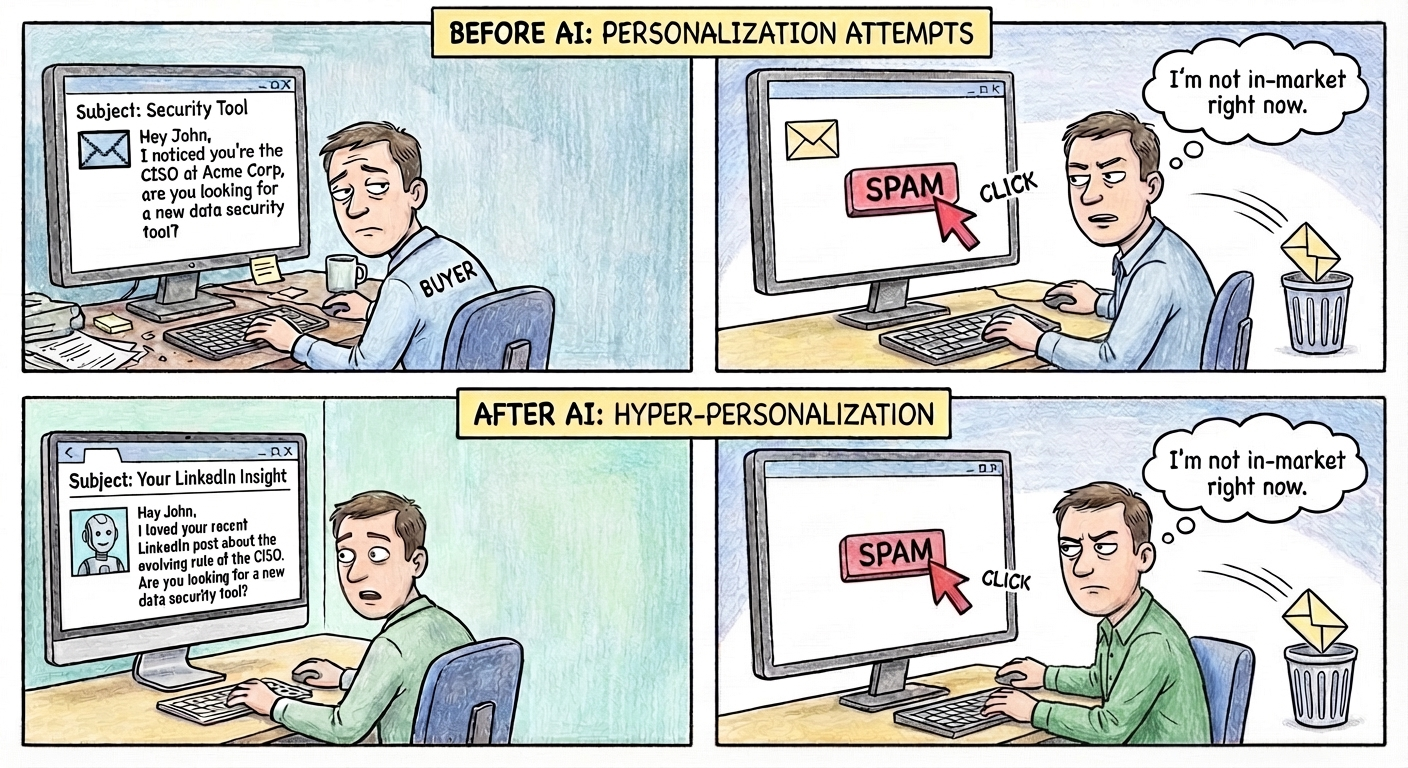
In technical sales - especially in technical sales - precision is paramount. Technical buyers don’t like being sold to, so unless you have insight into the problems they’re facing right now, your outreach is going to bounce off a brick wall.
Yet to distill your TAM into a list of target accounts, you’ll need a complete picture of each buyer. After all, every sizable business will have dozens, if not hundreds, of engineers who deal with AWS and Azure. If you’re selling container management solutions, you need to know which team actually deals with K8, what tooling they currently use, and if they’re looking to upgrade right now.
The role of AI is not to increase the volume of poorly targeted messaging. Rather, it’s to give you the information you need in order to find the people who can benefit from your solution, right now. Once you use it to do the research, then it can help you with outreach.
Checkpoint: Have you clearly defined your ICP?
Before you start working on your TAL, make sure you’ve clearly defined your ICP. You may be selling frontier cybersecurity tech that can discover vulnerabilities no one else can find, but if you haven’t figured out who you’re selling to (and what business value you’re providing them), your GTM motion will be unfocused and erratic.
More importantly, when it comes time to prioritize your accounts for outreach, you’ll rely on your ICP to determine what counts as an intent signal for your buyers. For some, it might be freemium usage, while for others, open source software adoption could be more relevant. Without a well-defined ICP, you won’t know what matters, leading to imprecise outreach and wasted opportunities.
How to Create a Precise Target Account List
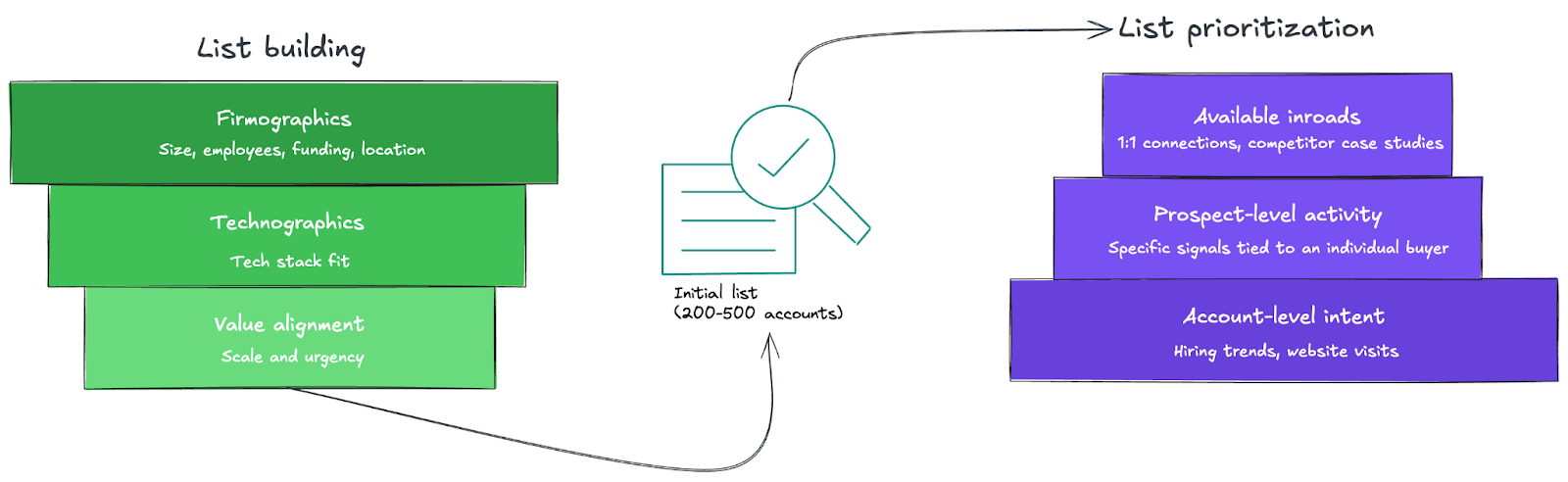
To narrow down a list of target accounts, you’ll need insight into firmographics, technographics, and potential value. Of these, firmographics are by far simpler to identify using standard sales tooling. Technographics and potential, however, are a bit trickier.
Firmographics: Company Size, Industry, Geo, etc.
Firmographics should serve as the foundation of your search. By systematically filtering accounts so you target ones that match your ICP’s firmographic characteristics, you’ll end up with a much more precise list.
For example, if your product is best suited for mid-market SaaS companies with 200–1,000 employees and a presence in North America, firmographic filters let you surface exactly those accounts and exclude the rest -- at least until your ICP changes.
Technographics: Which Tools and Technologies is the Company Using?
Firmographics are mostly an indication of companies who might have the budget to pay for your solutions. But without the right tech stack, they’re never going to buy. Selling a Kubernetes management platform to a company running everything on bare-metal VMs isn't going anywhere, regardless of headcount or industry. In technical B2B, your product has hard dependencies - it needs to slot into an existing stack and solve a problem the buyer already has. That makes technographic accuracy a qualifying factor, not a nice-to-have.
The challenge with technographics is that they're harder to pin down than firmographics. Employee count is a matter of public record; whether a company runs Kafka in production is (usually) not. But getting this right is worth the effort, because technographic fit is often the single strongest predictor of whether a deal will close.
Technographics also help you disqualify early, which is just as valuable. Nobody is going to start using Kafka, or switch to a different cloud provider, just to buy your product. The sooner you filter those accounts out, the more time your BDRs spend on conversations that can actually go somewhere. (Of course, getting accurate technographic data - especially for backend technologies - is a topic in itself. We've covered it in depth in our article about B2B data collection.)
Value Alignment: Big Logos Aren’t Everything
It's tempting to fill your TAL with the biggest names you can find: Fortune 500 logos look great on a case study page. But "big" doesn't always mean "best fit."
Value alignment is often a function of what the company does, not how large it is. If you’re selling a data pipeline, you might have a better time selling to companies with more data-intensive applications (and less complicated procurement processes). A mid-market streaming platform or a gaming analytics startup might generate orders of magnitude more data than a Fortune 500 consulting firm - and be far more motivated to buy.
When you build your TAL with value alignment in mind, you end up with a list that's smaller but far more actionable. Your BDRs aren't chasing logos for the sake of optics; they're reaching out to companies where the pain is most tangible. Those conversations go better, close faster, and churn less. Of course, this means you need a data layer that digs deeper.
Iterate: Learn and Update Your List
A TAL that never changes is just a static spreadsheet - and static spreadsheets are how BDRs end up working dead accounts for months. Your target market shifts constantly: companies adopt new technologies, teams get reorganized, budgets get approved or cut. The list you built in January might look very different by April.
Build a regular cadence for reviewing your TAL, looking at factors which accounts actually converted, and work backwards from there. If your best deals are consistently coming from a segment you underweighted, that's a signal to adjust your filters. If a certain firmographic or technographic criterion keeps producing dead ends, drop it.
The same applies to your ICP itself. Your TAL is only as good as the assumptions behind it, and those assumptions should evolve as you learn from the market
Now For the Hard Part: Prioritization
In the best-case scenario, you’ll be able to prioritize some accounts on the basis of personal knowledge and networking. Shared connections or former colleagues can open the door like nothing else. And of course, case studies and references from similar companies can give you an in, too.
But what about the target accounts you aren’t personally connected to, which almost certainly comprise the vast majority of your list? For these, you’ll need accurate data to make defensible prioritization decisions.
Organization-level buying intent
In addition to prospect-level intent signals, prioritization needs to take organizational behavior into account. Hiring trends, promotions, and funding rounds are helpful here, but first-party data is often the biggest lever. If you tie multiple OSS or freemium users to the same account, that’s a clear sign that they’re evaluating your product.
Similarly, if multiple people from the same company are attending tech events on problems you deal with, that likely means that they’re dissatisfied with their current vendor and searching for an alternative.
Prospect-level activity
Organization-level signals tell you an account is worth pursuing. But in a 5,000-person enterprise, "someone at this company is evaluating observability tools" doesn't give a BDR much to work with. They still need to figure out who.
And the "who" is rarely obvious from a job title. The person responsible for observability might be a platform engineer, an SRE, or a senior developer who inherited the problem when the last person left. They probably don't have "observability" anywhere in their LinkedIn bio. Finding them means looking at what people actually do - which teams they're on, what technologies they work with, what problems they own - rather than relying on title-based filters that produce dozens of loosely relevant contacts.
Timing matters just as much as finding the right person. Someone who just moved into a new role, inherited a mandate to consolidate tooling, or joined a team that's scaling infrastructure is far more likely to evaluate new solutions than someone who's been in the same seat for three years. When you can match the right person to the right moment, your BDR isn't cold-calling - they're reaching out to someone who has a reason to listen.
Bringing it all Together With AI
Both prospect-level and organizational intent are dynamic and can change on a day's notice. If your TAL consists of a few hundred accounts, tracking all the relevant signals manually is a full-time job in itself. And that's the whole problem you're trying to solve: BDRs spending their time on research instead of selling.
You essentially have two options. The first is to stitch together multiple data providers and a workflow builder like Clay, and build your own automation layer on top. This can work, but it requires significant RevOps investment to build and maintain - and the output is only as good as the underlying data sources.
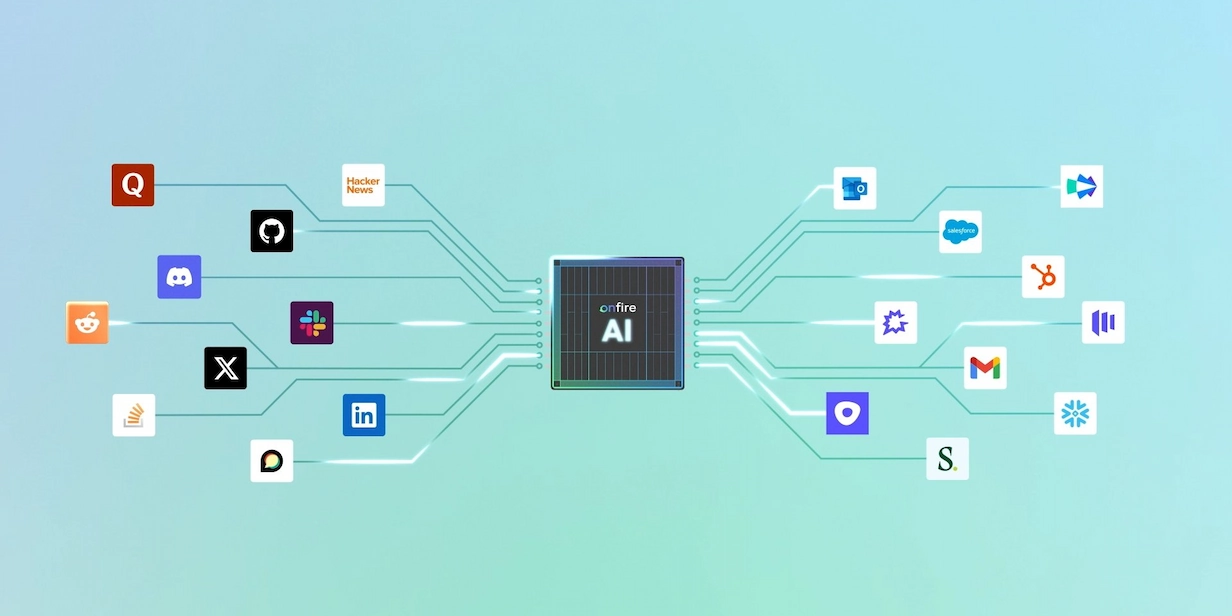
The second is to use a platform that handles the research, identity resolution, and prioritization for you. Onfire automates this entire process for software infrastructure companies: each customer gets a custom workflow tuned to their ICP that combines third-party signals with first-party data, so BDRs get a prioritized list of high-intent targets in their CRM every morning - with the evidence behind each recommendation. If you want to see how it compares to what you're using today, challenge us.
FAQs
How many accounts should be on a target account list?
There's no universal number, but most technical B2B teams find that somewhere between 200 and 500 accounts is the sweet spot. Fewer than that and you risk running out targets; more than that and your BDRs can't give each account the attention it deserves. The right size depends on your team's capacity and the depth of research each account requires. A good rule of thumb is that if your reps can't explain why each account is on the list, the list is too long.
How often should I update my target account list?
Because intent signals change on a daily basis, your TAL should be a living document. At minimum, review your list monthly to add accounts showing new intent and remove ones that have gone cold. If you're using dynamic signal tracking, much of this can happen automatically.
What's the difference between a target account list and account prioritization?
A target account list is the set of accounts that match your ICP based on firmographics and technographics. It tells you who you could sell to. With account prioritization, you rank those accounts by likelihood to buy and potential value, using intent signals, first-party data, and organizational behavior.
How does lead scoring fit into account prioritization?
Lead scoring is the mechanism that allows you to rank accounts consistently and defensibly. Your scoring model should reflect what's historically converted, and it needs to be transparent enough that BDRs understand why an account is ranked where it is. Because both the market and your business are dynamic, you should revisit your weights whenever your positioning or target market shifts.
How do I get reliable technographic data for backend infrastructure?
This is one of the harder problems in technical sales. Most data providers infer technographics from job postings and front-end code, which tells you very little about what's running behind the scenes. For backend and infrastructure technologies, look for providers that source data from developer communities, open-source activity, and technical discussions. High-quality data lets you tie a specific technology to a specific person (not just a company).
.webp)



%20(1).webp)














































.webp)