PQL vs. MQL: How to Score and Prioritize Leads in a PLG Motion



79–80% of MQLs never convert to sales. For a traditional SaaS company, that's a pipeline efficiency problem. For a product-led growth company, it's a signal that the entire qualification model is built on the wrong foundation. When your product is doing the selling, measuring marketing engagement to determine sales readiness is like judging a restaurant by its menu design. The food is what converts. This guide covers the practical differences in the PQL vs. MQL debate: how to define each, score them correctly, and route them so your sales team spends time on accounts that are actually ready to buy.
Key Takeaways
- MQLs measure marketing engagement; PQLs measure value realization. Only one reliably predicts purchase intent in a product-led motion.
- PQLs convert at 5–8x the rate of MQLs, making product behavior the strongest available signal for sales prioritization.
- A strong PQL scoring model combines product usage depth, frequency, and breadth , not just login counts or feature clicks.
- Sales should treat PQL outreach as a continuation of a conversation, not a cold introduction. The prospect has already found value.
- Hybrid GTM teams need two distinct routing tracks: a product-behavior track for PQLs and a nurture track for MQLs, with clear criteria for moving leads between them.
What MQLs and PQLs Actually Mean in a PLG Context
These terms get conflated constantly, so let's clear that up before going further.
An MQL (Marketing Qualified Lead) is a prospect who has engaged with your marketing content at a level that suggests potential interest. The scoring inputs are typically content downloads, webinar attendance, email click-through rates, ad interactions, and website visits. The implicit theory is that marketing engagement predicts intent to buy.
A product qualified lead is a prospect who has reached a meaningful level of product usage that signals genuine value realization , not just curiosity. The scoring inputs are behavioral: which features they used, how deeply, how often, and whether they've hit the moments in your product that correlate with paid conversion or expansion.
For lead quality for developer tools companies, the gap between these two models is especially pronounced. A developer who downloads your whitepaper on Kubernetes observability is expressing curiosity. A developer who has deployed your agent in a staging environment, run three test queries, and invited a teammate to the workspace has found value. These are not comparable signals, but many GTM teams treat them the same way.
Why MQL Scoring Breaks Down in a Product-Led Growth Model
MQL scoring was designed for a world where prospects couldn't experience your product before talking to sales. Content was a proxy for intent because it was the only signal available. In a product-led growth motion, that assumption falls apart.
The failure modes are predictable:
Volume without signal. MQL models reward engagement volume , the more downloads, the higher the score. But content consumption has almost no correlation with purchase readiness in a PLG context. A developer researching your category isn't necessarily ready to buy. They may be evaluating five tools or writing a blog post.
Wrong buyer, high score. Marketing engagement doesn't validate firmographic fit. A well-engaged prospect from a five-person startup with no budget will outscore a low-content-engagement engineering lead at a 2,000-person fintech firm. MQL models routinely surface the former and miss the latter.
Timing mismatch. MQL triggers are based on marketing thresholds, not buying moments. A prospect who crosses an MQL threshold on a Monday might get called by an SDR on Wednesday , when they've moved on, lost context, or haven't yet had the product experience that makes a sales conversation worth having.
As product-led growth flips the traditional GTM playbook, the teams winning on PQL vs. MQL aren't just changing their scoring model. They're changing their theory of when and why to involve sales at all.
How to Define PQL Scoring Criteria for Your Product
A workable PQL model has three dimensions: depth, frequency, and breadth. Each maps to a different type of product signal.
Depth measures whether a user has reached the core value moment , the feature or workflow that distinguishes your product from a free alternative. For a developer observability tool, this might be configuring a custom alert, completing a first trace, or integrating with a CI/CD pipeline. Shallow engagement (login, dashboard view) scores low. Deep engagement (alert fired, data exported to Slack) scores high.
Frequency measures sustained use rather than one-time exploration. A user who logs in across five sessions over two weeks is a different signal than someone who logged in once after signup. Recency matters here too , usage that has gone cold should decay in score weight.
Breadth measures how many users from the same account are active. A single power user is interesting. Three users from the same org, including someone with a job title suggesting budget authority, is a buying signal.
Worked example , infrastructure monitoring tool:
Assign points across these dimensions:
- Core event completed (e.g., first agent deployed to production): +30 pts
- 3+ sessions in past 14 days: +20 pts
- Integration connected (e.g., PagerDuty, Datadog): +15 pts
- Second user from same domain activated: +20 pts
- Job title match (Engineering Manager, VP Infra, CTO): +15 pts
- PQL threshold: 60+ points
- High-priority PQL: 80+ points with a job-title match
For intent signals for developer marketing, in-product signals alone don't tell the full story. A free trial user who is also asking category questions on Stack Overflow, contributing to a relevant GitHub repo, or attending a DevOps conference is showing a materially different signal than one who's only inside your product. Standard PQL models miss this entirely.
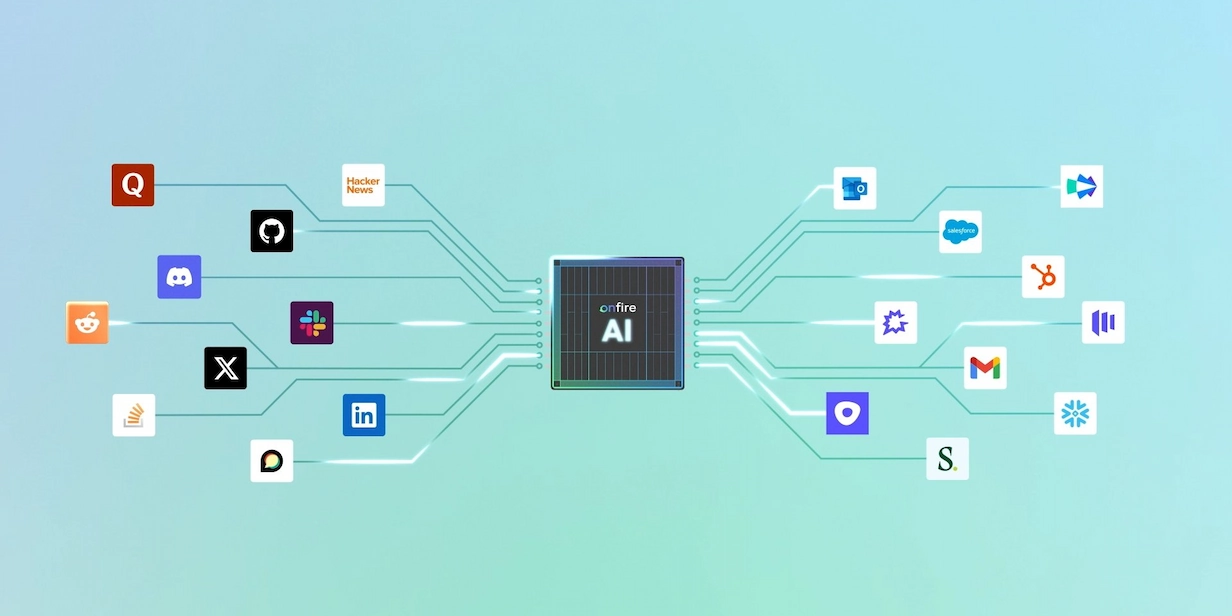
This is where external technical community signals add a layer of precision that no first-party product analytics stack can replicate. Onfire captures these signals across 100K technical data sources. Understanding how GTM teams actually use intent signals beyond in-product behavior is increasingly what separates product-led sales teams that convert well from those that don't.
How to Route and Prioritize PQLs vs. MQLs in a Hybrid GTM Motion
Most B2B SaaS companies run hybrid PLG + sales-led motions , PLG for sub-$10K ACV, sales-led above $25K, and hybrid in between. Routing logic has to match this structure.
Here's a practical decision framework:
PQL + ICP fit → immediate AE or senior SDR assignment. These are your highest-priority accounts. Product behavior confirms intent; firmographic fit confirms revenue potential. Call same day.
PQL + poor ICP fit → monitor, don't ignore. A strong product user from a company that doesn't match your ICP today may represent future expansion, a champion who moves to a better-fit company, or a signal that your ICP definition needs updating. Don't route to active sales, but do track in CRM.
MQL + ICP fit → standard nurture with product activation prompt. Marketing engagement signals interest, not intent. Move them toward a trial or sandbox experience. If they activate and hit the PQL threshold, promote to the sales queue.
MQL + poor ICP fit → low-touch nurture only. No SDR outreach. Automated sequences only.
The routing trigger matters as much as the scoring. Product usage signals should fire routing actions in near real-time. A prospect who just deployed to production is most reachable in the next few hours, not the next few days. For a deeper look at the data infrastructure behind this, the top B2B intent data providers comparison is a useful reference point.
Common PQL Scoring Mistakes GTM Teams Make
Treating login events as meaningful signals. Logins are access, not engagement. Score the actions inside the session, not the session itself.
Static thresholds. A PQL score calibrated when your product had three features won't hold up after you've shipped ten more. Build in a quarterly review cycle. ProductLed's scoring methodology explicitly recommends revisiting thresholds as your ICP and product evolve.
Ignoring score decay. A prospect who hit PQL threshold six weeks ago and hasn't logged in since is not still a PQL. Active decay logic , reducing scores for inactivity , keeps your sales queue current rather than filled with cold signals.
Conflating account-level and user-level scoring. A PQL model needs to track both. User-level signals tell you who to talk to; account-level signals tell you whether the organization is ready to buy. Per the Hightouch PQL framework, the strongest signals combine individual depth of usage with multi-user breadth at the account level.
No feedback loop from sales. If reps are consistently closing PQLs from one scoring segment and ignoring another, that's data. A PQL model without win/loss feedback from sales will drift from reality within a few quarters.
FAQ
How should sales reps approach a PQL differently from a traditional MQL in their first outreach?
Skip the discovery-from-zero script. A PQL has already experienced your product , reference that specifically. Lead with what they've done: "I saw your team connected your PagerDuty integration , most customers who do that are trying to solve X." Make the conversation a continuation, not an introduction. The value prop is already partially proven.
What product events are the strongest PQL signals for developer tools companies specifically?
High-signal events typically include: first successful API call or SDK integration, connecting a third-party integration (CI/CD, alerting tools), inviting a second team member, deploying to a production environment, and setting up scheduled jobs or alerts. One-time exploratory actions score lower than repeated, functional use in a real workflow.
How do you handle PQLs from free users who don't match your ICP firmographics?
Don't route them to active sales, but don't ignore them either. Tag in CRM, monitor for ICP signals that change over time (company growth, funding events, job title changes), and keep in low-touch nurture. High product engagement from a poor-fit company today can mean a champion who moves to a target account next year.
When does it make sense to run a hybrid PQL+MQL scoring model vs. going PQL-only?
Run hybrid when a meaningful portion of your TAM isn't yet in a free trial or product experience , enterprise prospects who won't self-serve, or new market segments still in the awareness stage. PQL-only works cleanly when your free tier or trial has wide enough reach that almost every qualified prospect touches the product before sales contact.
How do you keep PQL scoring thresholds accurate as the product and ICP evolve over time?
Review thresholds quarterly using closed-won data: which product events appeared most often in the 30 days before conversion? Rebuild your scoring weights against that cohort. When you ship new features that become core to the value prop, add them to the scoring model explicitly. Sales win/loss feedback should feed directly into threshold adjustments.
.webp)











%20(1).webp)
















































.webp)