How AI Is Replacing Manual Account Research for SDR Teams



Your SDRs spend 16 hours per week researching accounts. That's 40% of their time identifying prospects, enriching data, and finding personalization angles,before they send a single email. Sixty-seven percent of sales reps devote at least 11 hours weekly to research and follow-up, leaving just 2 hours daily for actual selling. This math doesn't work. It's getting worse as buying committees expand and technical buyer expectations rise.
AI research agents are eliminating this time tax. By autonomously handling prospect identification, signal detection, and outreach preparation, AI account research SDR tools compress 20-minute manual research tasks into 2-minute automated workflows without sacrificing quality. The result: SDRs who spend 50% of their time selling instead of 25%, pipeline that grows without headcount, and personalized outreach at scale.
Key Takeaways
- Manual research consumes 40% of SDR time: 16 hours weekly spent on activities AI can automate, leaving just 10 hours for actual selling and relationship-building.
- AI research agents deliver 10x efficiency gains: reducing per-account research from 20 minutes to 2 minutes while identifying signals human researchers would miss.
- Quality improves alongside speed: AI-driven prospecting generates 50% more qualified leads and 2.3x higher conversion rates through behavioral signal detection.
- Implementation delivers ROI in 60-120 days: teams see productivity gains within weeks as AI handles data enrichment, ICP matching, and personalized outreach prep autonomously.
Why Manual Account Research Is Breaking SDR Productivity
The productivity crisis in SDR teams isn't about effort. It's about time allocation. SDRs average just 2 hours per day on active selling or outreach, with the remaining 6 hours consumed by research, data entry, and administrative tasks. This creates a brutal trade-off: either compromise on research quality to hit activity metrics, or sacrifice volume to maintain personalization.
The compounding cost shows up in three ways:
Pipeline lost to missed signals. Manual research means checking LinkedIn, company websites, and news alerts. Surface-level sources that miss the behavioral signals where technical buyers actually reveal intent. When a VP of Engineering comments on a Reddit thread about Kubernetes challenges or a DevOps lead contributes to a GitHub project addressing observability gaps, manual researchers don't see it. AI does.
Burned-out reps cycling out. Spending 16 hours weekly on repetitive research tasks while watching quota slip creates a morale problem. When SDRs know their manual research will be outdated by next quarter anyway, the motivation to maintain quality erodes.
Scaling costs that don't scale results. Adding headcount to maintain research quality multiplies the problem. Three SDRs spending 16 hours each on research means 48 hours weekly of duplicated effort across overlapping accounts. Work that ai sales prospecting tools handle once, automatically, for the entire team.
The traditional response,better processes, tighter account assignment, more enablement,treats symptoms. The root cause is that human-powered research can't keep pace with the volume and velocity of signals that matter for technical-buyer GTM.
What AI Account Research Agents Actually Do
AI research agents operate differently than traditional sales tools. Instead of providing static databases you query manually, they autonomously execute research workflows from end to end. Here's what that looks like:
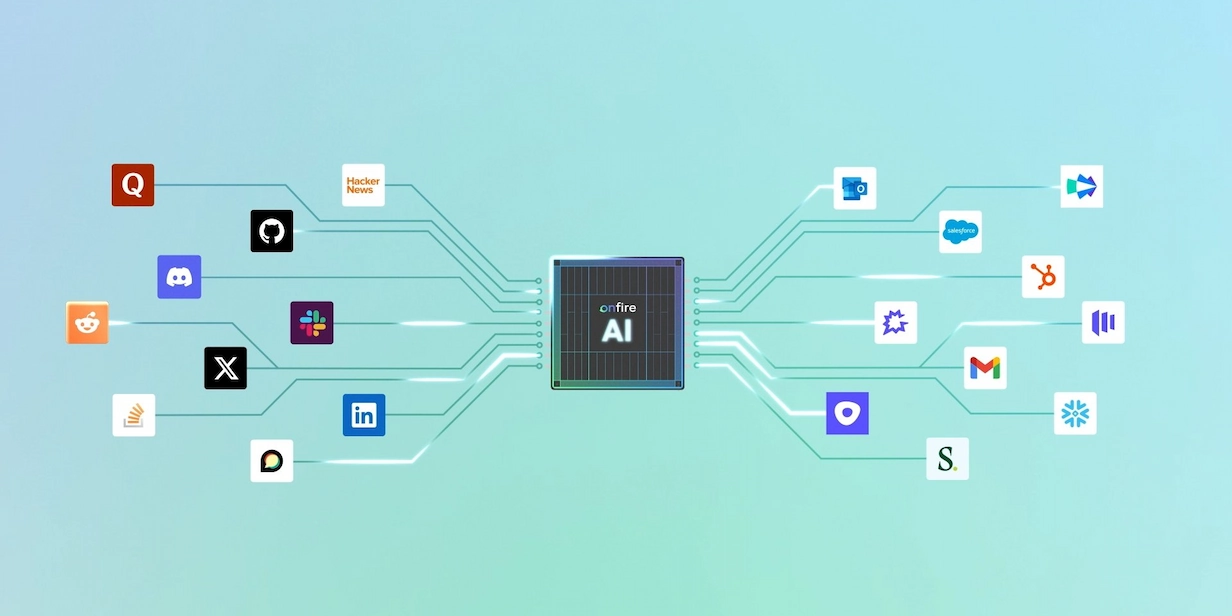
Autonomous prospect identification. AI agents crawl technical communities, open-source repositories, developer forums, and conference participation data to identify individuals exhibiting buying signals. This goes beyond company-level intent tracking. Onfire's Account Intelligence Graph™ connects the public footprint of 50M engineers to specific product needs, identifying which developer at which company is actually researching solutions.
Multi-source data enrichment. Rather than pulling from a single database, AI agents synthesize information from 100K+ technical data sources: GitHub activity, Discord communities, Reddit discussions, Stack Overflow contributions, conference talks, and technical blog posts. This creates a behavioral profile competitors using horizontal tools can't access.
Signal detection and prioritization. AI identifies patterns human researchers would miss: a DevOps team suddenly active in observability discussions, a platform engineering lead asking questions about cost optimization, an infrastructure architect comparing specific vendor approaches. These signals indicate in-market buyers, not just ICP matches.
Personalized outreach preparation. For each prioritized prospect, AI generates research summaries that include specific conversation starters: relevant technical challenges they've mentioned, communities they're active in, technologies they're evaluating. SDRs receive context that makes personalization possible at scale.
The technical differentiation matters. Generic B2B intent signals track website visits and content downloads. Lagging indicators that every competitor sees simultaneously. Vertical AI for technical buyers surfaces leading indicators from where engineers actually spend time, before they're ready to talk to vendors.
Onfire's approach to building precise target account lists shows this: instead of filtering company firmographic data, the platform identifies specific engineers solving problems your product addresses, then surfaces the accounts where those engineers work. The research flows from prospect to account, not account to prospect.
SDR Account Research Before and After AI: A Practical Comparison
Let's map a real sdr account research workflow against the AI-enabled alternative:
Manual Research Workflow (20-30 minutes per account)
1. Account identification: Pull account list from marketing (company-level intent data), filter by ICP criteria in CRM (5 minutes).
2. Prospect selection: Check LinkedIn for relevant titles at target account, cross-reference with ZoomInfo for contact data (7 minutes).
3. Context gathering: Review company website, recent news, LinkedIn activity of selected prospects (6 minutes).
4. Personalization research: Search for shared connections, relevant content they've engaged with, company initiatives mentioned publicly (8 minutes).
5. Research documentation: Log findings in CRM, draft personalized opening line (4 minutes).
Result: One researched account with 2-3 prospects, surface-level personalization, no technical signal validation.
AI-Enhanced Workflow (2-3 minutes per account)
1. Signal detection: AI identifies accounts where technical buyers are actively researching solutions in your category (automated, no SDR time).
2. Prospect prioritization: AI surfaces specific engineers/decision-makers exhibiting buying signals, ranked by intent strength (30 seconds to review).
3. Context synthesis: AI provides research summary: technical challenges mentioned, community activity, relevant conversations, competitive evaluation stage (60 seconds to review).
4. Outreach preparation: AI suggests conversation starters based on prospect's stated challenges and recent technical contributions (30 seconds to customize).
5. CRM enrichment: Research findings, signals, and contact data automatically logged (automated).
Result: Twenty researched accounts with 3-5 prioritized prospects each, technical-signal-backed personalization, transparent sourcing for verification.
The efficiency gain isn't just speed. It's the compounding effect of better signal detection.
One hundred percent of AI-powered SDR users reported time savings, with nearly 40% saving 4-7 hours per week. But the quality improvement matters more: AI-driven prospecting delivers up to 50% more qualified leads and 2.3x conversion rates because the targeting is behaviorally validated, not just demographically matched.
For abm account research specifically, AI agents excel at identifying the full buying committee. When Onfire detects that a platform engineering lead is researching observability solutions, the AI automatically maps connections to the VP of Engineering who'll approve budget, the DevOps team who'll implement, and the infrastructure architects who'll evaluate technical fit. Research that would take an SDR 90+ minutes manually.
How to Roll Out AI Account Research in Your SDR Team
Implementation follows a staged approach that builds confidence before scaling:
Phase 1: Parallel validation (Weeks 1-4)
Run AI research agents alongside your current process for a subset of accounts. Have SDRs complete manual research, then compare against AI-generated insights. This builds trust in the data quality and helps identify where AI adds value your team wasn't capturing.
Key metrics to track: research time per account, signal accuracy rate, prospect response rates.
Phase 2: Hybrid workflow (Weeks 5-8)
Shift to AI-first research with human validation. AI handles prospect identification, data enrichment, and initial signal detection. SDRs review AI-generated research summaries, validate key signals, and add context AI might miss (recent conversations, specific account nuances).
Integration with existing CRMs and sales engagement platforms matters here. Most AI account research workflows sync directly with Salesforce, HubSpot, Outreach, and SalesLoft. Research findings appear as CRM fields, signals surface in engagement sequences, and contact data enriches automatically.
Phase 3: Full automation with spot-checks (Weeks 9-12)
AI autonomously handles all account research. SDRs focus on outreach, conversation, and relationship-building. Implement random spot-checks (10-15% of AI research) to maintain quality assurance and catch edge cases.
Research shows that AI reduces research time by 10x while maintaining quality, but the quality maintenance requires thoughtful implementation.
Critical success factors:
Data foundation matters. AI research agents perform best when your CRM hygiene is solid and ICP definitions are clear. If your existing data is incomplete or your ideal customer profile is vague, AI will amplify those problems rather than solve them.
Vertical specialization beats horizontal breadth. Generic ai for account research tools trained on all B2B sales miss the technical nuances that matter for developer and infrastructure GTM. Agentic AI for technical-buyer GTM delivers better results because it understands the data sources, language, and signals specific to your buyers.
Transparency builds adoption. SDRs trust AI insights when they can see the underlying evidence. "This prospect is in-market" lacks credibility. "This prospect asked a question about Kubernetes cost optimization in the CNCF Slack three days ago" gives SDRs confidence to personalize outreach.
ROI timeline is 60-120 days. Teams typically see productivity improvements within 4-6 weeks, but the full impact,higher conversion rates, shorter sales cycles, improved pipeline quality,manifests over a full quarter as SDRs learn to use AI-generated insights effectively.
The end state isn't replacing SDRs with AI. It's eliminating the time tax that prevents SDRs from doing what only humans can do: building relationships, navigating complex technical conversations, and adapting messaging in real-time based on prospect reactions. AI shortens sales cycles by up to 25% by freeing SDRs to focus on these high-value activities instead of data gathering.
See how Onfire's vertical AI delivers prospect-level precision for technical buyers. Book a demo to compare our technical community data with any tool you're currently using.
FAQ
What types of account signals does AI research best, and which still require a human?
AI excels at behavioral signals: technical community activity, GitHub contributions, Stack Overflow questions, conference participation, and product evaluation patterns. These are high-volume, pattern-based signals where AI's processing power creates advantage. Humans add value in relationship context,recent conversations, political dynamics, budget timing nuances,that aren't captured in public data sources.
How does AI account research change the workflow for SDRs doing ABM vs. high-volume outbound?
For ABM, AI handles buying committee mapping and multi-threaded account intelligence, identifying all stakeholders exhibiting signals within target accounts. For high-volume outbound, AI prioritizes which accounts to pursue first based on signal strength, allowing SDRs to focus on in-market prospects rather than cold outreach. Both workflows benefit from AI doing research; the application differs.
What happens to research quality when AI is wrong about a signal, and how do SDRs catch it?
Quality AI research provides transparent sourcing: links to the GitHub issue, Reddit comment, or Stack Overflow question that triggered the signal. SDRs verify by clicking through to the source. If AI misinterprets context (common early in implementation), SDRs flag it as feedback, improving the model. The verification step takes 15-30 seconds versus 20 minutes of original research.
How long does it take to see productivity gains after introducing AI account research tools?
Most teams see immediate time savings (4-7 hours per SDR weekly) within the first month. Quality improvements,higher conversion rates, better qualified meetings,manifest over 60-90 days as SDRs learn to use AI insights effectively in conversations. Full ROI typically appears within one quarter as the compounding effects of better targeting and faster cycles materialize.
How does AI account research integrate with existing CRMs and sales engagement platforms?
Most AI research platforms offer native integrations with Salesforce, HubSpot, Outreach, SalesLoft, and Apollo. Research findings sync as custom CRM fields, contact data auto-enriches, and signals surface within existing engagement sequences. Implementation typically requires minimal IT involvement,OAuth authentication and field mapping, completed in 1-2 hours. The AI operates as a data enrichment layer, not a replacement platform.
.webp)







%20(1).webp)


































.webp)