Top 9 Revenue Intelligence Platforms for 2026



Revenue intelligence is a fast-changing category in salestech - covering a wide variety of tools used for account research, conversation intelligence, and intent data. Used correctly, these platforms can help sales organizations (BDRs, AEs, and RevOps) close data gaps between themselves and their market, find ICP-fit customers, and automate manual prospecting processes.
In this blog, we’ll see what it covers, explain how revenue intelligence tools help sales team find, reach, and convert the right buyers, and look at some of the leading providers in this space.
Key Takeaways
- Revenue intelligence is a broad category spanning conversation analysis, pipeline forecasting, activity capture, intent data, and account targeting. Most platforms specialize in one or two of these.
- The biggest gap is the data. Most platforms are strong at analyzing data you already have. Fewer solve the upstream problem of whether that data is accurate, particularly for technographics and buyer-level intent.
- Stack compatibility matters more than feature lists. A platform that writes back to your CRM and fits your team's workflow will deliver more than one with a longer spec sheet that no one logs into.
- No single tool replaces a GTM stack. Despite the push toward consolidation, most teams still need multiple tools, which makes integration quality a deciding factor.
Top Revenue Intelligence Tools
- Onfire - vertical AI for account research, prospecting, and accurate buyer data
- Gong - conversation intelligence
- Clari - pipeline prediction
- People.ai - prospect activity tracking
- Aviso - revenue forecasting
- 6sense - legacy intent data
- ZoomInfo - buyer intelligence
- Salesforce - built-in deal insights and forecasting
- Hubspot - conversation intelligence and buyer data
What Is a Revenue Intelligence Platform?
A revenue intelligence platform captures data from sales interactions and turns it into insights that help you forecast more accurately, spot deal risks earlier, and coach reps based on objective information, rather than what gets self-reported.
Originally, the category was limited to call recording, but in 2026, it’s quite broad. Today’s revenue intelligence platforms typically cover some combination of conversation intelligence, pipeline analytics, automatic activity capture, and AI-driven forecasting.
Some have even expanded into areas that used to be dominated by data providers, such as sourcing buyer intent signals, enriching account records, and identifying the right contacts within target organizations.
How Revenue Intelligence Software Helps GTM Teams Day to Day
When they work well, revenue intelligence tools help with just about every aspect of GTM:
BDRs and AEs
Rather than spending hours on manual research each day, BDRs and AEs use revenue intelligence tools to find and prioritize accounts. AI-powered tooling surfaces intent signals online, allowing sales teams to focus on crafting highly relevant outreach.
Once they establish a relationship, this software saves additional time and effort by logging emails, calls, and meetings for them automatically. Based on those logs, the tools then identify deal risks like missing stakeholders or unresolved objections so reps can act before a deal ships.
Sales managers
Those automatic logs then give sales managers objective information in addition to rep self-reporting. Instead of relying on gut feel, they can see engagement patterns, stakeholder involvement, and whether a deal is progressing along a timeline that historically leads to close.
RevOps
Thanks to the wide range of first-party and third-party data that revenue intelligence tools ingest, RevOps gets cleaner CRM data, more accurate forecasting inputs, and better integrations across outbound tools, marketing automation, and BI platforms.
GTM Leaders
In addition to the people who use revenue intelligence tooling day-to-day, leaders get better oversight into GTM motions, including what needs to change if teams aren’t hitting their numbers.
Top 9 Revenue Intelligence Platforms for 2026
1. Onfire
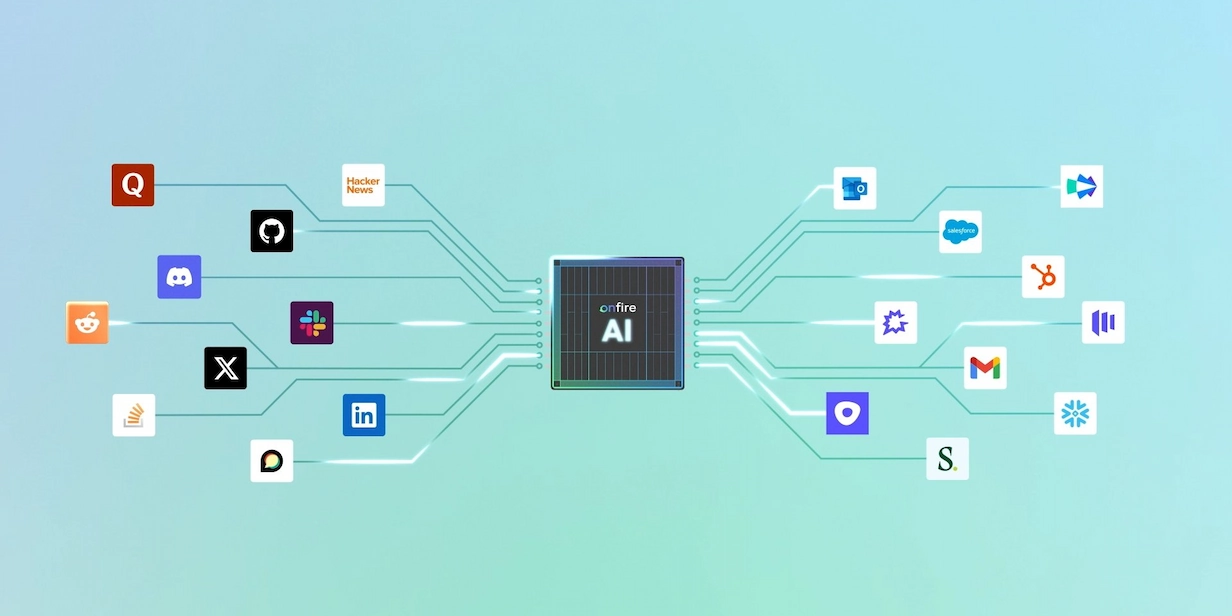
Onfire is a vertical AI platform that helps teams selling to technical buyers find the right accounts and the right people within them. It surfaces buying intent and accurate technographic data to prioritize leads within BDRs’ existing workflows.
2. Gong
Gong focuses on conversation intelligence. It captures calls, emails, and meetings, then surfaces patterns across winning and losing deals. Recently, it has expanded into forecasting and deal management. Its strength is in coaching, buyer engagement analysis, and deal risk detection.
3. Clari (+ Salesloft)
Clari aggregates CRM, email, and calendar data to predict close rates and track pipeline movement over time. The December 2025 merger with Salesloft adds sales engagement and conversation intelligence, though full integration is still in progress. Note that Clari's intelligence mostly targets leadership and managers, so rep-facing "what to do next" guidance is thinner.
4. People.ai
People.ai automatically logs every email, call, and meeting, then maps activity to the right CRM records. The platform has expanded into forecasting and recently launched an MCP integration for AI agents. It’s designed for enterprise orgs who rely on accurate activity data.
5. Aviso
Aviso was built from the ground up around machine learning for revenue forecasting, rather than bolting AI onto an existing product. It covers pipeline inspection, deal management, and rep coaching alongside its forecasting core.
6. 6sense
6sense focuses on identifying which accounts are in-market based on anonymous web research, content consumption, and behavioral signals. It's a marketing-and-sales tool aimed at ABM programs. Note that its intent data relies on IP-based tracking that works reasonably well for traditional enterprise buyers, but can struggle with technical audiences who research in communities and OSS channels rather than vendor websites.
7. ZoomInfo (with Chorus)
ZoomInfo offers the largest B2B contact and company database, with firmographic and technographic data across hundreds of millions of profiles. Its Chorus acquisition added conversation intelligence. The data is broad but often inferred from job posts and public web sources, which can produce stale or inaccurate results for backend and infrastructure technologies.
8. Salesforce Revenue Intelligence
Salesforce's built-in revenue intelligence layer (powered by Einstein AI) offers pipeline inspection, deal insights, and forecasting without leaving the CRM. It's limited to the data already in Salesforce, so its insights are only as good as what reps and integrations put in.
9. HubSpot Sales Hub
HubSpot has steadily built out revenue intelligence features within Sales Hub: conversation intelligence, deal tracking, forecasting, and pipeline analytics. It won't match the depth of dedicated platforms, but for mid-market teams already on HubSpot's CRM, it can make sense.
How to Choose the Right Revenue Intelligence Solution for Your Stack
Since this category is and contains many different type of tools, the most important thing is to understand what you’re actually looking for. Are you looking for a point solution to plug specific blind spots - such as intent data or conversation intelligence - or do you need a complete solution? Are you happy with DIY-type tools or do you want a fully managed service?
Another factor you’ll want to test thoroughly is data accuracy, especially when it comes to tools that provide 3rd party data. While many tools will promise they can provide accurate data on technographics and buyer intent, many of the datasets being sold are not up-to-date or just plain wrong, especially when you’re selling to technical buyers. Double check vendor data against known accounts and don’t take the vendor’s word for it.
Beyond these preliminary requirements, there are a few other aspects that you don’t want to overlook:
- CRM compatibility. Does the platform write back cleanly, or does it add needless complexity to your team’s workflow?
- Team size. Enterprise forecasting tools often require dedicated RevOps support, making them unfit for small and mid-sized teams.
- Implementation effort. Some platforms deliver value in days, but others take months, creating an additional up-front cost in addition to the overall price tag.
- Pricing model. Some tools offer usage-based pricing that’s difficult to predict, while per-seat costs can spiral quickly when you're deploying across a large sales org.
Think about where each tool sits in your data flow. Revenue intelligence platforms that analyze deal activity need clean inputs to produce useful outputs. If your account and contact data is inaccurate upstream, even the best analytics and forecasting won't help you hit the right targets.
See Where Onfire Fits in Your Stack
Onfire works alongside the tools above to enrich your CRM, feed intent data into your workflows, and make sure the accounts and contacts entering your pipeline are worth your team's time. If you're selling to technical buyers and want to see how a custom workflow with accurate technographics change the quality of your pipeline, book a demo.
FAQ
How do revenue intelligence platforms work with existing CRMs and sales engagement tools without creating more admin work?
Most platforms integrate via native connectors or APIs that sync data bidirectionally with your CRM. Activity capture runs in the background, logging calls, emails, and meetings without manual entry. The key question during evaluation is whether the platform writes back to your CRM automatically or requires reps to use a separate interface. If it creates another tab to check, adoption will suffer.
Which teams usually get the most value first, leadership, RevOps, or frontline reps?
It depends on the tool. Forecasting platformstend to deliver value to leadership and RevOps first. Conversation intelligence often lands with managers and reps through coaching workflows. Activity capture benefits RevOps immediately by improving data quality. Account intelligence tools tend to hit BDRs first, since they directly impact daily prospecting.
What data quality or adoption issues can stop a revenue intelligence platform from delivering accurate forecasts?
Incomplete CRM data is the most common culprit, if reps aren't logging activity (or the platform isn't capturing it automatically), the forecasting model is working with a partial picture. Low adoption is the other killer: a platform that only 40% of your team uses will produce forecasts biased toward those users.
When does it make sense to upgrade from point tools to an all-in-one revenue platform?
When the cost of maintaining and syncing multiple tools exceeds the cost of consolidation, both in dollars and in RevOps hours. If your team spends significant time reconciling data across platforms, or if insights from one tool can't inform actions in another, consolidation starts to make sense. That said, best-of-breed tools still outperform bundled features in most categories, so the right answer is usually a lean stack of well-integrated specialists rather than a single monolith.
.webp)










%20(1).webp)














































.webp)