Use AI to Compete on Value, Not Volume
Everyone can now send 1,000 “personalized” emails in one minute. The value of AI is elsewhere.



GTM efficiency is crashing. Particularly in software infrastructure, buyers are growing weary of superficially personalized messaging that doesn’t take their actual challenges into account. AI was supposed to help, but when revenue teams use it to compete on volume, it just makes the problem worse.
But that doesn’t mean AI should be written off. In fact, GTM leaders have found ways to supercharge efficiency by using AI to compete on value. In this article, we’ll show you how.
Key Takeaways
- AI-driven personalization and mass outreach are both overused and ineffective. But it’s not AI’s fault: poorly thought out tactics are to blame.
- By using AI to compete on value, instead of volume, teams are seeing dramatic improvements in their GTM efficiency. We call this AI-led growth.
- In the emerging AI-led growth model (AI-LG), GTM teams are automating manual research and lead prioritization so they can focus on building relationships.
- To adopt AI-LG, focus on the relevance of your messaging, act as a trusted advisor to your customers, and hone in on the things that actually differentiate your offering.
Volume ≠ Value
Many GTM organizations are over-indexing on personalization and mass outreach -- tactics that were over-used and ineffective even before their marginal cost went down to zero. Here’s the result:

When every revenue organization has access to high-volume personalization, no one stands out. And for customers, the situation is equally frustrating. Many buyers are inundated with shallow, machine-generated messaging, even when they’re not in market. No wonder many are reluctant to respond to outreach.
It’s tempting to indulge in the knee-jerk reaction of blaming AI for this state of affairs, and it is certainly true that automated outreach isn’t living up to the hype. But it also isn’t clear that AI is itself at fault. After all, some GTM teams have significantly improved their efficiency with AI sales tooling.
The thing that sets these leaders apart isn’t AI, it’s how they’re using it.
Why High-Volume AI Outreach Sends the Wrong Message
When revenue teams use AI to compete on volume, they play into the same high-volume pattern that is overwhelming buyers and tanking GTM motions. Besides, when everyone has the same models, generic AI doesn't communicate the reassuring message that you understand the ins and outs of your customer’s challenges and have the time to help. And as the barrier to shipping software continues to drop, that message will only become more important.
Consider the implications of two recent AI-driven financial shakeups. When Google launched Project Genie, an AI prototype that lets you create and explore open worlds, on January 29th, video game stocks like Roblox and Unity Software dropped by as much as 21%. Just a week later, Anthropic released 11 open-source Claude plugins that automate complex legal and compliance workflows, triggering what Forbes called the “SaaS-Pocalypse.”
While Forbes probably exaggerated, the losses were substantial. SaaS mainstays like Thomson Reuters and LegalZoom each dropped by over 18%, and the S&P Software Index took a 15% hit. Why? Because the market recognized that AI systems are capable of executing the autonomous, long-form activities that SaaS products are supposed to solve for.
These market shocks have profound ramifications for revenue leaders. If autonomous systems can ship fast and cheap, then SaaS companies can no longer rely exclusively on their products to set them apart. And that’s what we’re already seeing: McKinsey reports that only a select few companies are seeing outsized gains from product-led growth. Instead, leading SaaS GTM teams are moving towards more traditional, sales-led motions.
If almost every product feature is set to become commoditized, the focus goes back to ‘soft skills’ that can’t be automated and are often associated with good old-fashioned sales: relationships, expertise, and specificity. When features cluster around an AI-dominated mean, clients ultimately close contracts because they trust a team, not because they’re impressed by product specs.
And that’s why high-volume outreach isn’t moving the needle. Buyers are looking for evidence that a team understands their challenges and is willing to work through the particularities of their niche in order to help them succeed. Shallow personalization sends the opposite message. Prospects can tell when they’re just another node on an n8n “personalization” workflow, just like they could tell when they were one of 20,000 recipients of an automated sequence.
How GTM Teams Are Using AI to Create Value
Volume isn’t the solution to the GTM efficiency crisis, but that doesn’t mean that AI has no role to play. To the contrary: the GTM teams reaping the benefits of automation are leaning on AI in their workflows. But instead of using it to compete on volume, they’re using it to create value.
Here’s what this might look like in practice:
- A BDR uses AI revenue intelligence to get a full picture of their target account. This includes the technologies they use, activity in online communities, and the relevant buyer for a specific type of technology.
- Armed with this information, the rep can then use AI to collate all the relevant information - including previous conversations with others at the account, product usage, and content consumption. They can quickly surface relevant pain points, mapping them to product capabilities.
- The rep then reaches out to the exact person or team that’s actually looking for a solution, with messaging that’s tailored around the specific pain points that they’ve already surfaced - either in direct interactions with the seller’s own products, or in their online behavior.
- Rather than spamming every engineer in the account, the rep reaches a specific buyer with a message that’s relevant to them, and that’s genuinely helpful.
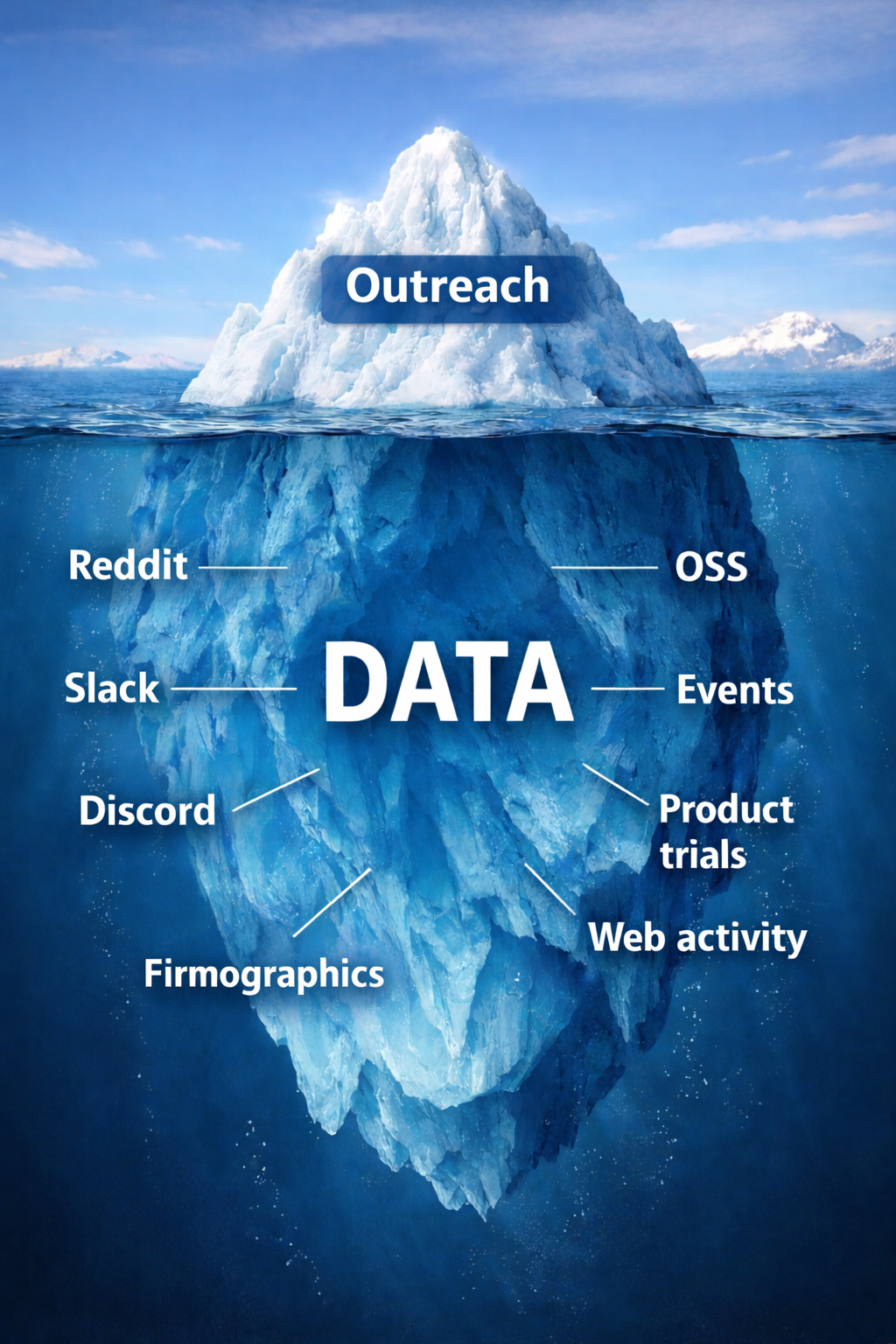
AI is helping sellers achieve this scenario by automating the necessary yet tedious work of research, prioritization, and signal collation. Instead of scaling shallow personalization, it scales the quantity and type of data that a GTM team can use to discover potential buyers. The result of all the unseen work is more relevant and timely outreach:
So while some teams aren’t seeing value from AI sales tooling, it would be a mistake to blame the LLMs. By using an AI-led growth model to compete on the basis of value, revenue leaders can use AI to turn around GTM efficiency.
Adopting a Value-First Mindset in the Age of AI-Led Growth
AI-led growth puts value first by taking care of the busywork that goes into qualifying leads: collecting and interpreting intent signals, evaluating first-party data, identifying potential champions, and putting it all together so BDRs get a prioritized list of leads when they login to their CRM each morning. When 80-90% of the manual tedium is taken care of, revenue teams can focus on building relationships with buyers.
But AI-LG isn’t simply a toolset. It’s also a mindset, and it can take a while before your team truly embraces it. Here are some of the key principles that make it work:
Relevance > raw numbers
It’s easy to fall into the trap of trying to send as many messages as possible. To make AI-LG work, revenue teams have to resist the urge to measure success in terms of raw numbers. Instead, GTM leaders that focus on making their outreach relevant, precise, and helpful will be well positioned to reap the benefits of AI.
Service over sales
By using AI to focus on value, BDRs can truly understand the needs of their buyers. Outreach should then be about serving those needs. Instead of acting as salespeople, BDRs (and AEs) should aim to become trusted advisors. By providing real value to customers, leaders can send the message that they have the time, expertise, and motivation to act as partners, not just vendors.
Hone in on your differentiator
As AI keeps decimating the cost of shipping features (and personalizing messages), SaaS leaders will orient their GTM motions around the things that differentiate their offering. Factors like customization, scalability, and the team behind the product will be more important than ever. And while revenue teams rarely have direct impact on the product roadmap, they do shape the first impression buyers get of the people they’ll be working with if they commit to a contract.
AI-LG challenges GTM teams to make that impression distinct, persuasive, and above all, human. When LLMs can draft messages in seconds, buyers scan past formulas to see if anyone has taken the time to see what their challenges are. AI-LG gives revenue teams the evidence they need to make their case.
Accelerate AI-LG with Onfire
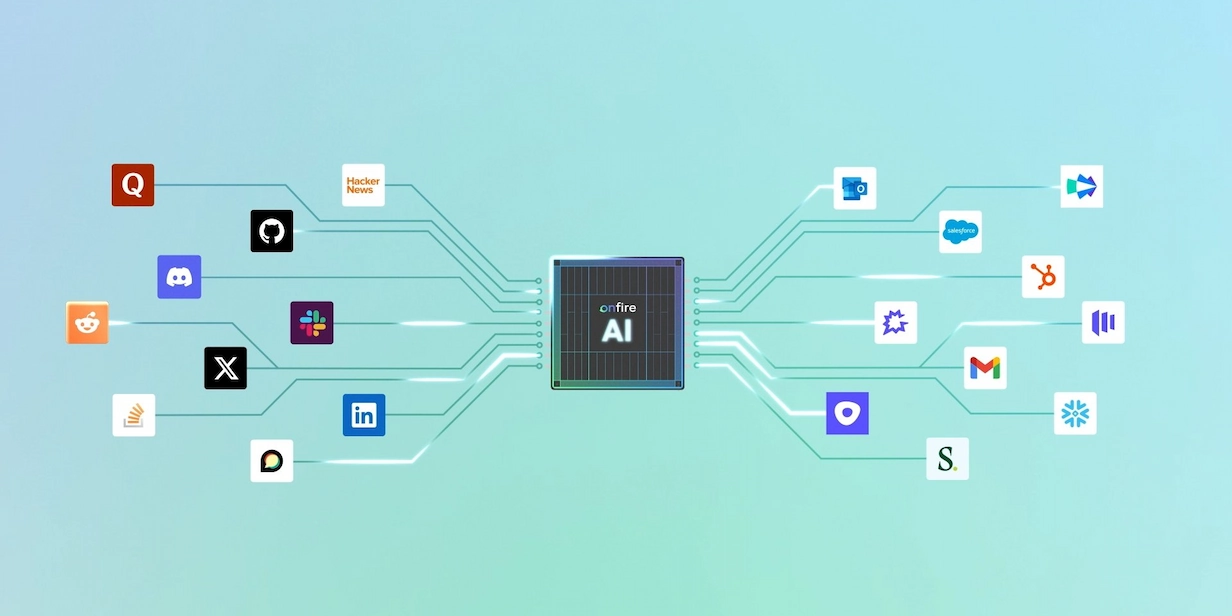
Onfire is the revenue intelligence platform built for AI-LG. Designed specifically for software infrastructure providers, it gives BDRs insight into 100,000 developer communities and combines intent signals with first-party data to prioritize leads.
Our customers are using it to automate the busy work so they can build relationships. See how Onfire can help you create value with AI.
.webp)




%20(1).webp)




















































.webp)