5 Best Cyber Security Lead Intelligence Software for SDR and BDR Teams in 2026



If you sell cybersecurity, there's a good chance your team has spent hours this week emailing CISOs who never respond. The problem is that the CISO is rarely the person evaluating your product. More often it's a senior engineer running an AppSec initiative or a director leading a DevSecOps rollout.
What do these roles have in common? Neither of them have “security” in the job title.
Cyber-specific lead intelligence software should take care of account research so you can focus on building relationships with the right people. This article walks through what to look for in a platform, then reviews the five best options for SDR and BDR teams heading into 2026.
Key Takeaways
- Cybersecurity buyers are hard to reach, but lead intelligence software can pinpoint the engineer or architect actively involved in evaluating products.
- Robust lead intel includes accurate technographics, engineering-specific intent signals, and identity resolution to tie anonymous activity back to specific individuals.
- At its best, lead intelligence substantially reduces the burden of manual account research, freeing up a majority of SDR and BDR time for selling.
- While small teams can benefit from point solutions that solve for a specific aspect of lead intelligence, larger organizations don’t need yet another tool, they need a comprehensive solution built for their motion.
What Is Cyber Security Lead Intelligence Software?
A contact database tells you who works at a company, but you still have to wade through it to figure out who to contact, and it tells you little about what tools they’re running in their deep tech stack. In other words, you’re stuck doing manual research.
Lead intelligence is supposed to change that. Solid lead intel doesn’t ask you to do the leg work. Instead, it tells you which companies are worth pursuing right now, what specific tools they use, who you should reach out to, and the context you should use to start a conversation.
In cybersecurity, that info is critical. After all, security buyers are notoriously hard to reach:
- The technical evaluator for a given initiative is often a lead engineer or analyst, so they’re virtually hidden from public view.
- Their intent signals don't show up in traditional channels. They might research in security-focused Discord and Slack communities, but they certainly won’t be downloading your gated whitepaper.
- Traditional web analytics will likely miss them completely because they may never visit your website before booking a demo.
Because of these challenges, SDRs and BDRs selling in cyber tend to spend a majority of their time on account research. Lead intelligence software automates much of the research process so teams have more time to focus on outreach.
What to Look For in a Cyber Security Lead Intelligence Tool
In the best case, lead intel tooling does your research for you so you can spend your time building relationships and selling. In the worst case, it gives you a semi-accurate list of technographics that stop at the account level, leaving you with a bunch of manual work to do before you can contact anyone. So if you’re trying to figure out if lead intelligence tooling is worth the spend, the details matter.
If your SDRs and BDRs are going to hand off research to AI, they need to be able to rely on it to tackle a few discrete tasks. First off, they need to be able to tie technographic info to concrete individuals they can reach out to. When selling to an enterprise account, it’s not enough to know that the company uses Splunk for SIEM. To skip manual account research, you’ll need a tool that can tell you who at the account is responsible for security data analysis.
From there, sales intel platforms need to be able to prioritize leads on the basis of timely buying signals. It’s one thing to get accurate technographic information and another to sort through that list to determine who’s ready for outreach. If your tool is asking your team to crunch data or evaluate intent on their own, it’s not actually automating account research.
And since your team is already juggling a bunch of software, it’s critical that they can get this information without extra effort. If a sales intel platform serves information in its own complex dashboard, it’s likely that busy SDRs will never use it. That’s why lead intelligence needs to be integrated into where reps already work: Salesforce, HubSpot, Outreach, Salesloft, and LinkedIn Sales Navigator.
The 5 Best Cyber Security Lead Intelligence Tools in 2026
1. Onfire
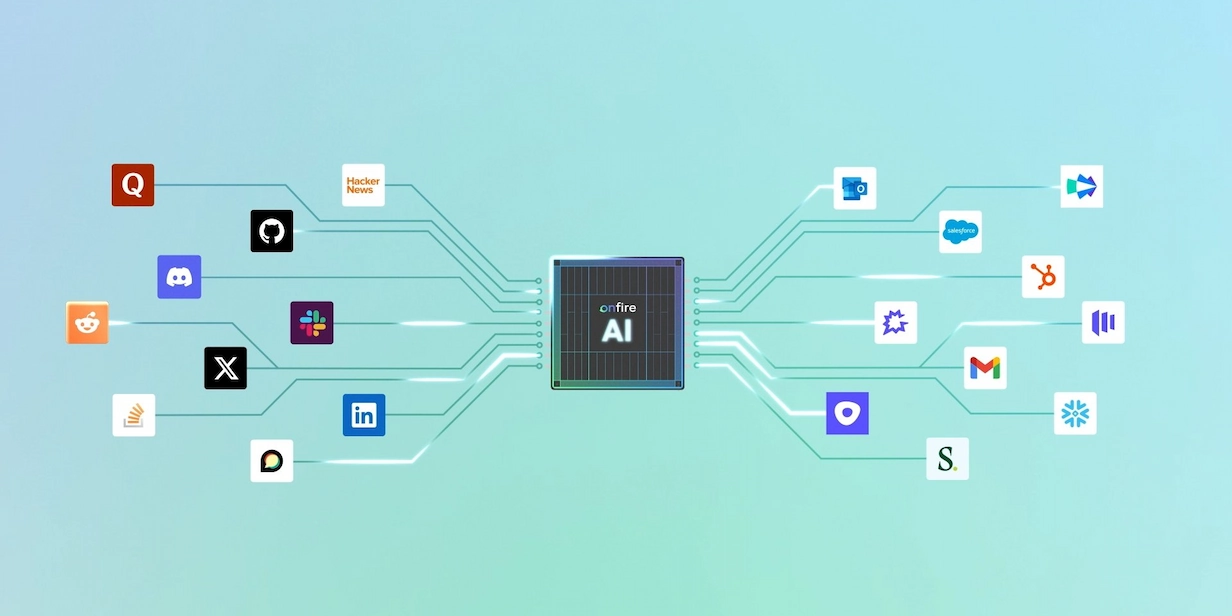
Onfire is a vertical AI platform built specifically for companies selling software infrastructure. Its AI takes care of account research so SDR and BDR teams can focus on sales. Onfire works by surfacing prospects that meet your team’s ICP, analyzing their open-source and community activity, and handing you a list of prioritized leads within your existing CRM. For technical buyers, its strength lies in its data sources, which include over 100,000 developer and security communities, OSS activity on GitHub, and event data.
Key features:
- Custom ICP and persona mapping tuned to security buying motions (AppSec, DevSecOps, container security, cloud security, identity)
- Technographics for 91% of companies globally, sourced from actual technical activity rather than job posts
- Identity resolution that de-anonymizes community activity
- Onfire Agent — an agentic AI copilot for account lists, GTM questions, and outreach sequences
- Native integrations with Salesforce, HubSpot, Outreach, Salesloft, and LinkedIn Sales Navigator
2. Leadfeeder
Leadfeeder (now part of Dealfront) identifies companies visiting your website based on IP address, even when visitors don't fill out a form. If you’re selling cyber, you should be aware that it only surfaces buyers who have already reached your site (a small slice of in-market activity for security vendors), and it can't tell you who at the company visited.
Key features:
- IP-based company identification for anonymous website visitors
- Page-level visit tracking and scoring
- CRM and sequencing integrations (Salesforce, HubSpot, Pipedrive, Outreach)
- Slack and email notifications for high-value visits
3. HG Insights
HG Insights specializes in technographic data, tracking install base, adoption depth, and IT spend estimates. Its signals come largely from web scraping, job posts, and data aggregators, which works for broad strokes but struggles with granular, security-relevant signals. Prospect-level coverage is thin, so you'll need to pair it with a contact source.
Key features:
- Broad technographic coverage across IT categories
- IT spend estimates and adoption scoring
- Firmographic filtering and account segmentation
- Integrations with Salesforce, Marketo, and major ABM platforms
4. ZoomInfo
ZoomInfo is a contact database with tens of millions of contacts, extensive firmographic coverage, and decent org chart data for enterprise accounts. For cyber, though, it hits the same ceiling as other generalist databases. Technographics are inferred from job posts and web signals, prospect targeting rarely gets more specific than job title, and its intent product relies on IP-based tracking that misses most of what technical buyers actually do.
Key features:
- Large contact and firmographic database
- Org chart and reporting structure data for enterprise accounts
- Intent signals via IP-based content tracking
- Deep integrations across the sales tech ecosystem
5. 6sense
6senseis an account-based intent platform that aggregates behavioral signals across a wide publisher network and scores accounts by buying stage. Enterprise cyber teams running coordinated ABM motions can use it to time their outreach to accounts actively researching. However, while 6sense tells you Company X is showing elevated intent on "endpoint security," it can’t tell you which person is driving the research or how to reach them.
Key features:
- Account-level intent scoring across a broad data network
- ABM workflow orchestration and programmatic advertising
- Predictive analytics for account stage and fit
- Integrations across CRM, MAP, and sales engagement tools
Which Lead Intelligence Tool Fits Your Team?
The right fit depends on the scale you operate at. If you’re a small organization and you need a low-cost solution for a discrete problem, many of these tools can solve it for you. If, however, you’re operating at scale and need reliable, granular insight into technical buyers, Onfire is the only platform built for that purpose.
Unlike small organizations, medium and large-sized companies often have dozens of different dashboards and tools. This leaves SDRs and BDRs to work with a confusing tangle of sales software. In that context, if you add yet another point solution to the mix, your team will likely set it to one side and rarely, if ever, use it.
Onfire is designed to pre-empt this by working within your CRM. Its research and prioritization agents operate automatically in the background, stitching a complete picture of your buyers. The result is a prioritized list of leads served to your reps right in their current workflow. As Lior Edry, Director of Sales Development at OXx, says, “"Once you start using Onfire, you cannot go back. My SDRs are basically addicted to it.”
See Onfire in Action
All five tools covered in this article serve a purpose, but only one is built for cyber sales from the data layer up. If your reps are spending more time researching prospects than actually selling to them, Onfire is worth a serious look. Book a demo and we'll show you what your pipeline looks like when the data matches how security buyers really research.
H2: FAQ
What is lead intelligence software and how does it help SDRs?
Lead intelligence software researches firmographic, technographic, and intent data for you so you can focus on accounts that are actually in-market. Rather than working from a flat list of contacts, reps get context: which companies match the ICP, which are showing buying signals, and who at those accounts to reach. The result is better targeting and far less time wasted on poor-fit prospects.
How is cyber security lead intelligence different from a contact database?
A contact database gives you names, titles, and emails. Good cyber security lead intel adds technographic accuracy (what security stack the company actually runs), prospect-level specificity (the engineer leading AppSec, not every senior engineer), and intent signals sourced from places security buyers actually research. It turns a list into a prioritized action plan.
Can lead intelligence tools integrate with my CRM and outreach stack?
Most modern platforms integrate with Salesforce, HubSpot, Outreach, Salesloft, and LinkedIn Sales Navigator. The deeper question is how the data flows. A good integration pushes prioritized accounts and enriched contact records directly into the tools your reps already use, so BDRs don't spend their day toggling between dashboards. Before buying, check integration depth, not just whether a connector exists.
What data points should a good lead intelligence platform provide?
At minimum: accurate firmographics, verified contact details, and technographics sourced from real technical activity rather than inferred from job posts. For cyber, add intent signals from technical communities (Reddit, Discord, OSS contributions, event attendance) and identity resolution that links anonymous signals to real prospects. Evidence-based signals where you can see the underlying source beat opaque intent scores.
Is there lead intelligence software built specifically for teams selling to technical buyers?
Yes. Onfire is purpose-built for companies selling software infrastructure, including cybersecurity, developer tools, data, and FinOps. Unlike generalist platforms that treat cyber as one filter among many, Onfire's models and data sources are designed around how technical buyers actually research in communities, on GitHub, and at technical events, and how they move through a buying cycle. Book a demo to see it in action.
.webp)

%20(1).webp)













































.webp)