6 Best AI Lead Scoring Tools for B2B Teams in 2026
Choose the right tool to prioritize perfect-fit buyers and skip the time wasters.



If you’re an SDR, you’re likely spending most of your time on account research, and yet you already have more data than you could possibly make sense of. The thing is, if your signals are trapped in a web of site visits, content downloads, product trial activity, job changes, technographics, and conference attendance, they’re not exactly helpful day-to-day.
AI lead scoring tools are supposed to help you make sense of the data you already have so you can spend less time on research and more on selling. They ingest signals from across your stack, weigh them against historical patterns of who actually closed, and hand your reps a ranked list instead of an analytics challenge.
The best lead scoring tools will save you hours per day, but the bad ones fail to take important signals into account, leading to poor prioritization. This article walks through six lead scoring tools to help you choose the best fit for your buyers.
Key Takeaways
- AI lead scoring combines behavioral, firmographic, and intent signals into a ranked list, replacing manual research with prioritization that updates in real time.
- The right tool depends on your motion. CRM-native scorers fit teams with rich first-party data, ABM platforms fit enterprise marketing, and vertical platforms like Onfire fit teams selling software infrastructure to technical buyers.
- A scoring tool that doesn't push prioritized leads into your reps' daily workflow won’t get used consistently enough to justify the spend.
- The top AI lead scoring tools include Onfire, 6sense, Demandbase, HubSpot, Salesforce, and Apollo
Why AI Lead Scoring Matters for B2B Teams
When you have lead scoring automation that’s sensitive to your real drivers of business value, you can dramatically reduce the time you spend building lists and devote that time to outreach instead. However, not every lead scoring system will get you to that best-case scenario.
In fact, it’s likely that you already use a few AI tools as part of your account research & prioritization workflow. And if you’ve read this far, you’ve probably noticed that despite the hype, most AI-powered sales tools are only marginally better than their manual forebears.
The main reason why AI sales tooling tends to be less than transformative is that it’s working with low-quality data. To work, tools need to effectively track the signals that correlate with closed-won. If they don’t, you risk optimizing for things that don’t matter.
For instance, a model that ranks accounts by web visits will reward whoever has the biggest paid budget. To reflect buyer behavior, you need AI that understands your buyers.
When lead scoring automation has been tuned to align with your GTM motion, you’ll get results that reflect a mixture of product usage, hiring patterns, buying conversations, and other signals that you’ve found valuable. That’s the intel you need to stop researching and start selling.
What to Look For in a Lead Scoring Platform
Most lead scoring tools look similar in demos, so here are four things to ask about as you evaluate:
1. The data behind the score. Every vendor will show a leaderboard sorted by some confidence percentage. The question is what produced that number. If it's mostly anonymous web traffic and IP matching, the score reflects who's already aware of you, which is useful for retargeting. If it includes product usage, technographics, and active buying conversations, it reflects who's actually evaluating, which is useful for finding net-new pipeline.
2. Fit with your GTM motion. A platform that demands months of professional services to configure won't survive a leadership change. Look for tools that match how your team already sells: the personas you target, the CRM your reps live in, the sequencing tool they already use.
3. Actions, not dashboards. A score on its own is just a number. What your reps need is the next step: who to call today, what they care about, where to start. The platforms worth paying for translate scores into a workable queue inside the rep's daily workflow.
4. Coverage of your buyer. If you sell to technical audiences, generic horizontal scoring misses most of the signal. Engineers and security teams research in places that don't show up in standard web analytics, and they don't fill out forms. The tool needs to see where your buyers actually are.
The 6 Best AI Lead Scoring Tools for B2B in 2026
1. Onfire
Onfire delivers ranked, ready-to-work account and contact lists to revenue teams selling software infrastructure. Your reps log in to a daily queue of accounts that match your ICP, with the specific person to contact already identified. That way, the research a BDR would normally spend the morning doing (qualifying technographics, mapping the buying committee, finding evidence of active evaluation) is already done.
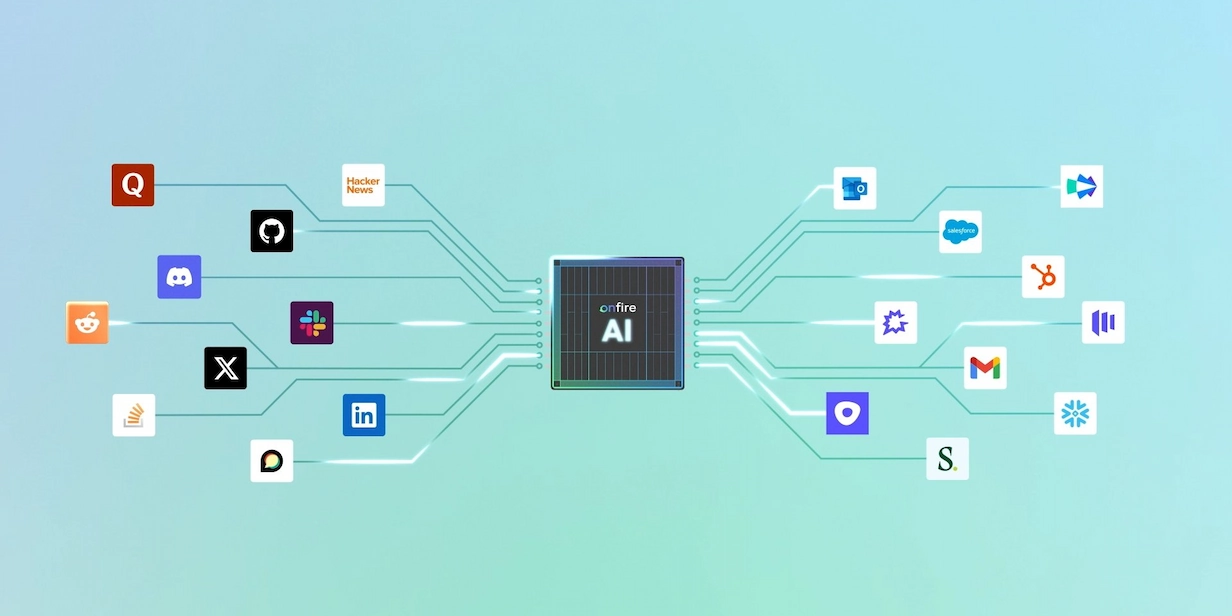
Onfire is built as a vertical AI platform for companies selling to engineering, data, and security teams. Its Account Intelligence Graph combines third-party signals (community activity, OSS contributions, conference attendance, technographics) with each customer's first-party CRM and product data, mapped to specific people inside specific accounts. Setup typically takes days rather than months, and Onfire integrates with Salesforce, HubSpot, Outreach, Salesloft, and Sales Navigator so the prioritized list shows up in the tools your reps already use.
2. 6sense
6sense builds predictive models that combine third-party intent data with first-party engagement to identify in-market accounts. It segments accounts by buying stage, surfaces engagement spikes, and feeds scored lists into ad and outreach orchestration.
However, the data behind the score leans on IP-based web tracking, ad engagement, and content syndication, so it’s best for accounts that engage with vendor websites and gated content. With technical accounts, it misses things that matter greatly, like open source software downloads and community discussions. We've covered this trade-off in detail in our Onfire vs. 6sense comparison.
3. Demandbase
Demandbase competes directly with 6sense, and the two are often shortlisted together. Demandbase puts more weight on the execution layer (advertising orchestration, account journeys, sales engagement workflows) alongside its scoring models. Like 6sense, Demandbase's predictive scoring is built largely on web behavior, third-party intent, and firmographic data. Demandbase does well for marketing-led organizations with significant content and advertising investment, where there's enough first-party engagement to feed the model.
4. HubSpot Predictive Lead Scoring
HubSpot's predictive lead scoring sits inside the HubSpot CRM and uses machine learning to score contacts based on properties and behavior tracked there. If you're already standardized on HubSpot, it offers minimal integration work. However, the model is only as informative as the data flowing into HubSpot.
If your team has rich form fills, email engagement, and website activity, you'll see useful predictions. If your first-party data is thin, the scores will be too. HubSpot's scoring also doesn't pull in external signals like community activity, OSS contributions, or third-party intent. It ranks what you already have, rather than helping you find what you're missing.
5. Salesforce Einstein Lead Scoring
Einstein Lead Scoring is Salesforce's scoring product, sold as part of Sales Cloud. It analyzes historical conversion patterns in your Salesforce instance and ranks new leads against the profile of leads that have closed in the past. If you have years of clean Salesforce data and consistent rep behavior, this can make sense. However, somewhat like HubSpot’s lead scoring offer, Einstein can only see what's in Salesforce. If your reps don't log activities consistently, or your data hygiene is patchy, or you've recently shifted ICP, the model has less to work with.
6. Apollo
Apollo combines a contact database, sequencing tool, and basic AI scoring in a single platform. Its scoring leans on engagement signals (email opens, replies, meetings booked) and firmographic fit, with optional intent data layered on top.
Apollo's contact data is broad but relies on the same public-web sources as most data providers, which means technographics are inferred from job posts and similar signals. If your motion depends on knowing exactly which technologies an account uses or who the technical champion is, Apollo won’t be able to do it all for you.
Which Lead Scoring Tool Is Right for Your Team
No tool wins every comparison. The right answer depends on what you sell, who you sell to, and where your data already lives.
To narrow it down, start with where your buyers actually research. If most engage with vendor content and ads, the ABM platforms work. If most are already in your CRM, the native scorers do the job. If most are technical buyers, you need a platform built around technical GTM motions.
Onfire: Lead Scoring Built for Technical Buyers
If you sell to engineering, security, or data teams, book a demo and bring an account list you're working today. We'll show you what the score looks like when it's built with the challenges of selling software infrastructure in mind.
FAQ
What is AI lead scoring and how does it work for B2B sales?
AI lead scoring uses machine learning to rank leads by likelihood to convert. The model ingests behavioral, firmographic, and intent signals (web activity, product usage, technographics, engagement history) and weights them against historical patterns of closed-won deals. The output is a prioritized list your reps work top-down rather than guessing.
How is automated lead scoring different from traditional lead scoring?
Traditional lead scoring relies on rules you set up manually, with fixed point values for actions like a demo request or pricing page visit. Automated scoring learns from outcomes instead. The model continuously adjusts weighting based on which leads converted, picking up patterns a human wouldn't think to encode.
Can lead scoring tools integrate with my existing CRM?
Yes. Most platforms integrate natively with Salesforce and HubSpot, and many also push into Outreach, Salesloft, or Sales Navigator. Look for integrations that write the score and ranked list directly into the rep's CRM view, not just into a separate dashboard your reps have to remember to check.
What's the difference between account-level and prospect-level lead scoring?
Account-level scoring ranks companies by buying intent, which is useful for ABM motions. Prospect-level scoring ranks individual people inside those accounts. Most B2B teams need both. Knowing an account is in-market is only half the work; you still need the specific person who'll champion the deal.
How do I know if my team is ready to use a lead scoring platform?
You need three things: a defined ICP, enough historical conversion data for the model to learn from, and a workflow where your reps will actually act on the prioritized list. Without all three, AI scoring tools are going to be unhelpful.
.webp)





%20(1).webp)
















































.webp)