The Best B2B Buying Signal Tools in 2026
Intent signals can make or break your sales motion - but you need to separate signal from noise.
%20(1).webp)


A B2B buying signal tool is software that detects evidence that an account is moving toward a purchase, ties that evidence to a named account or person, and delivers it to the people who will act on it. A contact database tells you who exists; a sequencer sends the email. Buying signal software sits between the two and decides who your reps should talk to this week.
With outreach volume climbing and reply rates falling, most reps know exactly why their pipeline isn't building the way it used to: they're spending their day on accounts that aren't ready to buy, with messages that don't land because the timing is wrong.
In theory, buying signals should change that. If you track the right ones, your team should be able to stop casting wide nets and start having timely conversations with the people who actually need what you sell. That's how modern revenue teams compete on value rather than volume.
This article covers the buying signal tools worth evaluating in 2026, what to look for when choosing one, and how to match a tool to your specific go-to-market motion.
Key Takeaways
- Buying signal tools help you time outreach so you reach the people who are in market this week, with evidence for why.
- Signal type depends on who you sell to. Generic intent scores work for some markets; technical buyers need community, OSS, and event signals that traditional platforms don't track.
- First-party + third-party fusion beats either alone. Your CRM and product usage data become much more useful when combined with external buying signals.
- The best tools automate the work around the signal, not just the signal itself: lead prioritization, account research, and integration with the systems your reps already use.
What Are B2B Buying Signals?
A buying signal is any piece of evidence that a person or account is more likely to buy something right now than they were yesterday. The category breaks down in a few different ways.
First-party signals come from your own systems: a prospect downloads a whitepaper, signs up for a free trial, or starts using a feature that historically correlates with upgrades. On the plus side, you own this data, and it's usually the most reliable. However, it only covers people who have already engaged with you.
Third-party signals come from external sources, and the category is broader:
- Engagement signals: page visits, content downloads, ad interactions
- Hiring and org signals: a company posting roles for a security architect, a champion changing jobs and joining a new account
- Community and technical signals: GitHub activity, Stack Overflow questions, Slack and Discord discussions, conference attendance
- Technographic shifts: a target account adopting (or churning from) a related technology
Signal type matters depending on who you sell to. If you're selling marketing automation to mid-market CMOs, IP-based intent and content engagement go a long way. If you're selling a database tool to engineers, those same signals will miss most of your real buyers.
After all, technical audiences research in semi-anonymous communities, not on vendor websites. Picking a signal tool that has a blind spot right where your buyers actually spend their time is one of the most common mistakes GTM teams make.
What to Look For in a Buying Signal Tool
A few things separate a useful signal platform from one that just adds another dashboard.
Coverage of the channels where your buyers actually are. A signal you can't see is a deal you can't catch. If your buyers research in technical communities and your tool only tracks website visits, you're missing the early part of the buying cycle, which is the part where you can still shape the conversation.
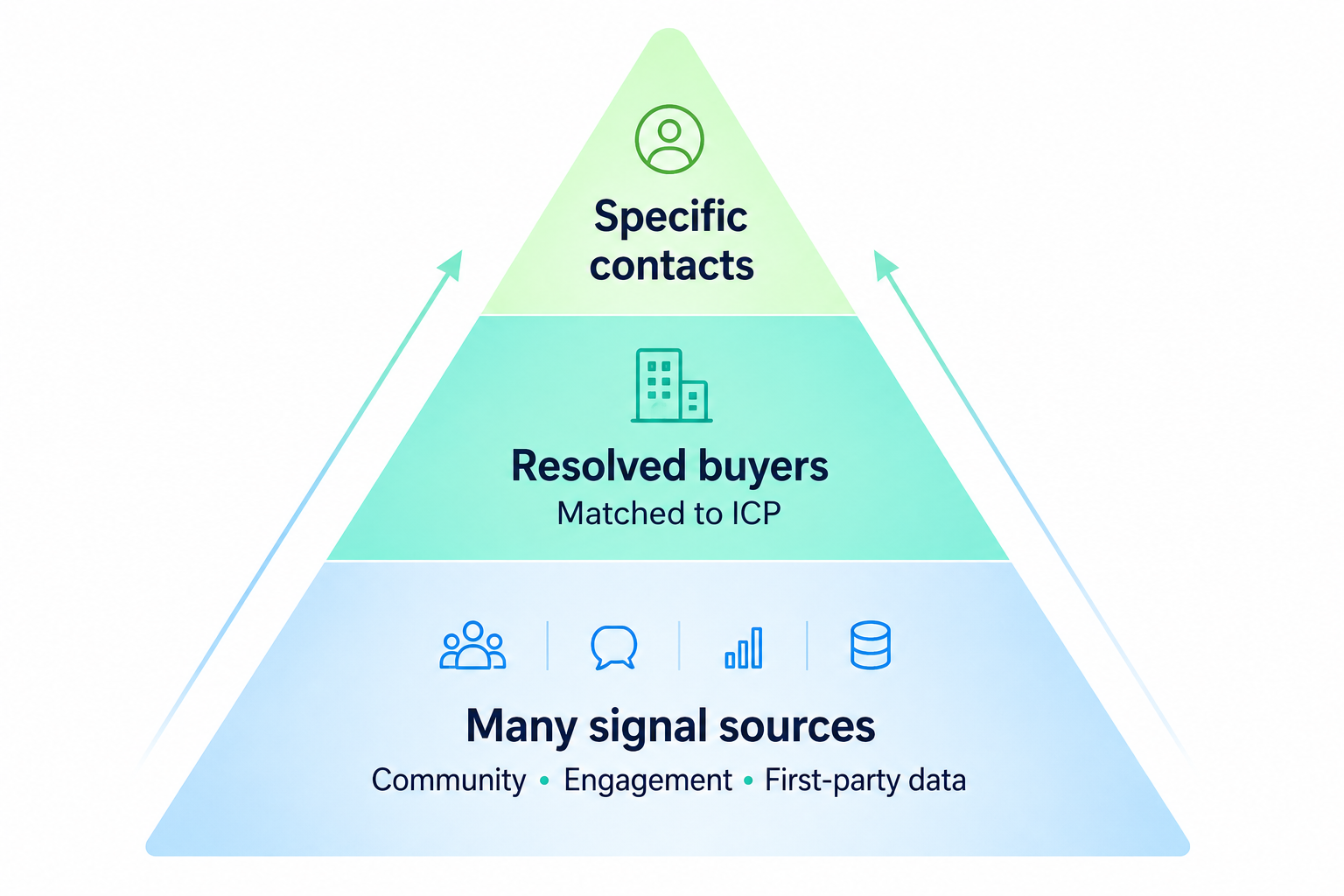
Identity resolution that connects signals to real people. Knowing "someone from Capital One looked at your pricing page" doesn't tell a BDR who to call. A good tool resolves activity back to specific accounts and, where possible, specific buyers. This includes anonymous or pseudonymous activity in places like Reddit or Stack Overflow.
First-party data fusion. The strongest signals come from combining what you already know about an account (CRM history, product usage, past conversations) with external activity. A tool that ignores your own data is leaving most of the picture out.
A path from signal to action. Surfacing signals isn't enough. To ensure use, your reps need signals in the tools they already use, prioritized in a way that reflects your ICP and sales motion. Interesting data points aren’t useful on their own.
The result should look something like this:
The Best B2B Buying Signal Tools in 2026
1. Onfire
Onfire is a vertical AI platform built for software infrastructure companies. It delivers SDRs a prioritized list of accounts and prospects each morning, tailored to each customer's ICP and sales motion, so reps spend their day on conversations rather than research.
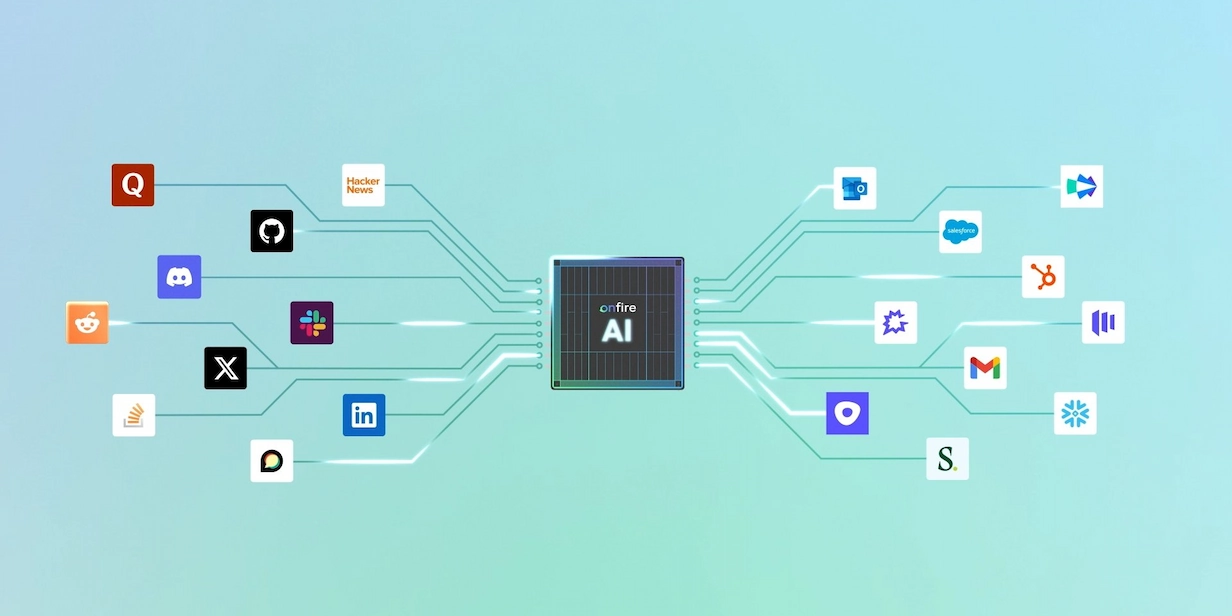
What sets it apart is the data foundation. Onfire tracks over 100,000 communities (Stack Overflow, Reddit, Discord, Slack, X, Hacker News) along with OSS contributions and technical event attendance. Proprietary identity resolution connects anonymous and pseudonymous activity back to real prospects, and the platform combines that with each customer's first-party data to produce an Account Intelligence Graph tailored to their GTM.
2. 6sense
6sense is a legacy intent and ABM platform. It uses IP-based tracking and a large data co-op to identify accounts researching solutions in your category, scores them by buying stage, and feeds that into ABM campaigns and outbound prioritization. It works well for teams selling horizontal SaaS to mid-market and enterprise buyers who do most of their research on vendor websites and review sites.
Where it struggles is with technical and developer-focused audiences. Those buyers don't show up well in IP-based tracking, and account-level intent scores often don't tell a BDR which specific person to contact.
3. Demandbase
Demandbase plays in the same ABM and intent space as 6sense, with similar strengths: account identification, intent scoring, advertising integration, and workflow tools for marketing and sales alignment.
That means the same caveat applies. Intent scoring at the account level is useful for orchestrating campaigns but doesn't replace prospect-level intelligence, especially for technical sales motions where the buying committee can be hard to identify from job titles alone.
4. Bombora
Bombora is the third-party intent data provider that powers many other platforms behind the scenes. It aggregates content consumption signals across a publisher network and surfaces topics each account is "surging" on. You can use it directly or consume its data through integrations with platforms like ZoomInfo, Salesloft, and HubSpot.
It's a foundational layer rather than a complete workflow, and the signals are coarse, so while they can be useful for territory planning and prioritization, they’re less useful for telling a rep what to say in a specific conversation.
5. UserGems
UserGems focuses on a specific category of signal: job changes. When a champion or past customer moves to a new company, that's often a strong outbound signal because they already know your product, and they have a problem you can solve in their new role. UserGems tracks these moves and pushes them into your CRM and outreach tools.
6. Clay
Clay isn't a signal source on its own. Instead, it's an orchestration platform that lets RevOps teams and "GTM engineers" combine data from many sources, run AI-driven enrichment, and build custom workflows. You can plug Bombora intent into Clay, mix it with LinkedIn data, run an LLM over the result, and push the output to Salesforce.
Clay amplifies whatever data you feed it. If your underlying signals are wrong or shallow, the workflow just produces personalized outreach to the wrong people, faster.
Using Buying Signals Inside an AI Agent
Most teams now do at least part of their account research in Claude or ChatGPT. A buying signal tool that only lives in its own dashboard leaves that work stranded. Look for a vendor with an MCP server, the open standard that lets an agent query a data source directly.
For example, you can use the Onfire connector for Claude to enable your AI agents to pull an account's stack, team structure, likely champions, and recent buying signals in a single prompt, then rank accounts or draft outreach from the result. It works in Claude (web, Code, and Cowork), ChatGPT, Gemini, and any other MCP-compatible agent.
You can use a prompt such as: Take my current accounts, prioritize them by signals and ICP fit from Onfire, give me the top 10, and draft a first message for each. The signal is one input here. The agent also sees the stack, the team, and the person who would own the decision, which is what turns a signal into a conversation.
Which Signal Tracking Tool Fits Your GTM Motion?
The right tool depends on who you sell to and how you sell. A few rough heuristics:
Choose Buying Signal Software for Your Motion
When it comes to signals, what matters isn’t so much quantity as the way your reps can act on them. If they have to sort through multiple tools to pull everything together, they’ll likely miss opportunities. But if all they have to do is login to their CRM to see a prioritized list of prospects they can reach out to, then you don’t have to worry about gold getting buried under the noise.
If you're selling software infrastructure and want to see what your motion looks like when revenue intel is built into your CRM, book a demo.
FAQs
What are B2B buying signals and why do they matter for sales teams?
Buying signals are evidence that a person or account is more likely to buy than they were before. They include research activity, hiring patterns, technology adoption, and community discussions. These matter because most accounts aren't in market at any given time. Signals help reps focus on the share where a conversation can actually go somewhere.
What's the difference between first-party and third-party buying signals?
First-party signals come from your own systems: CRM activity, product usage, content downloads, email engagement. Third-party signals come from external sources: review sites, communities, conferences, hiring data, intent data co-ops. The most useful GTM motions combine both — first-party signals tell you who's engaged with you, third-party signals tell you who's about to be.
Can signal tracking tools integrate with my CRM and sales engagement tools?
Most modern signal platforms integrate with Salesforce, HubSpot, Outreach, and Salesloft as a baseline. However, coverage of newer AI-native tools varies.
How do signal-based marketing tools improve outreach timing?
Timing is one of the biggest predictors of reply rates. Signals like a champion changing jobs, an account hiring for a relevant role, or an engineer asking about your category in a community let reps reach out during the narrow window when the buyer is thinking about the problem. Timely, relevant outreach consistently outperforms cold outreach to a longer list.
Are there buying signal tools built specifically for technical or developer-focused sales?
Yes. Onfire is purpose-built for software infrastructure companies selling to engineers, data teams, and security professionals. It tracks community activity, OSS contributions, and technical event attendance, which are the channels where technical buyers actually research, and resolves anonymous activity back to specific buyers within target accounts. Generic intent platforms tend to miss this audience entirely.
If you're selling to technical buyers and want to see what tailored signal tracking looks like for your specific motion, book a demo or read more about the Onfire data advantage.
.webp)



























































.webp)