How to Elevate Your Account Intelligence With Company Data Enrichment



Company data enrichment comes in layers. While basic info like firm size and industry often come built-in to your CRM, drilling down into technographics, projects, and prospect-level data is harder.
This article walks through how to think about company data enrichment as the foundation underneath everything else in your GTM motion. It covers the data that actually matter, how to build a workflow that ties account information to specific actions, and the mistakes that often waste pipeline budgets.
Key Takeaways
- Company data enrichment lets you identify ICP fit, prioritization, and account-level intent.
- Basic firmographics are commoditized. The differentiation today is in technographics, OSS activity, and deanonymization, which are also the hardest to get right.
- For technical GTM, the highest-value enrichment goes beyond the company level. It lets you drill from account → buying committee → champion, with evidence behind each step.
- AI agents are only as good as the data they sit on top of. Outdated company data will reliably train automated workflows to make the wrong decisions faster than any human can catch them.
- A workable enrichment process combines multiple data types, refreshes them on a sensible cadence, and feeds the output directly into your reps' existing tools.
Contact Enrichment vs. Company Data Enrichment
Both fall under the "data enrichment" umbrella, but they solve different problems and lean on different sources.
Contact enrichment is about filling in what you know about a specific person. You might start from an email, but you want to add a phone number, a LinkedIn URL, a job title, and maybe a recent role change.
Company data enrichment is about filling in what you know about an account. You may start with a domain or company name, and you’ll need size, industry, tech stack, recent funding, hiring activity, locations, and so on to be able to sell effectively.
Many of the high-leverage GTM decisions happen at the company level. Is this account ICP-fit? Are they likely in-market? Do they use the technology our product complements or replaces? Should we run an ABM play here?
Every one of these is a question about the company, not the person. Contact enrichment matters once you've decided to act on an account but company enrichment is what tells you whether to act in the first place.
That's why getting company data right is the more consequential of the two — a wrong phone number costs you one call, while wrong account-level data can send your team chasing the wrong companies for months.
The Company-Level Data That Drives Account Intelligence
Company enrichment isn't one thing — it's a collection of data, each coming from different sources and serving a different role in your GTM motion.
- Basic firmographics: industry, employee count, location, revenue band, parent company.
- Firmographic changes and funding events: changes matter more than the static values.
- Hiring velocity: a coarse indicator of growth and where investment is flowing, but a poor proxy for technographics.
- Technographics: which technologies a company uses, how heavily, and where in the org.
- Intent: Is the company actively buying a solution? Are there signals that indicate a need for the type of technology you offer? For technical products, this can often be inferred from OSS activity and discussions in engineering communities.
Good enrichment tools automatically answer questions you might have at all points in this stack, ranging from whether a company received Series B funding to who sits on a buying committee.
Why Company Data Enrichment Matters More for Technical and Developer-Focused GTM
For most B2B sales motions, you can get away with weak company data and lean on your reps to fill the gaps. After all, if you’re selling HR software to a 2,000-person manufacturer, you probably don't need to know which database they run. Industry, size, and a couple of intent signals will carry you most of the way.
Selling to technical buyers is different. The viability of an entire deal often hinges on details that don't show up in standard firmographics:
- Whether the prospect actually runs the technology your product is built for (and how heavily)
- Which team inside the company owns that technology
- Whether the people on that team have evaluated competitors recently
- Whether the broader engineering org is in build-vs-buy mode right now
None of these are answered by basic firmographics. They require granular technographic data, evidence of where workloads run, and visibility into how engineering teams actually talk and work.
How to Build a Company Data Enrichment Workflow for Your B2B Pipeline
Here’s how to build a workflow that produces accurate, actionable account intelligence rather than another sprawling CRM field set:
1. Define what you actually need to know
Start from the questions your reps are trying to answer. Not "what data fields can we collect" but "what do we need to know about an account to decide whether to pursue it and how to engage". The answers will vary by GTM motion, but typically include:
- Does this account fit our ICP firmographically and technographically?
- Are there signals they're in-market right now?
- Who in the org is the likely buying committee?
- Who is the most plausible champion?
Build your enrichment around those four questions.
2. Map data types to your ICP
For each question above, pick the data type that answers it best. For instance, you might choose funding and hiring velocity for growth and budget, and OSS and community activity for technical use and live intent.
3. Set freshness expectations
Company size changes slowly, but technographics change faster than people think, particularly in the AI era. That means that while you can afford to update firmographics monthly, you need a weekly cadence for technographics and a daily refresh for intent signals.
4. Drill from company → buying committee → champion
Most enrichment workflows stop at the company level, but that’s really just the beginning. Once you've identified an in-market account, the workflow has to surface the buying committee (the people likely involved in the decision) and the champion (the person most likely to push the deal forward).

💡 To drill from company to person, you’ll need data at both levels. You need to know not just that an account runs managed Kubernetes, but who specifically inside the account is responsible for it. That's where community activity, OSS contributions, and conference attendance tie technology choices to specific people rather than just job titles.
5. Push the output to the tools your reps already use
The best enrichment workflow in the world fails if reps have to context-switch into a separate UI to use it. The enriched data should land wherever they’re already working, whether that’s in their CRM, their outbound sequencer, or their LinkedIn Sales Navigator. The morning view for a BDR should be a prioritized list of accounts and people to act on, not a dashboard to interpret.
6. Plan for AI agents on top of your data
As AI agents take over more of the marketing and sales workflow in the form of automated email follow-ups, lead scoring updates, account routing, and sequence personalization, the cost of bad company data goes up sharply. A human rep looking at stale technographics will usually catch the mistake and adjust, but an AI agent running an automated nurture sequence will dutifully send the wrong message to the wrong person, then re-run the same flawed logic next week. We've written more on this dynamic in our piece on AI-led growth.
Common Mistakes Teams Make With Company Data Enrichment
These are mistakes we’ve run into in hundreds of conversations:
- Treating enrichment as a one-time event. Data is enriched at lead-creation and then never refreshed. Six months later, the technographics are stale, the head of engineering left, and the company tripled its cloud footprint, but that doesn’t show up anywhere in the CRM.
- Stopping at the company level. Account-level data is necessary but not sufficient. If your workflow ends at "this company is a fit", you've handed your reps a list of names and told them to figure out who matters. That's where 80% of their time goes.
- Trusting technographic data sourced from job posts. Job descriptions are written by HR to attract candidates, not to accurately describe production stacks. Tools that infer technographics this way are guessing more than they admit.
- Buying enrichment for fields you don't actually use. Plenty of teams pay for 200 enrichment fields and use 12. The rest creates noise, slows down reps, and inflates renewal invoices.
- Skipping data validation. Enrichment vendors will happily quote 95% accuracy. The right question is: accurate compared to what? Spot-check against your closed-won accounts during a PoV before committing.
- Layering AI on top of bad data. Running personalization, scoring, or agentic workflows on weak company data doesn't fix the data, it just amplifies the errors.
See What Onfire Adds to Your Account Data
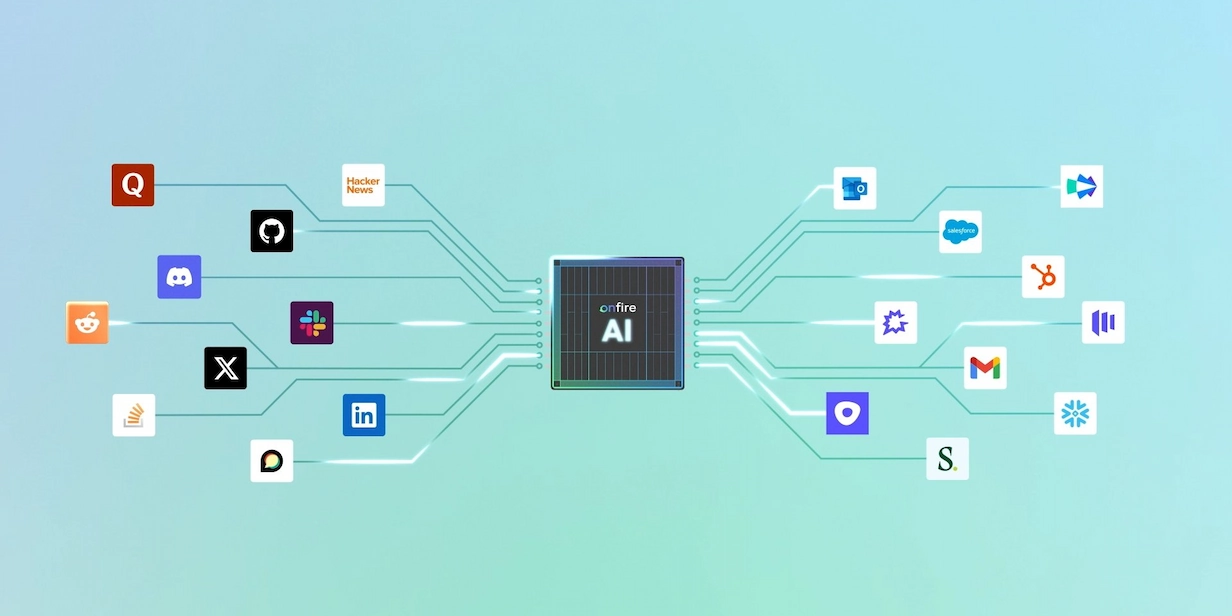
Onfire is built for revenue teams that take company-level intelligence seriously, especially those selling to technical buyers, where standard enrichment falls short. We combine your first-party CRM data with technographics, OSS activity, community data, and event attendance to build an Account Intelligence Graph that goes from company down to the specific champion your reps should reach today. If you want to see what your accounts look like at that granularity, get in touch.
FAQs
How often should company data enrichment be refreshed to stay accurate?
It depends on the data. Firmographics like company size and headquarters change slowly and can be refreshed monthly or quarterly. Technographics, hiring activity, and funding events move faster and should be refreshed weekly. Intent and community signals lose value within days, so they need to be near-real-time to be useful for outbound prioritization.
Which company-level data fields matter most when scoring accounts for outbound?
For technical GTM, technographics and in-market data are the highest leverage. Knowing a company actually uses the technology your product is built for matters more than industry codes or revenue bands, and recent community or OSS activity tied to your category is the strongest indicator that they're evaluating now. Funding and hiring velocity are useful secondary signals for budget and growth context.
Can company data enrichment replace intent data, or do the two serve different purposes?
They're complementary. Enrichment tells you whether an account fits your ICP, and intent data tells you whether they're in-market right now. Without enrichment, your intent data points at companies you don't want to sell to. Without intent, your enrichment gives you a clean list with no idea when to act.
How do you handle company data enrichment when your ICP spans very different company sizes?
Tier your ICP and tune your enrichment to each tier. For SMB and mid-market, basic firmographics plus one or two technical signals usually suffice. For enterprise, you need much deeper account intelligence to figure out which teams own which technologies, who reports to whom, where workloads run by region or business unit. The data you collect should match the granularity your reps need to make decisions at each tier.
What's the best way to validate that enriched company data is actually improving pipeline quality?
Track downstream outcomes, not data field completeness. Compare reply rates, meeting-set rates, and opportunity conversion for accounts enriched with the new data against a control group. What matters is whether your team is reaching the right accounts and people more often, not whether the CRM looks tidier.
.webp)









%20(1).webp)















































.webp)