Top 7 Firmographic Data Providers (And Why You Might Not Need Them)



Firmographics are essential, but do your SDRs need a dedicated firmographic data provider? In 2026, the answer may be “no.” This article explains what firmographic data is, what its limits are, and seven providers worth evaluating in 2026.
Key Takeaways:
- Firmographic data (size, industry, revenue, location) is the entry-level filter for outbound and ABM. It disqualifies obvious non-buyers but does little to qualify or prioritize the accounts that remain.
- For basic firmographics, you may not need a paid tool. Most CRMs include the data, and a tool like Claude Code can generate a clean, CRM-ready list for free.
- The value shows up when firmographics are combined with technographic and intent data and resolved to the actual buyer, which is what separates a fit from a deal.
What Is Firmographic Data
Firmographic data describes a company's observable attributes, like industry, headcount, revenue, location, and ownership. You need it to hone in on the companies that are likely to buy what you sell. For example, if you sell a cybersecurity solution that costs $300K per annum, it’s unlikely that you will manage to sell it to a 10-person startup without a dedicated security team. Similarly, if your solution requires a lot of hands-on implementation, it might be difficult to support customers in regions where you do not have a local presence.
Types of Firmographic Data
Firmographic data will typically cover the following categories:
- Number of employees, often with band ranges and headcount growth trends
- Annual revenue or revenue range
- Industry classification (SIC, NAICS, or a vendor's own taxonomy)
- Headquarters location and office geographies
- Company age or founding year
- Ownership structure (public, private, PE-backed, subsidiary)
- Corporate hierarchy (parent companies, subsidiaries, family trees)
- Funding stage and recent funding events, for private companies
Together these fields make it possible to segment, dividing your market into groups you can target, route to reps, and report.
Benefits and Limitations of Firmographic Targeting
Firmographics can be seen as a “floor” - a company that does not meet your firmographic criteria can likely be disqualified. But it is rarely enough to qualify a company. A bank with 10,000 employees and a billion dollars in revenue is a firmographic match for plenty of enterprise software, but that does not mean that every bank is in-market for your solution. To understand that, you need to combine two more types of data:
- Technographic data, which is about the technology the company runs (cloud provider, database, observability stack).
- Intent data, which is about behavior (research activity, content consumption, community discussion) that suggests a company is in market.
Firmographics do not tell you whether a company needs what you sell, runs a stack you integrate with, or has anyone evaluating a purchase right now. A 2,000-person fintech in your target region might be a firmographic match, but so are the other 4,000 companies that share those attributes. Firmographic targeting can't rank them because every account on the list looks identical on paper.
To qualify and prioritize, you to layer in technographic and intent data, your sales team can get a clearer signal as whether it’s worth reaching out to a specific company or prospect. Combining a broad range of signals across firmographic, technographic, and intent data - analyzed, ranked, and contextualized in light of your specific sales motion and target market - can help you build an actionable picture of your buyer.
So firmographics are necessary, but they’re rarely sufficient.
Do You Need a Firmographic Data Provider?
If the only thing you want is company size, industry, and location, you may not need to pay for a separate firmographic tool.
Most modern CRMs already handle basic B2B data enrichment. Salesforce, HubSpot, and others fill in headcount, industry, and location on the accounts you create, either natively or through a low-cost add-on. For a lot of teams, that covers the firmographic layer entirely.
When it doesn't, the data is now cheap to assemble yourself. Firmographic attributes are public information, so an agentic tool like Claude Code can pull together a structured list of companies that match your criteria, complete with headcount, industry, and location, and hand it back as a CSV you drop straight into your CRM. This task is now so simple that you can do it without an annual contract and without per-credit billing.
For example, Claude Opus 4.8 (in Cowork) one-shots this request to create a list based on firmographic filters:
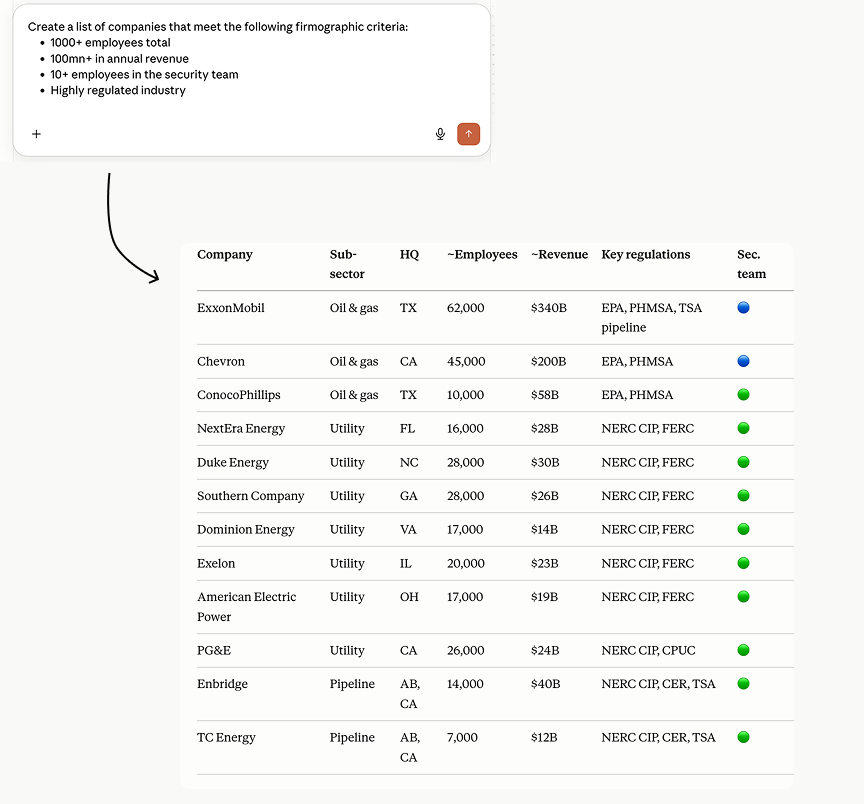
(To see an example of prompts that Claude can’t one-shot without external data, check out our blog on connecting Onfire to Claude and ChatGPT)
The firmographic layer on its own is close to commodified, and paying a dedicated firmographic data provider for it often means paying for something you can already get at a much lower cost.
The real value of firmographics comes from combining firmographic, technographic, and intent data in a single platform that knows your business. It’s that context that tells you which of the “right-shaped companies” are worth your rep's time this week.
That combination is why we built Onfire to help teams selling software infrastructure hone in on elusive technical buyers. Onfire starts from your specific GTM motion, filters for firmographic and technographic fit, layers in intent signals from the places technical buyers actually talk (open source activity, developer communities, conferences), and resolves all of it to the specific people inside an account who drive the buying decision. And it works with the tools you’re already using, including Claude Cowork.
Top 7 Firmographic Data Providers Worth Evaluating in 2026
If you've decided you want a dedicated provider, these seven are worth a look. We've left out the obvious volume databases (ZoomInfo, Apollo) to focus on tools with a clearer point of view, including a few that pair firmographics with something more.
1. Onfire
Onfire is a revenue intelligence that understands your business context and layers in data enrichment that fits your GTM motion. For teams selling to engineering, data, or security leaders, it answers the question firmographics can't: which of the right-shaped accounts are actually in market, and who to reach out to. Spectro Cloud used it to generate over $1.65M in new pipeline and cut time-to-opportunity by 30%.
2. HubSpot
HubSpot acquired Clearbit in 2023, and since then, it enriches CRM records with firmographic and technographic fields and identifies anonymous website visitors by company. For teams already on HubSpot, the enrichment happens natively inside the records and workflows they already use.
3. LinkedIn Sales Navigator
Sales Navigator sits on top of LinkedIn's member graph, which is user-maintained and therefore fresher than most scraped databases. Its account filters cover firmographics (size, industry, geography), its lead filters cover persona, and alerts fire on job changes and funding events. That means it tells you who fits, not who's buying.
4. Bombora
Bombora is built on a consent-based co-op of thousands of B2B publisher sites. Its Company Surge product flags when an account's research on a topic spikes above its baseline, and it enriches those signals with firmographic attributes so you can filter surging accounts by fit. However, signals are company-level, so you learn the account is surging, not who is doing the reading.
5. Crunchbase
Crunchbase pairs firmographic profiles with funding and investor data that covers more than 4 million private companies. Recent funding rounds, leadership changes, and acquisitions work as buying signals, and saved searches with alerts run passively. However, its contact data is inconsistent and its data doesn’t reach the prospect level.
6. Dun & Bradstreet (D&B Hoovers)
D&B Hoovers is a legacy firmographic platform anchored to the D-U-N-S numbering system across hundreds of millions of company records. It has in-depth corporate hierarchy and private-company financial data, but the firmographic records are static rather than signal-driven.
7. Coresignal
Coresignal delivers raw firmographic data (alongside employee and job posting data) through APIs and flat files, with headcount trends, funding, and technographic fields across 100M+ company records. It's built for teams that want to assemble their own enrichment pipeline rather than work inside someone else's interface.
Firmographic Data Providers, Side By Side
Which Provider Fits Which Type of Sales Team
You can match most teams to a provider without sitting through a single demo:
- Selling to technical buyers (dev tools, data, security, FinOps): Onfire. You need firmographics plus technographics plus intent, resolved to the actual buyer, not another company list.
- Already standardized on HubSpot: HubSpot. Native enrichment beats a separate contract when you mostly need to fill in fields.
- Manual, relationship-led outbound: LinkedIn Sales Navigator. Fresh people data and a familiar interface for reps who work account by account.
- Mature ABM and demand gen with a full stack: Bombora. Layer third-party intent onto firmographic lists you already build elsewhere.
- Selling into startups and growth-stage companies: Crunchbase. Funding events are your buying trigger, and Crunchbase tracks them best.
- Enterprise account planning and global territories: D&B Hoovers. Authoritative firmographics and corporate hierarchies for complex orgs.
- Building your own data pipeline: Coresignal. Raw firmographic data via API for teams with engineering resources to spare.
See What Firmographics Miss
Firmographic data tells you which companies could buy. It can't tell you which ones are about to. If you sell to technical buyers, book a demo and we'll show you the accounts that fit, the signals that say they're in market, and the specific people to reach.
FAQ
1. How often does firmographic data go out of date?
Firmographic attributes shift constantly. Companies hire, restructure, relocate, get acquired, and change revenue every quarter. Providers that refresh continuously stay closer to reality than ones updated in batches, but any firmographic record is worth re-verifying before high-priority outreach.
2. Do AI tools replace firmographic data providers?
For basic firmographics, increasingly yes. Company size, industry, and location are public, and a tool like Claude Code can compile a structured, CRM-ready list from a plain-language prompt at no per-record cost. What AI doesn't replace on its own is the combination of firmographics with technographic and intent data, resolved to the specific buyer. That combination is where dedicated platforms still earn their place.
3. What's the difference between a firmographic data provider and a B2B database?
A firmographic data provider specializes in company-level attributes: size, industry, revenue, location, hierarchy. A B2B database is usually broader, pairing those firmographics with contact records (names, titles, emails, phone numbers) and sometimes intent or technographic data. Many large providers do both.
4. Do smaller companies appear accurately in firmographic databases?
Less reliably than large ones. Most firmographic data is inferred from public sources, and small or private companies leave a thinner trail, so headcount, revenue, and industry fields are more likely to be stale or estimated. Coverage also skews toward the US and English-speaking markets. For SMB targeting, expect to verify records and supplement with first-party data.
.webp)







%20(1).webp)



















































.webp)