What Is Account-Based Intelligence? A Modern GTM Guide for Technical Sales Teams



If you’re still guessing your way through outreach, you’re missing account-based intelligence. Before you pick up the phone, you should know three things: which account to contact, which individuals to speak to, and how you can start the conversation with value.
In this article, we’ll break down how account intelligence helps you get there.
Key Takeaways:
- Account based intelligence pulls firmographics, technographics, buyer intent signals, and buying committee data into one view of which accounts deserve attention and why.
- Agentic AI workflows can deliver account intelligence much faster than manual research, and far more accurately than legacy sales intel platforms.
- The payoff is value, not volume. Connecting scattered clues into account scoring you can act on beats another export of a thousand look-alike companies.
A Quick and Simple Definition of Account-Based Intelligence
Account intelligence is everything that can be known about a target account. Rather than treating a single lead or a single campaign as the unit of work, account intelligence organizes around the company: what it is, what it runs, who sits on the buying committee, and whether it shows signs of being in-market.
That may be easier said than done. To get a complete picture of each of your accounts, you need to combine both first party and third party data, that is, data that lives in your CRM and data from the web. By pulling it all together, you can improve the precision of your outreach. But in traditional workflows, that task consumed as much time as selling, if not more.
The Data Layers That Make Account Intelligence Work
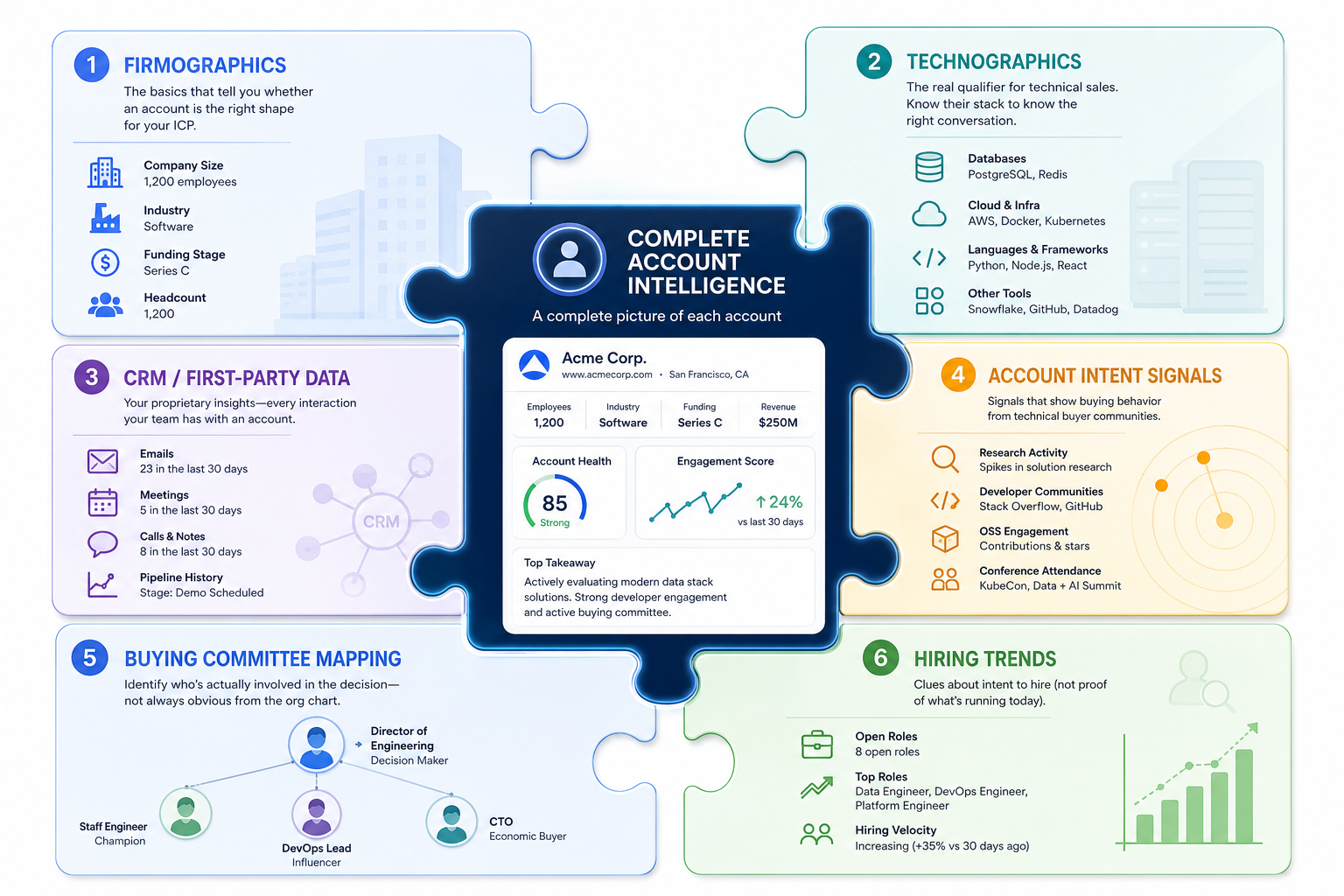
Account intelligence is painstaking to assemble manually because it relies on many distinct types of data:
Firmographics are the basics: company size, industry, funding stage, headcount. They tell you whether an account is the right shape for your ICP.
Technographics are the real qualifier for technical sales. If you sell a database migration tool, an account on MySQL is a different conversation than one on MongoDB. The problem is that most providers infer technographics from job descriptions and scraped front-end code, which means the data is often months old and frequently wrong. Instead, you need observed behavior like OSS commits and container registries.
First-party data from your CRM is an important part of the picture. Every interaction your team has with an account should inform your account intel. A good agentic workflow can automatically combine your proprietary insights with third-party data for account research and prioritization.
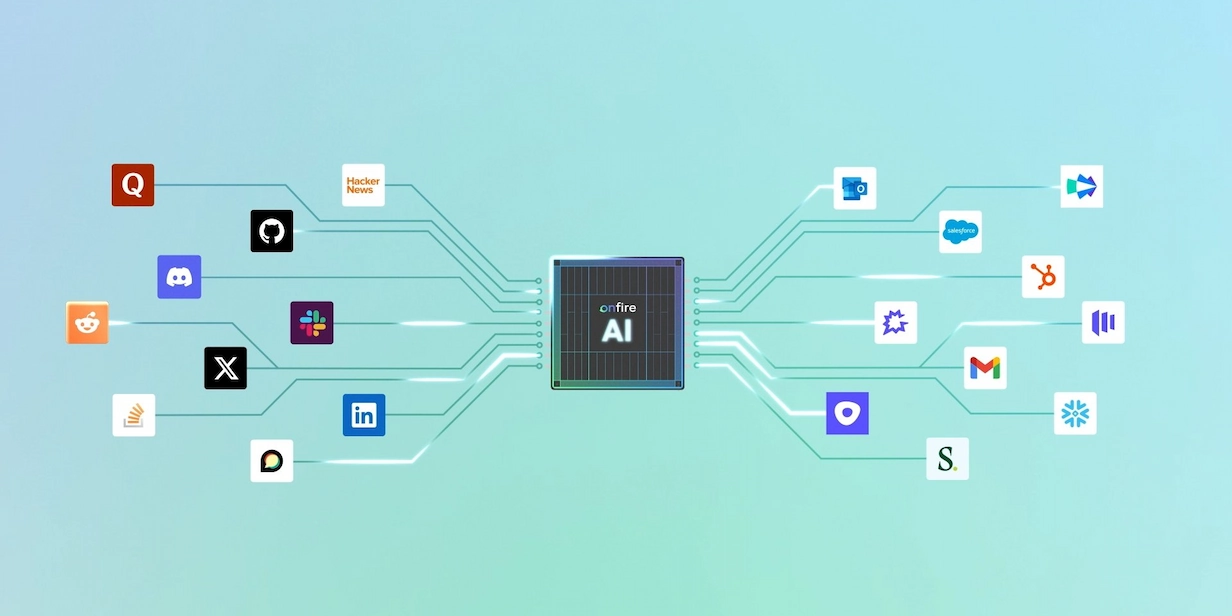
Account-level intent, made up of buyer intent signals, tells you whether a company is showing the behavior of a team that's evaluating. For technical buyers, those signals show up in developer communities, Stack Overflow threads, OSS activity, and conference session attendance.
Buying committee mapping identifies who's actually involved in the decision. For technical products the committee is rarely obvious from the org chart, which is a problem we'll come back to.
Hiring trends get cited a lot, and they're worth understanding because they're weaker than they look. A req for a Splunk admin or a Snowflake engineer is a clue, but it's a clue about intent to hire, not proof of what's running today.
While each of these data points is tangible, their value for your specific GTM motion is not pre-given. Instead, the weight and meaning of each of these pieces of information has to be evaluated in light of your goals. When you do that, you can walk away with account scores that reflect your company’s needs.
And there’s another data-driven task that operates behind the scenes: identity resolution. You may pick up on OSS activity and hiring changes without realizing that they’re coming from the same account. To connect the dots, you need an identity resolution layer that cross-references signals against one another to deliver something you can act on. That’s where an agentic platform can save you lots of time and headache.
How Technical Sales Teams Use Account Intelligence Day to Day
Whether you have an agentic platform or a manual workflow, you’re already using account intelligence. The question isn’t “what” so much as “how.” In the best case, you have enough insight to focus your outreach on the highest-quality accounts. But in the worst, you’re stuck with a spray-and-pray approach.
Because account intelligence is so complex, a number of companies offer solutions that automate at least some parts of the research process. However, because most providers provide horizontal solutions that cut across B2B verticals, their tooling is ICP-agnostic by design. That means that their intelligence can miss the nuances of narrowly focused GTM motions that have to be tuned to reflect industry-specific activity. In the end, sales teams are left with plenty of guesswork on top of their subscription.
What not to do
Too many BDRs are stuck with something like this: Open ZoomInfo, filter for companies that "use Snowflake," and export a hundred accounts. Then start dialing, working title by title, calling every senior data engineer you can find. Most of those people aren't evaluating anything, and a good chunk of the technographic data is out of date. By lunch you’ve left twenty voicemails and irritated a handful of engineers who will now remember your brand for the wrong reasons.
What to aim for
Here’s what account intelligence can look like: Your account-based intelligence engine has already scored and ranked your list. The five at the top each come with a reason attached: a data engineer at one has been comparing options in a community Slack, and another team just flagged pipeline reliability issues that map directly to the product. Now you spend your morning on accounts that fit and on people who are already in motion, and you can open each conversation with something relevant instead of a cold pitch.
With an agentic workflow tuned to your specific ICP, you can stop guessing your way through outreach and have more quality conversations every day. For example, Spectro Cloud used account-based intelligence to increase qualified opportunities by 30% after reps stopped guessing which Fortune 500 accounts to chase.
Key Use Cases for Account Intelligence
Account-based intelligence can improve virtually every aspect of technical sales, from research to outreach. Here are some key use cases:
Prospecting
Prospecting is the most challenging part of B2B sales, and it gets even harder in technical verticals. Without insight into the tools that an organization uses, you’re often left guessing on the basis of old job postings and whatever you can glean from the skills section of LinkedIn profiles. An account intelligence platform can take that manual labor off your plate so you have more time to sell.
Enrichment
Enrichment is another tedious yet necessary aspect of technical sales. A fully enriched CRM entry won’t just give you a name and email address, it will also tell you who sits on buying committees, what organizations might be in market for new tooling, and how you might multi-thread outreach to an account. Yet without account intelligence, you’ll never get the complete picture of your buyers your motion depends on.
Prioritization
Once you’ve found new prospects and enriched your contacts, it’s time to prioritize the hundreds of accounts in your CRM into a workable list. With an agentic workflow tuned to your ICP, you can automatically score accounts based on fit and buying intent so all your GTM team has to do is pick up the phone.
Multi-threading the buying committee
As we’ve already mentioned, for most technical solutions, the buying committee isn’t immediately visible. However, a vertical account intelligence platform can give you insight into the committee members by identifying the person who owns the repo, runs security review, or holds budget. Then, your team can contact multiple people simultaneously to “multi-thread” the account and increase the chances of conversion.
Personalization
Most GTM teams have already noticed that shallow personalization doesn’t get you far. With account intelligence, though, you can reach out with real value: Hey, saw you mention issues scaling Prometheus and I may know what the issue is. Want to talk? An AI platform can even suggest the topic by surfacing the relevant signals.
Trigger-based outreach
By alerting you to changes like funding rounds, new leadership, or migration signals from OSS activity, an account intelligence platform can help you time your outreach to match current needs.
Many of the above fall within account-based marketing (ABM) motions. If you’re running ABM, account intelligence is the engine powering your entire approach. From identifying ICP-fit accounts to alerting you to buying signals, it provides the information you need to focus your efforts.
Why AI Sales Tools Are Only as Good as Your Account Intelligence
In an age where every GTM team is expected to embrace AI sales tooling, account-based intelligence is more important than ever. Many AI sales tools can write the email, score the lead, and book the meeting. What none of them can do is invent accurate information about your market.
When the account data underneath is wrong, AI will prioritize the wrong accounts and personalize messages to the wrong people, only faster and with more apparent confidence. We've written before about how AI-led growth depends on the data layer holding up, and the logic is the same here: better models on top of bad data still produce bad decisions.
From Account Intelligence To Prospect-Level Data
Even strong account intelligence has a ceiling. After all, knowing that a 5,000-person company fits your ICP and is showing buyer intent signals is a genuinely good start, but you’re still left with dozens of plausible contacts.
Onfire closes that last stretch with prospect-level resolution. We start from the same account picture, then layer in the signals that reveal the specific individual: who's contributing to the relevant open source project, who's active in the communities where this category gets debated, who recently joined and is rebuilding a stack from scratch. The result is lead intelligence tied to a real, contactable person, with the evidence to back it up.
Want to see what that looks like for your GTM motion? Talk to us.
FAQ
How is account based intelligence different from a traditional CRM?
A CRM is a record of what you already know: your contacts, your deals, and your past activity. Account based intelligence brings in what you don't yet know from outside your own data, including technographics, buyer intent signals, and buying committee structure. The CRM stores the relationship but account intelligence tells you which new accounts belong in it and why they're worth pursuing now.
Do you need a large tech stack to use account intelligence?
No. Plenty of teams assume account intelligence means bolting together a data provider, an intent tool, and a workflow builder. That fragmentation is usually the problem rather than the fix. A platform built for technical sales can deliver scored accounts and prospect-level data straight into the CRM and outreach tools you already use, which means fewer moving parts to maintain, not more.
How quickly does account intelligence data go stale?
Faster than most teams expect. Firmographics shift with every funding round, reorg, and layoff, while technographics change as teams adopt and retire tools. Data inferred from job posts can be months old before you ever see it. This is why account scoring needs to refresh continuously from live signals, rather than sitting in a static list that quietly ages inside your CRM.
Can account intelligence replace a dedicated RevOps function?
No, and it isn't meant to. RevOps owns processes, systems, and the rules of engagement across the funnel. Account intelligence gives that function better raw material. Good tooling reduces the manual cleanup RevOps inherits, but the strategy, routing, and accountability still need a human owner.
.webp)






%20(1).webp)

















































.webp)