The 7 Best AI GTM Tools in 2026, and 4 You Don't Need



Between 2023 and 2025, most companies bought every AI tool under the sun, and RevOps teams are still paying for the hangover. Software sales teams don’t need another all-in-one platform. Instead, they need a small set of tools that each take one time-consuming job off a rep's plate.
This list covers seven tools that you can use to offload the most time-consuming aspects of software sales, along with a buyer’s guide and a collection of tools you really don’t need.
The Top 7 at a Glance
1. Onfire: AI revenue intelligence that automates account research and prioritization for software-infrastructure sellers, resolving hard-to-find technical signals to named, contactable buyers.
2. Fathom: records, transcribes, and summarizes sales calls, then syncs notes and action items straight into your CRM.
3. Guru: turns internal documentation into a verified knowledge base that answers rep questions with AI wherever they already work.
4. 11x: autonomous AI SDR agents that run outbound end to end on the long-tail accounts your team has deprioritized.
5. Gamma: generates on-brand decks, one-pagers, and microsites from a prompt, making tailored collateral cheap enough for every follow-up.
6. Hyperbound: simulates realistic buyers so reps can practice cold and discovery calls before touching live pipeline.
7. Klue: monitors competitors across the web and your own call recordings, then compiles everything into battlecards reps can pull up mid-deal.
Four categories you can skip: workflow builders, traditional firmographic data, standalone AI email writers, and single-purpose research copilots are all being absorbed by AI-native platforms and coding agents.
What Software Infrastructure Sales Teams Need From a GTM Tool Stack
If you sell dev tools, cybersecurity, data infrastructure, or FinOps, you’re likely using an AI agent like Claude or Codex alongside 10-or-so GTM tools in your stack. But more often than not, these tools are not solving your most difficult revenue challenges, which would typically include:
- Finding and interpreting vertical-specific information that’s hard to find on the public web, like technographics and buying signals.
- Resolving them to specific, contactable people - e.g. the handful of engineers in a Fortune 500 who are directly involved in a new AppSec project.
While slapping an agent onto your stack may make some things simpler, it won’t solve these problems unless your tooling already does.
How to Avoid Wasting Money on AI Tools You'll Never Use
Before adding anything to your stack, ask yourself:
- Does this offer unique value, or a marginal improvement on something I already have? If a frontier model with a good prompt gets you 90% of the way there, you don't need a dedicated product for the last 10%.
- Will this work with the tools I'm already using? Native CRM sync and an MCP server are basic. If the tool wants to be your new "single pane of glass," that's a red flag because it’s asking you to rip everything out and start over.
- Does this fit the way my reps work today? Tools that require reps to change their daily routine die within a quarter, no matter how good the demo looked.
- Is the implementation customized to my needs, or does that fall on my RevOps team? Some vendors do the tuning for you as part of onboarding while others hand you a DIY platform and a documentation link. The latter comes with a heavy burden for your team.
- Can it show its work? If a tool tells you an account is hot or a message is good, you should be able to see the evidence. Black boxes erode rep trust fast.
7 Best AI GTM Tools for Software Sales Teams in 2026
Onfire: AI revenue intelligence
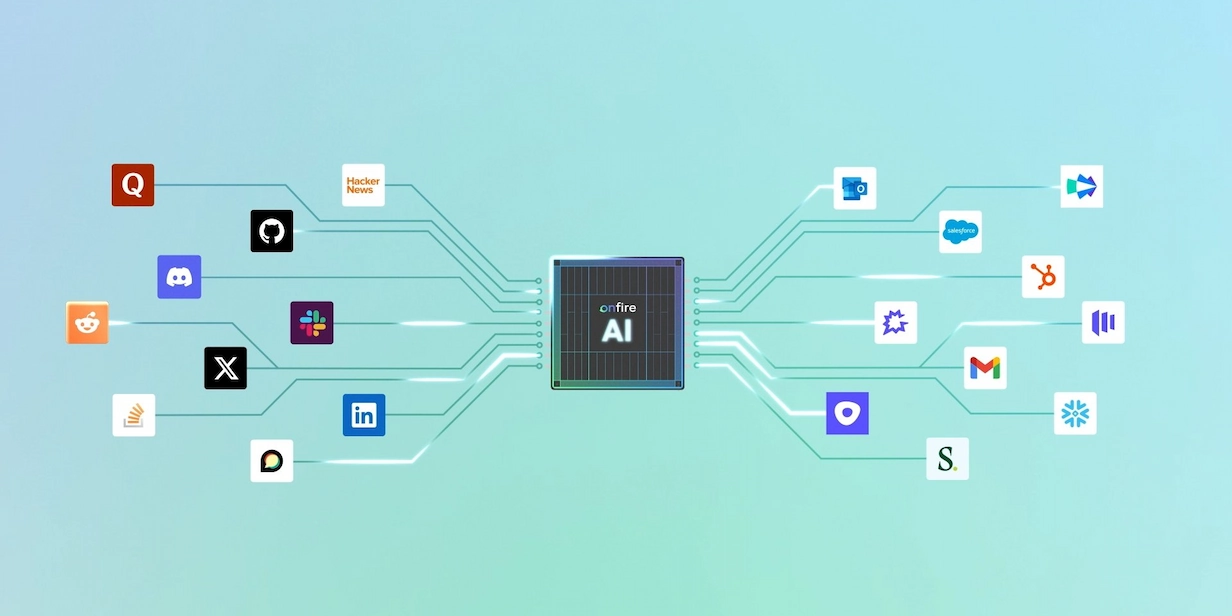
What is it? Onfire is a vertical AI platform built to automate account research and prioritization for teams selling software infrastructure to technical buyers. Onfire’s AI collates and refines signals - including 100,000+ developer communities, OSS activity, and event data - and resolves pseudonymous activity to named, contactable people. Rather than a static, keyword-based list of 100 leads, Onfire is built to deliver the specific contact and specific team that is responsible for solving the specific problem your software can help with.
Through its MCP server, Onfire provides context for the agents you’re already using such as Anthropic’s Claude and OpenAI Codex. This unlocks new capabilities for account research, prospecting, and outreach using said agents - built around trusted and accurate buyer data.
Which AI capabilities does it unlock?
- AI-powered research: reps start the day with outreach instead of research, since account prioritization and champion identification happen automatically overnight.
- Accurate buyer data: using AI to refine disparate signals, Onfire can point out the potential champion in an enterprise account, along with the specific pain points that should be addressed.
- Improved context for agents performing outreach or prospecting tasks: With Onfire, an agent such as Claude Cowork can write better outreach messages and perform more relevant research by accessing Onfire’s data (rather than whatever surfaces in a Google search).
- Outreach becomes evidence-based: every recommendation links to its source signal, so a rep knows exactly why an account is warm before dialing.
What does it replace? Static contact databases, standalone intent trackers, and the hours of manual research reps do to stitch those together.
Fathom: AI call recording and notes
What is it? Fathom records, transcribes, and summarizes your sales calls, then syncs summaries and action items directly into Salesforce or HubSpot. It offers a free tier, sets up in minutes, and doesn’t force reps to run their calls differently.
Which AI capabilities does it unlock?
- Automatic CRM hygiene: next steps get logged, objections get captured verbatim, and deal reviews are thorough.
- Managers can search across calls for patterns ("how often does data residency come up?") without listening to a single recording.
- Because transcripts are structured data, they become an input other agents can use for follow-up drafting and deal summaries.
What does it replace? Manual note-taking, post-call CRM data entry, and shared “call notes” docs.
Guru: AI knowledge management
What is it? Guru turns your internal documentation, wikis, and tribal knowledge into a verified knowledge base, then answers rep questions with AI directly in Slack, Chrome, or wherever they already work. Subject matter experts periodically confirm answers are still accurate to ensure the info is fresh.
Which AI capabilities does it unlock?
Instant, sourced answers to the hard questions technical buyers ask mid-deal. For teams that sell technical products, a rep who can answer live on the call beats one who says "let me get back to you" every time.
What does it replace? Your internal wiki, shared drive, and a meaningful share of the questions you send to your product and engineering teams.
11x: autonomous AI SDR for the long tail
What is it? 11x builds autonomous digital workers: Alice runs outbound email end to end, Julian handles phone and inbound. Once you configure your ICP and messaging guardrails, the agents source prospects, write, send, respond, and book meetings without human involvement.
Which AI capabilities does it unlock?
Coverage of accounts that would otherwise get nothing because of size or a low probability of conversion.
Automated multi-channel escalation from email to phone to SMS across thousands of accounts.
What does it replace? Outsourced SDR agencies and the sequencing licenses you'd otherwise burn on low-value accounts. However, this only works if you segment clearly so humans keep the strategic accounts.
Gamma: AI presentations and sales collateral
What is it? Gamma generates presentations, one-pagers, and shareable microsites from a prompt or an outline. When you feed it your notes from a discovery call, it will produce a polished, on-brand deck in minutes, one that’s editable like a document rather than a canvas of text boxes.
Which AI capabilities does it unlock?
- Per-deal collateral that is so economical to produce that every follow-up can include a deck built around your prospect's stack, their stated pain, and the specific benefits that matter to them.
- Engagement analytics on shared pages tell you which stakeholders actually opened it, and which slide they stalled on.
What does it replace? Rather than replacing tools, Gamma replaces human effort, namely, the design requests clogging your marketing team’s queue.
Hyperbound: AI call practice
What is it? Hyperbound simulates buyers for sales training. For example, it can model a skeptical director of platform engineering who already runs a competitor's product for your reps to practice cold calls and discovery calls against. The AI raises objections, pushes back on weak answers, and goes cold when reps ramble.
Which AI capabilities does it unlock?
- Ramping up sales reps without burning real prospects.
- Simulated reps-in-training can fail safely, repeatedly, and get scored on talk ratio, discovery depth, and objection handling.
- Pressure-testing new messaging or a new persona a dozen times before you try it on a real buyer.
What does it replace? Manager roleplay sessions, shadowing programs that eat senior rep time, and learning on live pipeline.
Klue: AI competitive intelligence
What is it? Klue monitors competitor websites, review platforms, news, and your own call recordings for competitive mentions, then uses AI to compile everything into battlecards reps can pull up mid-deal.
Which AI capabilities does it unlock?
- Up-to-date battlecards that don’t eat up research time so you know about recent pricing changes, outages, and losing arguments.
What does it replace? Your competitor notes documentations and win/loss spreadsheets.
4 Tools You Can Skip
Some categories that made sense in 2024 are being absorbed by general-purpose AI or by the platforms above. These include:
- Workflow builders. The drag-and-drop automation platforms your GTM engineer once spent weeks configuring are being replaced by coding agents. Claude Code can build, run, and maintain the same integrations from a plain-English description, without a per-workflow subscription or a proprietary canvas to maintain.
- Traditional firmographic and IP-based data. Employee counts, industry codes, and IP-to-company matching are now standard inside AI-native platforms. Paying to maintain them as a separate building block means paying twice for the weakest layer of your data.
- Standalone AI email writers. Frontier models with a decent prompt and real account context write better outbound than any dedicated "personalization" wrapper. The bottleneck was never the writing, it was always knowing what to say, and that’s a data problem.
- Single-purpose AI research copilots. Browser sidekicks that summarize a prospect's website or LinkedIn are thin wrappers around models you already pay for. An agent connected to your stack through MCP does the same research with more context and no extra license.
How These GTM Tools Fit Together Into a Working Sales Tech Stack
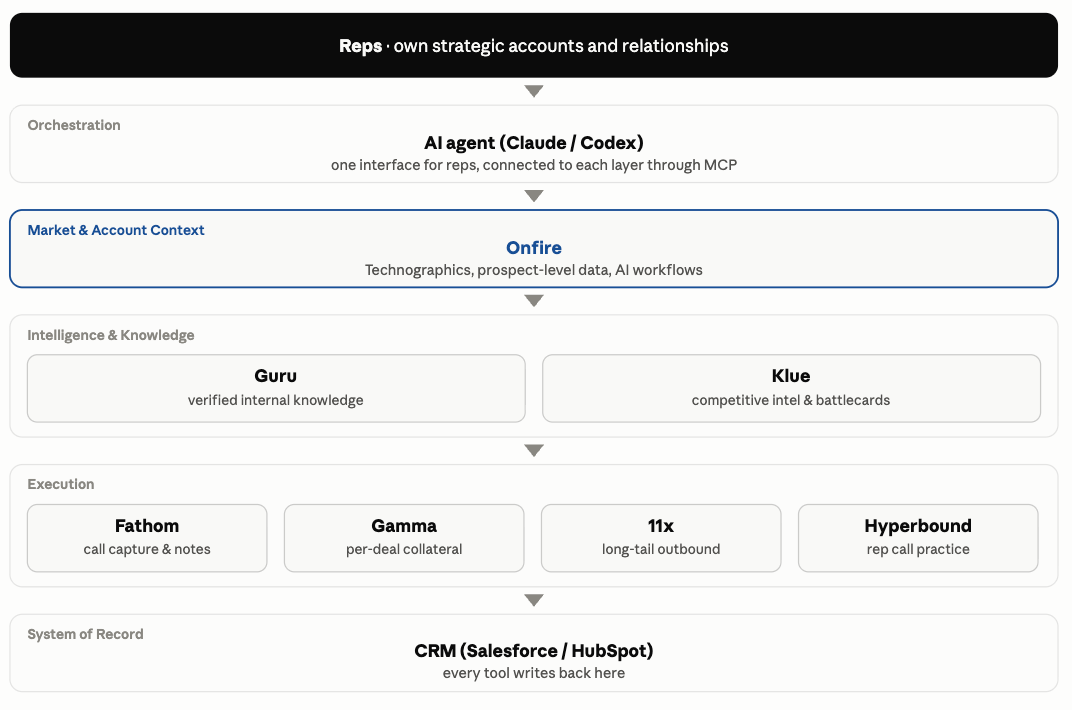
Many GTM stacks fail because when tools overlap, each rep stores information in a different place. In a working tech stack, each tool has its own well-defined task, so there’s never confusion about what information is stored where. Instead, your entire team will be running the same motion, the same way.
For instance, imagine you’re a cybersecurity vendor running the 7-tool-stack described above. Your motion starts when Onfire flags an account overnight: a platform engineer at a target enterprise asked about SIEM migration paths in a Slack community, and the account uses Splunk.
The next morning, your BDR will find it at the top of their morning list with the evidence attached, check Guru for the current answer on the exact integration question the prospect raised, and book a meeting. Fathom then captures the discovery call and syncs the notes to Salesforce where your AE skims the summary, sees the prospect mentioned an incumbent competitor twice, and pulls the Klue battlecard before the follow-up. Simultaneously, Gamma turns the call notes into a tailored deck referencing the prospect's actual stack.
All the while, 11x would work the hundreds of SMB accounts your team consciously deprioritized, and the two new BDRs who started this month would run Hyperbound sims against a "skeptical SOC manager" persona before anyone lets them near your live pipeline.
And all of this would run without anyone exporting a CSV, switching between ten chat boxes, or replacing the CRM. Each tool feeds the next stage or gets out of the way.
Future-Proofing Your AI GTM
Model capabilities are improving every few months, so buying is harder than ever. Here are a few principles to keep in mind:
1. Buy data advantages, not model wrappers. Anything whose main value is "we put GPT on top of X" will be commoditized by the next model release. Tools with proprietary data, like your unique business context, get more valuable as models improve, because better models extract more from unique data.
2. Make agent-readiness a requirement. Ask every vendor whether they ship an MCP server or an equivalent agent interface. Tools that only work through their own UI will feel increasingly like fax machines as more of the workflow runs through orchestrating agents.
3. Value vendors who do the tuning. As capabilities shift, someone has to keep the tool aligned with your ICP and motion. If that someone is the vendor, as part of the contract, you adapt for free. If it's your RevOps team, every model upgrade becomes an internal project.
4. Keep contracts short where you can. The category leaders of 2027 may not exist yet. Annual terms with clear exit points beat three-year commitments to a fast-moving category.
Getting Data That Actually Matches Your ICP
As the AI frontier expands, the durable layer of your stack is accurate data about your buyers and clean integration into your workflow. Everything else is increasingly swappable. If you want to see what that data layer looks like for software infrastructure sales specifically, put Onfire head-to-head against whatever your team runs today.
FAQ
What is an AI GTM tool?
An AI GTM tool applies machine learning or large language models to a specific go-to-market job: identifying accounts to target, capturing call notes, answering rep questions, running outbound, or maintaining competitive intel. The best ones automate one job deeply and integrate with your existing CRM and outbound tools, rather than trying to become a new all-in-one platform your team has to migrate into.
Do AI GTM tools replace SDRs and BDRs?
Not for accounts that matter. AI reliably automates research, prioritization, note-taking, and admin work, which typically consumes most of a rep's day. However, judgment, relationship building, and multi-stakeholder navigation remain human work. Autonomous agents make sense only for long-tail accounts that would otherwise get no coverage at all. The realistic outcome is more live conversations per rep, not fewer reps.
Which AI GTM tool should a team buy first?
You should buy the tool that automates your most time-consuming task each week. For most teams selling to technical buyers, that's account research and figuring out who to contact, which is why revenue intelligence leads this list. Fixing targeting improves everything downstream, but a better email to the wrong person still gets ignored.
How is GTM tooling different for software infrastructure sales?
Technical buyers research in communities, OSS projects, and Slack groups rather than on vendor websites, so IP-based tracking and job-post technographics miss most of their intent. Tooling built for this vertical needs to monitor those channels and resolve pseudonymous activity to real people. Generic GTM platforms treat every buyer the same, which is precisely why they underperform for infrastructure sellers.
.webp)








%20(1).webp)














































.webp)