How to Run an ICP Sales Strategy for Technical Buyer GTM



If you’re struggling to improve low reply, meeting, or win rates in technical sales, your ICP may be the issue. Compared to generic B2B sales, technical ICPs demand a higher degree of granularity and thoughtfulness. Here’s what’s worked for us as we target technical buyers.
Key Takeaways
- For technical products, ICP fit is decided by architecture, stack, and team maturity, none of which appear in a firmographic filter.
- ICP drift happens when reps chase the accounts that are easiest to talk to instead of those that are the best fit for your product. When they do so, your pipeline slowly fills with poor-fit logos, leading to lower win rates.
- The hard part of an ICP sales strategy isn't defining the criteria. Instead, it’s checking them against thousands of accounts, continuously.
What is an ICP in Sales?
An ideal customer profile (ICP) should describe the type of company that gets the most value from your product, in the shortest time, for the longest period. Building an ICP is the best way to narrow down the field of everyone you could theoretically sell to and end up with a narrowly defined list of high-value target accounts.
How to Think About ICP When Selling to Technical Buyers
In a typical B2B motion, a mediocre-fit account is a slower deal. In technical GTM, a mediocre-fit account is often an impossible deal. After all, your product either fits into their stack, or it doesn’t.
That means that you need to be far more meticulous and fine-grained when you build an ICP for technical buyers than for other B2B buyers. For instance, traditional sales motions place a lot of weight on firmographics. Yet if you’re selling a containerization solution, a 200-person company running Kubernetes might be a better fit than a 5,000-person enterprise on legacy infrastructure.
Instead of company size, you’ll need to focus on the scale of their infrastructure: how many services do they run? What’s their data volume, cluster count, and number of engineers involved in prod? These qualifiers are absolutely critical, and curiously, they often don’t track with revenue or company size.
And even once you’ve narrowed your market segment down to companies that may have a technical problem you can help them solve, you still don’t know who to contact in order to get the conversation started. After all, the people who deal with the problem likely don’t have the budget authority to buy your solution. That means that your ICP definition should account for whether the company has the kind of team that can champion and adopt your product, not just whether it could stand to benefit from it.
How to Identify ICP-Fit Companies for Technical Products
This may be counterintuitive, but you should start with negative criteria. In technical sales, it’s often cheaper to define what disqualifies an account than to look for qualification criteria. If you can rule out accounts who have embedded competing products, profess a hardline DIY build-it-yourself culture, or use an unsupported cloud provider, you’ll save yourself lots of time (and, eventually, money).
Now for qualifying accounts. The best way to start is to look at your own closed-won deals. Identify the deals that closed fastest, expanded, and renewed, and look for what they have in common. Ideally, you’ll have 20 or 30 to look at. Then, compare those against your closed-lost and churned accounts to weed out the criteria that show up across both lists. You’ll want to focus on the things that set your winners apart.
Concretely, this is what's worth checking for a technical product:
- Stack and architecture. What are they running in production, and does it sit next to where your product lives?
- Engineering scale and shape. How many engineers, and how are they organized? A company with 300 engineers and no platform team behaves very differently from one with 80 engineers and a dedicated infrastructure group.
- Change events. Migrations, re-platforming, a new CISO or VP of Platform, a compliance deadline, and a public incident can all help you time your outreach.
- Competitive and adjacent tooling. What are they using now, and is it something you displace, complement, or lose to?
- Community footprint. Where do their engineers show up, and what are they asking about?
In total, you might be looking at several hundreds of signals, with accounts qualifying as ICPs if they trigger 40 or 50 of them. Yet note that none of these are available in a standard filter, which is why most teams default to employee count and revenue.
Preventing ICP Drift: The Silent Pipeline Killer
ICP drift is the slow migration of your pipeline away from your stated ICP toward accounts that are simply easier to engage.
It's not caused by lazy reps, but by misaligned incentives. Poor-fit accounts often reply faster because they're less mature, less inundated, and more willing to take a call. When your reps feel the quota pressure, they’ll rationally take a meeting today over the ideal-fit account that requires six touches and a technical champion to get the conversation started.
But when your reps make that rational choice repeatedly, your pipeline may look healthy, but your win rate will drop as churn rises. Here’s what to look for if you suspect ICP drift:
- Meeting volume holds steady while opportunity-to-close conversion falls
- Sales cycles lengthen without a change in deal size
- Post-sale teams report more accounts stalling in onboarding
- Reps start describing wins as "unusual" or "a bit of a stretch, but…"
- Your best-performing segment quietly stops growing while overall activity is up
To fix ICP drift, don’t rely on better motivation. Instead, change the incentive structure. Score every new opportunity against your ICP criteria at creation, then review the distribution monthly. What percentage of new pipeline sits in your top fit tier versus your bottom? By tracking that number, you can catch drift before it affects your bottom line. You can also devolve accountability by capping the share of low-fit accounts each rep can work.
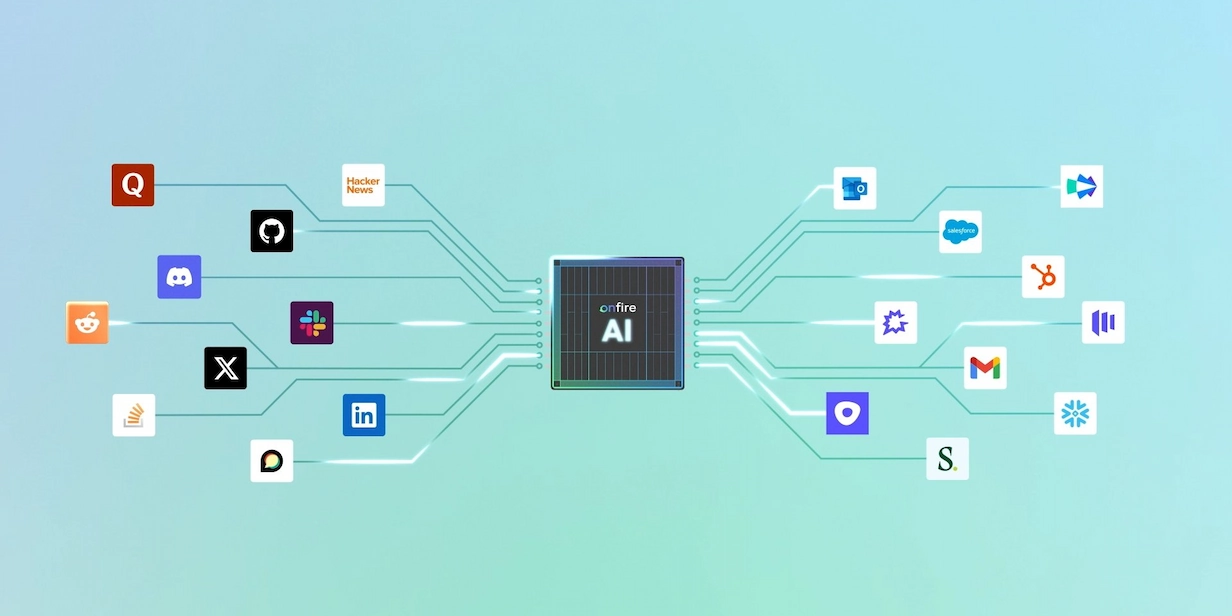
Automating ICP Lists and Prioritization with Onfire
Technically, you can do all of the above manually, but practically, it’s too much of an operational burden for teams to pull off. Checking 5,000 accounts against eight architectural criteria is weeks of work, and the intel you glean will be stale by the time it's finished. Technical buyers simply require a level of granularity that’s nearly impossible for human teams to scale.
This is where AI can deliver meaningful ROI by running account research for your specific ICP. That’s why we built Onfire to take the tedious research work from GTM teams so they have more time for quality outreach. It’s not that it does any single step in a way that humans can’t, it’s that it works at a scale that lets your team start selling again. Get a demo to see it run on your target list.
FAQs
How often should a sales ICP be updated?
Typically, you should review your ICP quarterly and rebuild it annually, or whenever you’ve made a significant change to your product, pricing, or market. For your quarterly review, check against your pipeline data: are the criteria still predicting win rate and cycle length? The annual rebuild should be a full ICP analysis against a fresh cohort of closed-won and churned accounts. Teams that revisit less often usually find their ICP has been wrong for several quarters.
What is negative ICP and how is it used?
A negative ICP is the explicit definition of accounts you shouldn't pursue because they have the wrong architecture, an entrenched competitor, a size band below your value threshold, or some other limitation. It's used as a filter before prospecting and as a disqualification checklist in discovery. In technical sales, it often does more work than positive criteria, because a single hard disqualifier can outweigh every promising signal on an account.
How do you validate your ICP against pipeline data?
Score historical opportunities against your ICP criteria, then check whether high-scoring accounts actually won more, closed faster, and churned less. If they didn't, the criteria you’ve selected don’t reflect success.
What is ICP drift and why does it matter?
ICP drift is the gradual movement of pipeline toward easier-to-sell accounts that sit outside your true ICP. It matters because it leaves activity metrics looking fine while win rates, cycle length, and retention degrade. To detect it, you’ll need to score your new pipeline against ICP criteria and track the distribution over time.
.webp)









%20(1).webp)
















































.webp)