The Rise of GTM Engineering, in 3 Charts: Salaries, Key Skills, and Demand



GTM engineering is a relatively new term, but it’s already enjoying widespread popularity among revenue teams. However, its close ties to orchestration platforms invite the question of whether the concept is just successful marketing, or whether it’s a genuinely valuable role.
We set out to find an answer in the data, scouring Google Trends, keyword volumes, and hundreds of recent job postings. Our conclusion? GTM engineering is a legitimate new field - and current demand is far outstripping supply.
Key Takeaways
- Demand is growing fast from a near-zero base. GTM engineer job postings grew 205% year over year, and US search volume for "gtm engineer" more than doubled in 12 months.
- The role is still small. Roughly 1,200 people on LinkedIn held the GTM engineer title as of May 2026, and 91% of the companies with at least one GTM engineer have only one of them.
- It's an AI-first job, not a Clay job. 95% of postings mention AI, LLMs, or agents. Only 3 of the 209 roles we analyzed named Clay and nothing else.
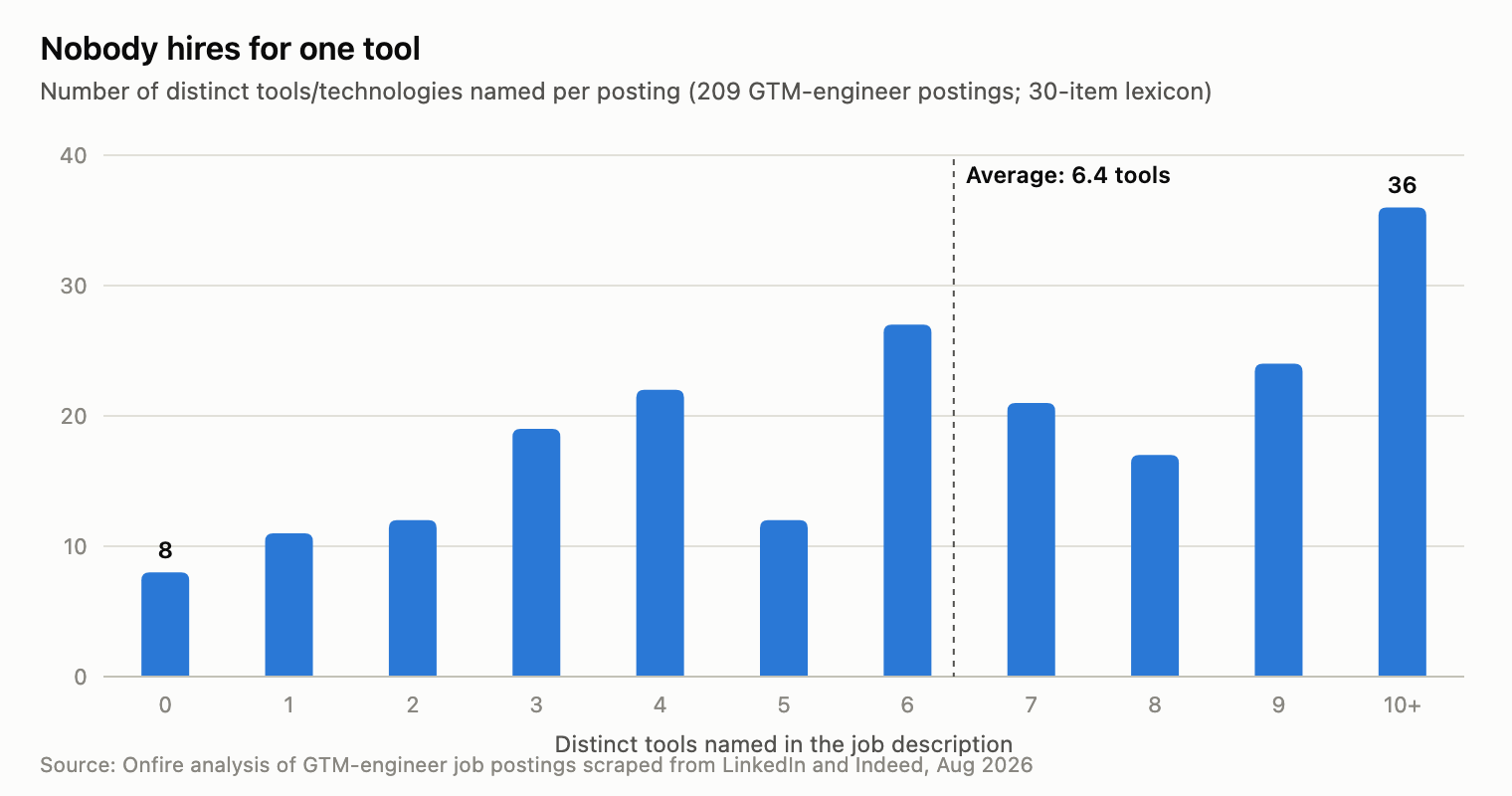
- Employers hire for range. The average posting names 6.4 tools, and 56% ask for working SQL, Python, or JavaScript.
- Pay is both high and highly variable. The median disclosed US range midpoint is $160K, with top listings above $250K. Outside the US, the median falls to roughly half that.
What is a GTM Engineer?
A GTM engineer builds (and maintains) the systems that generate pipeline. The job is a crossover between strategy and execution, with a fair amount of automation work bridging between the two. They assemble account data, enrich it, model it to find the prospects worth talking to, and wire the whole thing into automated outreach and routing.
Because they’re focused on building, these roles require expertise in AI, with most asking for at least some hands-on coding work. And unlike more traditional RevOps profiles, very little of a GTM engineer’s day (if any) is spent on CRM administration. These are builders.
The Ascent of a New Role?
Clay coined the term “GTM engineer” in 2023, but growth hackers and RevOps managers were already wiring enrichment waterfalls in 2019. Perhaps that explains the lag in industry-wide acceptance for the new position title.
When we looked at US monthly volume, we saw that the first real bump in usage didn’t come until 2025, with a peak of about 6,600 searches per month in the summer of 2026.
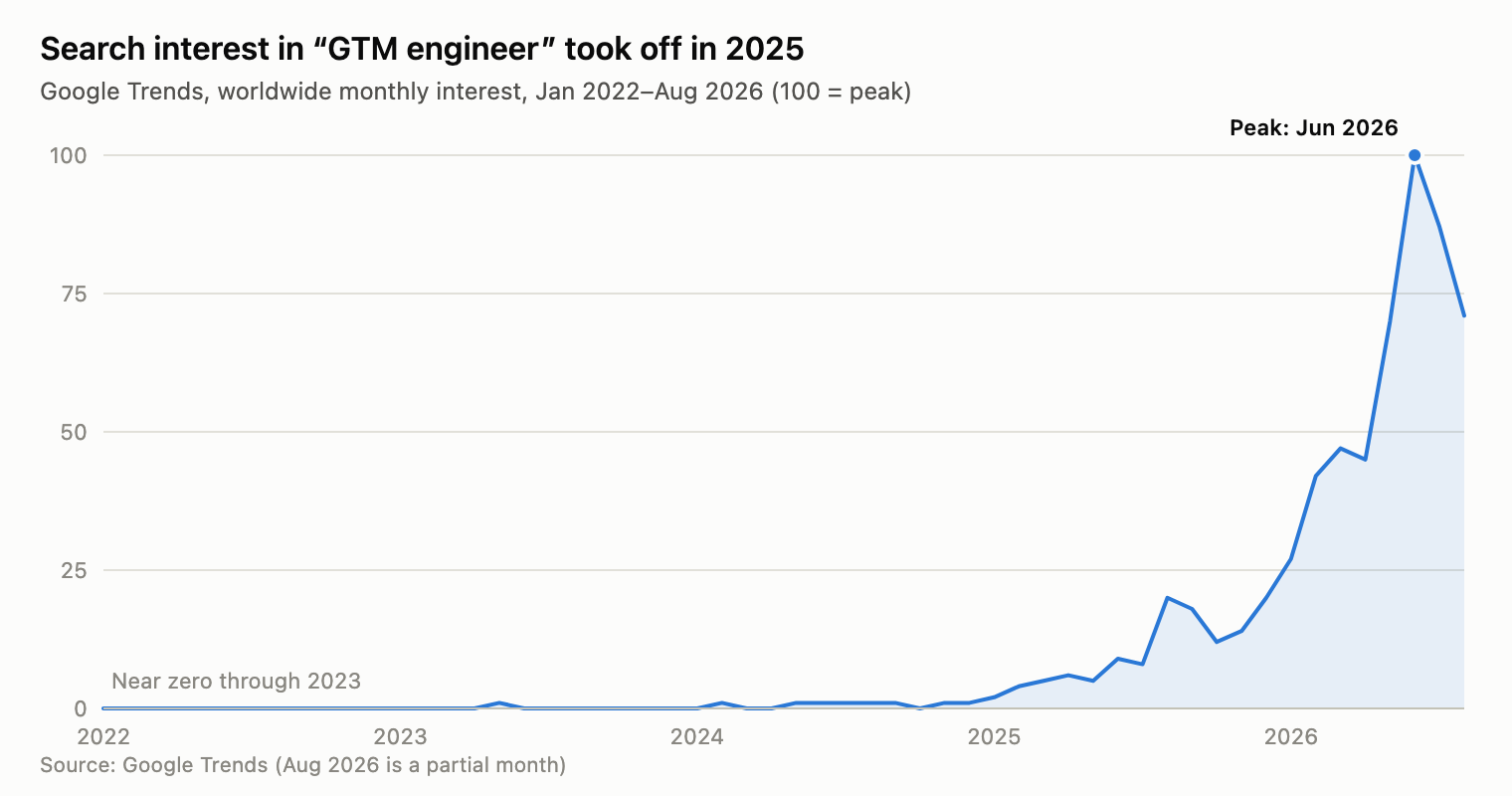
If this was just a reaction to clever marketing, we would expect the spike in interest to launch when Clay coined the term. We’d also expect that just about every job posting for a GTM engineer would be hyper-focused on Clay automations. Yet that’s not the case.
Along with the rise in search volume, job postings exploded between 2025 and 2026, reaching about 3,000 open roles in early 2026.
When we looked at 209 unique GTM engineer postings, we found that only 66% named Clay. Plenty of other tools and skills are in demand, ranging from HubSpot and Salesforce to Python, Gong, and JavaScript. The most important? AI. A full 95% of the postings we reviewed ask for AI/LLM expertise. This indicates that an ecosystem of solutions and practices is evolving to help teams bridge between GTM strategy and execution.
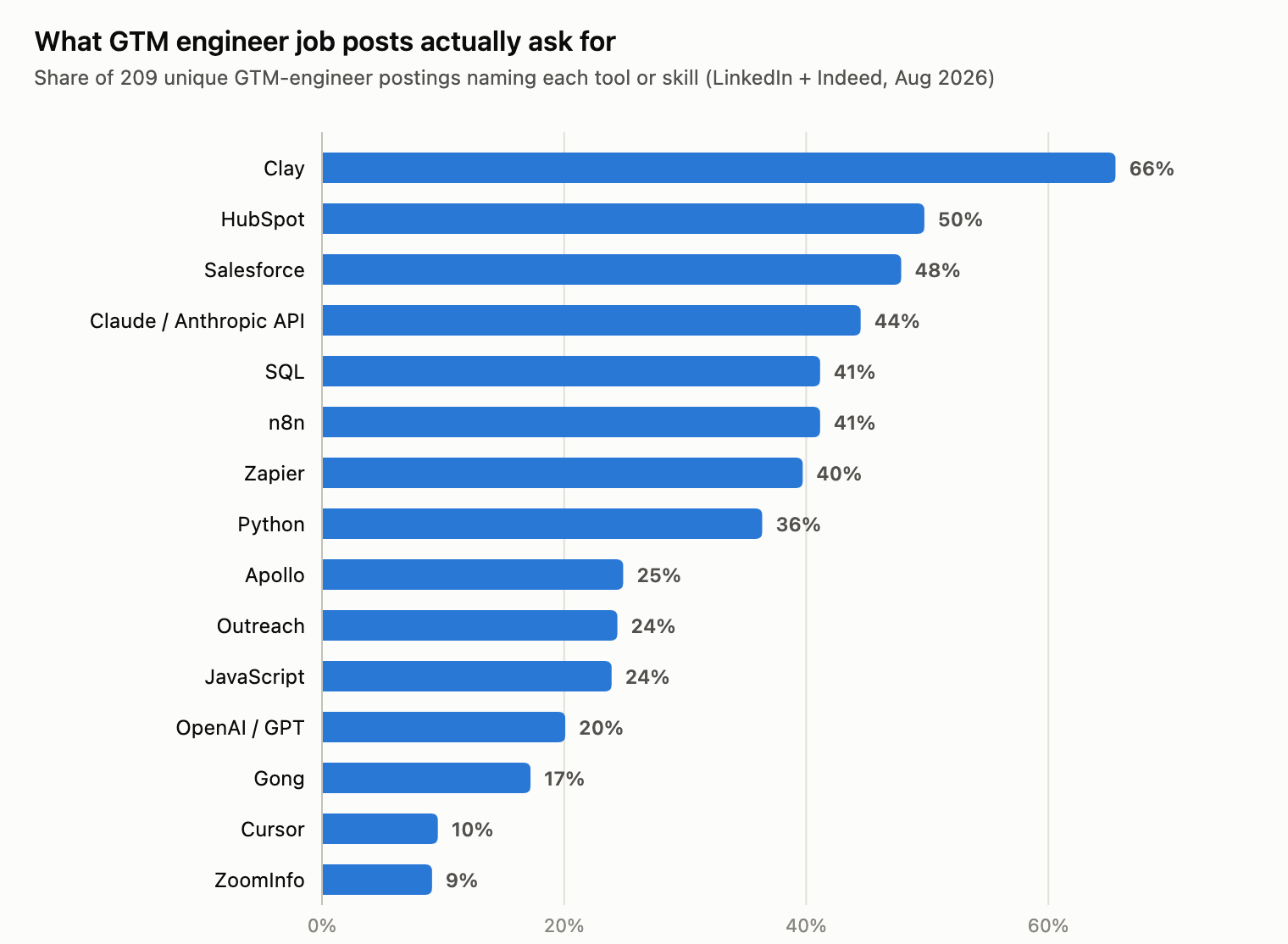
Interestingly, 40% of the postings asked for Claude proficiency, while just 20% called for OpenAI/GPT. That’s a sign that GTM engineers, like most other professionals, have made the switch to Anthropic. And the job postings also reflect something we’ve found at Onfire: context matters much more than prompt engineering. Data skills showed up 3.5x as often as prompt engineering in these postings.
As the above data would suggest, organizations expect GTM engineers to be fluent in multiple tools. In fact, the average job description mentions 6 tools, and most ask for programming skills as well as no-code solutions.
A Global Trend
The keyword data was just as revealing. In the US, “gtm engineer” already out-searches “revops,” indicating that the role has real staying power. Globally, however, “revops” is still the preferred term. Moreover, most searches are still definitional queries like “what is a gtm engineer,” indicating that many are still figuring out just what this role entails.
Globally, the highest-interest countries are the US, Canada, Singapore, Israel, the UAE, the Netherlands, and India. And across all of these geographies, it seems that small and mid-sized firms are doing most of the hiring. Companies with 51-200 employees claim 30% of the job postings, with over a third coming from software development verticals.
In other words, this is a startup-and-scaleup software role, which is likely why most of the job postings are on LinkedIn, not Indeed.
GTM Engineering is Still a Small Fraction of RevOps
There’s plenty of evidence that GTM engineering is a legitimate, fast-growing discipline. Yet as one might expect, GTM engineers have also done a great job building hype around the role. That means that you could be forgiven for thinking the position is more influential than it is.
According to a previous review of over 1,000 LinkedIn profiles, 91% of companies who employ GTM engineers employ only one. The companies employing more than one GTM engineer are largely those you’d expect, including Clay, Apollo, OpenAI, Adobe, and Vercel.
And interestingly, many of the organizations benefiting from GTM engineering don’t hire for it. As Kyle Poyar notes, 45% of GTM Engineers work in an agency or consulting capacity. This mismatch has led him to quip, “I bet there were more LinkedIn posts last month about GTM engineering than actual companies hiring for it.”
Indeed, while keyword volume shows GTM engineering searches steaming past RevOps, Poyar writes that “there’s 1 GTM engineering job post for every 5 RevTech/MarTech posts. One for every 14 in RevOps. One for every 35 in SalesOps.”
The most charitable interpretation of these stats is likely that because they build systems, GTM engineers have an outsized impact, enabling them to drive real revenue in numbers as low as one. And yet, the State of GTME 2026 report found that only 38% of practitioners work somewhere where their role is clearly understood.
What GTM Engineer Salaries Tell Us
The salary range for US-based GTM engineers is unusually broad. In the roles we reviewed, it ranged from $60,000 to $250,000, with the midpoint of the median range coming in at $160,000. That tracks with claims that these professionals make about 20% more than traditional sales/marketing operations contributors. And when coding skills get added into the mix, US salaries rise by about $45,000.
Internationally, it’s a different picture. The midpoint appears to be equivalent to about $75,000, though when you factor in the EU-standard 5 weeks of vacation and parental leave policies, the gap closes somewhat.
So while these roles may be a bit hyped up, salaries do speak to the fact that GTM engineers are highly valued, more so than their RevOps counterparts.
So You Want To Be a GTM Engineer?
Another sign that this role is well-established: there are now a number of credentialing programs would-be GTM engineers can turn to to get up to speed. Andreessen Horowitz (a16z) offers an 8-week fellowship for “growth engineers,” a role that corresponds to GTM engineering.
The roles of a growth marketer, PM, and engineer are all collapsing into one. And for many startups, this is becoming their most important hire - a first principles thinker who’s AI-native, incredibly curious, and willing to do whatever it takes to win leads and multiply revenue.
This fellowship, announced in April 2026, is just the latest of a number of courses and certifications, including Clay University, StackOptimise’s GTM Engineer course, and Maven’s GTM Engineer Foundations. Yet keyword research shows only about 90 searches a month for course-related terms.
So while we’re seeing the rise of the GTM engineer, the role still has a long way to go before it is fully established.
Building a Resilient Revenue System with Onfire
GTM engineering is growing fast, but it’s early days, and the role is changing quickly. If you’re looking to carve out space for this role in your organization (or become a GTM engineer yourself), don’t limit yourself to a tool operator. Instead, focus on building a complete picture of your buyers and wiring that into processes that run without constant human intervention.
To see how Onfire can help you find the data that makes sense for your specific GTM motion, grab time with the team.
FAQs
What is a GTM engineer?
A GTM engineer builds and maintains the automated systems that generate pipeline: account data, enrichment, scoring and routing, and outbound sequences, with AI handling research and drafting inside those workflows. The role is a crossover between GTM strategy and execution, and it's defined by building infrastructure rather than working leads by hand.
Do GTM engineers need to know how to code?
Increasingly, yes. 56% of the postings we analyzed asked for SQL, Python, or JavaScript, and coding ability carries a documented salary premium of roughly $40,000–45,000. That said, no-code and low-code work is still the bulk of the day job. Realistically, a GTM engineer is someone who works with no-code tools but can drop into a script when the workflow demands it.
How much do GTM engineers make?
Among US postings that disclosed pay, the median range midpoint was $160,000, with the top listings running past $250,000. That's roughly 20% above what traditional sales and marketing ops roles pay. Outside the US the picture is very different: the non-US median sits near $75,000.
Does my company need a GTM engineer?
Most companies that have one have only one, and they tend to be startups and scaleups selling software & tech. When you have more GTM ideas than engineering capacity, it makes sense to add a GTM engineer. It’s also fairly common for companies to use GTM engineers through an agency or consulting arrangement rather than hiring one full-time.
What tools do GTM engineers use?
The average posting names 6.4 tools, and 95% mention AI expertise. Of the solutions, Clay leads at 66% of postings, followed by HubSpot (50%), Salesforce (48%), Claude (45%), SQL (41%), n8n (41%), and Zapier (40%). Remember, employers are hiring for the ability to assemble a system, not fluency in any single product.
.webp)












%20(1).webp)

















































.webp)