5 Top B2B Contact Databases: Are They Relevant for Tech Sales in 2026?



Your AI agent can already find a platform engineer's GitHub profile, so why pay for a B2B contact database at all?
Because the agent still can't give you that engineer's mobile number. It also can’t sift through the 200 engineers at your target account to find the one that owns the budget for the solution you’re selling. So at least for the foreseeable future, contact databases can provide real value. Here’s our take on the top 5 in 2026.
The Top B2B Contact Databases at a Glance
- Onfire: a B2B contact database plus a vertical intelligence layer, built for companies selling software infrastructure to technical buyers.
- ZoomInfo: a generic B2B contact database built as a one-size-fits-all solution with an agent access layer.
- Apollo: a simple self-serve entry point that bundles data with sequencing and a dialer.
- Cognism: the strongest EMEA phone data with a solid compliance posture.
- Lusha: a lightweight, fast prospecting tool with transparent pricing and a usable Chrome extension.
Is the B2B Contact Database Dead?
It’s not entirely dead, but the landscape has changed significantly in the last few years. In 2026, the category often seems commoditized, and most of it is. Every vendor promises to provide a few hundred million contacts and high email accuracy, but just about every vendor buys their contacts from a small number of upstream sources. The result is that most products get you almost identical records.
At the same time, AI agents are now capable enough to do a fair amount of research work without direct supervision. When you can one-shot prompt your way to a company overview, funding history, and first-draft opener, you won’t be getting much value from standard contact databases.
And yet, agents have their limitations, namely: they can’t access non-public data. If your buyers are commenting in forums behind a login, that signal will be lost. This means that B2B data providers can provide real value by finding and aggregating data your agents can’t reach on their own. Without that context, neither your AI agents nor your salespeople can focus on what matters.
And it’s worth noting that collecting data isn’t enough. For technical sales, you need a tool that answers the questions that actually identify your best-fit buyers. Does an account run the technology your product plugs into, replaces, or depends on? Which specific person owns it? Have they said anything recently that suggests they're evaluating alternatives?
How Onfire Is Reinventing the B2B Contact Database
Onfire is a B2B contact database that also does a lot of other useful things for teams selling software infrastructure. That usefulness starts with the unique way it gathers data.
Vertical data instead of horizontal coverage
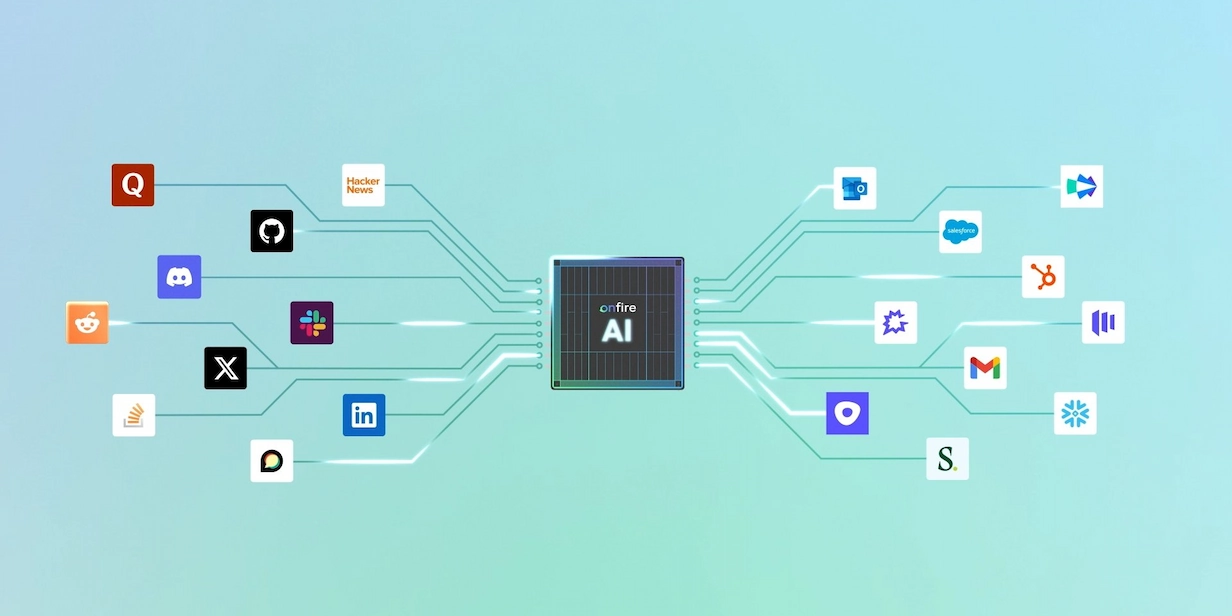
Onfire covers roughly 50 million engineers and processes around 5 million daily events from more than 100,000 sources where technical buyers actually spend time, like GitHub, Discord, X, and event platforms like Luma and Meetup.
Most contact databases infer technographic data from job postings and front-end scripts, which tell you what a company advertises and what loads in a browser, but not what's running in the backend, the CI pipeline, or the security stack. Onfire's technographic data comes from what engineers at the account actually contribute to, ask about, and complain about. It then resolves those contributions to named people, not just accounts.
Waterfall contact enrichment
For business emails and direct dials, Onfire doesn't pretend a single proprietary database beats the market. Instead, it runs waterfall contact enrichment across multiple providers, including several of the same sources that power the other tools on this list, and takes the best available record. That way, you get broad worldwide coverage for tech sales, without paying a premium for everything else.
An AI-first architecture
Onfire ships an MCP server, which means your agents query the Account Intelligence Graph directly rather than working from an exported CSV. The MCP combines Onfire's external signals with your CRM records and your own ICP configuration, so an agent can reason across first-party and third-party context in a single call.
Importantly, every signal carries a source URL and a timestamp so your reps can double-check the agent’s recommendations before reaching out to a new account.
A complete way to operationalize the data
A contact database is a starting point, but Onfire takes the next steps for you. It pushes prioritized accounts and enriched contacts into Salesforce, HubSpot, Outreach, and Salesloft, and includes a prospecting workspace and Chrome extension so BDRs can work directly from LinkedIn Sales Navigator without leaving flow.
4 Other Popular B2B Contact Databases
If you’re selling software infrastructure, you need deep technical data. These contact databases are built for more generic B2B verticals, so they stay a bit more shallow. If you’re not selling to technical buyers, that’s likely enough for your motion.
ZoomInfo
ZoomInfo offers broad contact data, and its GTM.AI product, a headless context layer, exposes its graph through an API and hosted MCP server. However, it comes with enterprise pricing with no public rate card (Vendr marketplace data puts the average contract around $33,500), annual commitments, and technographic data inferred largely from job postings and website scripts. Its coverage is strong in North America and weaker elsewhere.
Apollo
Apollo bundles a contact database (275M+ contacts and 60M+ companies, self-reported) with sequencing, a dialer, and intent data at $49–$119 per user per month, plus a free tier. In March 2026 it launched an agentic AI assistant that executes workflows from natural-language prompts, and acquired Pocus to fold signal-based revenue intelligence into the platform.
However, Apollo enriches from its own database with no fallback to secondary providers, so coverage gaps in EMEA, APAC, and LATAM show up directly as bounces and dead numbers.
Cognism
Cognism's differentiator is mobile numbers verified by human agents, screened against national DNC lists in more than a dozen countries, with GDPR, SOC 2, ISO 27001, and ISO 27701 documentation behind it. For phone-led outbound into the UK and EMEA, nothing else in the category matches the connect rates.
It is quote-only and expensive, with user reports putting platform fees in the $35,000 range before per-seat costs. US coverage is weaker than ZoomInfo's, and intent is limited to Bombora topics.
Lusha
Lusha started as a Chrome extension and still runs a very usable plug-in. It sets up in minutes and reports 280M+ contacts with strong US and UK accuracy.
Drawbacks include thinner EMEA and APAC coverage, phone accuracy complaints, restrictive credits. Moreover, technographic data, intent signals, and API access are all gated behind the custom-priced top tier.
How to Evaluate B2B Contact Databases for AI-native GTM
If you want to hand contact data to your AI agent, then you should evaluate providers with your agent. Here’s how:
1. Check for MCP servers and real integrations
Ask whether the vendor has an MCP server, what tools it exposes, and whether it can write as well as read. If your agent can only read, every workflow will still require your team to copy something into a CRM.
Also be sure to ask what the server can see. A third-party-data-only server that has no access to your CRM or your ICP definition will answer generic questions well and specific ones badly.
2. Run a real workflow through your agents and compare three things
Pick 50 accounts you know well and run this prompt against each vendor’s connection: "find the person at each account who owns [your category], with evidence." Then, look for:
- Accuracy. How often did the tool identify the right person, and can you verify the claim from the source it cited?
- Comprehensiveness. What percentage of your 50 accounts returned a usable answer?
- Token costs. A verbose tool surface, results that arrive as unstructured blobs, or a server that requires four calls instead of one will multiply your inference bill across every account, every day.
The vendor that wins on all three is the one your agents should be calling. In most technical sales motions, that won't be the one with the biggest database.
See the Onfire Data Advantage in Practice
If you’re looking for a way to automate the laborious account research that comes with technical sales, let us know. We’ll run Onfire against your real data to show you what a contact database can do when it’s built specifically for teams selling infrastructure. Grab time with the team
FAQs
How does a B2B database differ from a CRM?
A CRM stores what your company knows, like your accounts, your conversations, and your deals. A B2B contact database supplies what you don't know yet, such as contacts, firmographics, technographic data, and buying signals from outside your four walls. The CRM is your system of record but the database is your system of discovery.
How do you measure B2B contact database accuracy?
Test it against ground truth rather than trusting a marketing number. To do so, pull a sample of 200–500 records from your actual ICP, verify emails through a separate validator, dial a subset of the phone numbers, and cross-check job titles manually. Remember to track bounce rate, connect rate, and right-person match rate separately, because vendors often quote whichever is highest. And because regional accuracy varies enormously, be sure to sample the geographies you sell into.
Is B2B contact data compliant with GDPR?
It can be, but compliance depends on the provider's practices. Under GDPR, B2B processing typically relies on legitimate interest, which requires documented sourcing, honoring opt-outs, and notifying data subjects. Reputable vendors publish their legal basis, screen against national DNC and suppression lists, and hold certifications like ISO 27701 and SOC 2.
How does technographic data differ from firmographic data?
Firmographic data describes the company: industry, headcount, revenue, location, and funding. Technographic data describes what it runs, such as cloud providers, databases, CI/CD tooling, security platforms, and open-source dependencies. Firmographics tell you whether an account is the right size to buy while technographics tell you whether your product fits their stack at all. For infrastructure and developer-tool companies, technographic data is usually the stronger qualifier of the two.
How often should B2B contact data be refreshed?
Continuously, if you can. Records decay at roughly 25–30% a year, and tech and SaaS contacts churn faster than the B2B average. Refresh active outbound lists monthly at minimum, re-verify before any campaign, and enrich at request time whenever possible.
.webp)










%20(1).webp)















































.webp)