Six Popular Sales Outreach Tools for Technical B2B: Good Omens and Things to Watch



Engineers, platform leads, and security teams treat vendor email differently. They run link scanners that fire "opens" before anyone reads a word, sit behind gateways that hold or drop unfamiliar senders, and notice the tracking pixel in a "personal" note. But this doesn’t mean that outreach tools are irrelevant - outbound is still the most reliable way to grow an enterprise software business.
At Onfire, we don't make an outreach tool, but virtually all of our customers use one (typically using the unique data we provide to write better, more targeted outreach messages). So to help navigate this market, we dug through the public documentation, security pages, case studies, and company news for six popular options and wrote up what we found.
Key Takeaways
- The features that matter most for a technical audience are true plain-text sending, SEG detection, deliverability infrastructure, reporting that goes beyond opens, CRM write-back, and a usable MCP server.
- Of the six tools reviewed, only Smartlead clearly documents true plain-text sending. Outreach, Amplemarket, and Mixmax have the most developed MCP offerings.
- The tool solves the mechanics of sending. Replies still come down to reaching the right person with something relevant to say, which is the part Onfire covers.
Where Onfire Fits in Your Outreach Stack
Every tool reviewed below solves the mechanics of sending: deliverability, sequencing, reporting, CRM write-back. What they can’t do is reliably tell you which accounts to work, who owns the decision, or what would make that person reply - even if some tools will bundle the generic data that everyone has as part of their offering.
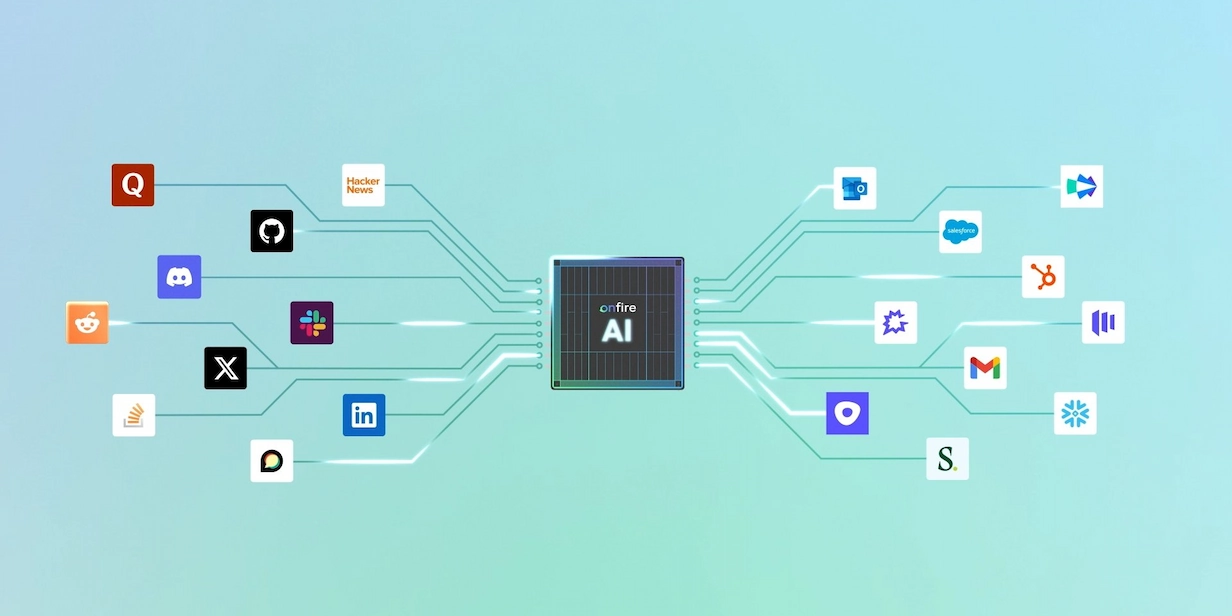
Onfire serves companies that sell software infrastructure to technical buyers. We use AI to collect data generic providers don't have, drawn from the public footprint of roughly 50 million engineers, and tie it into a single living picture of each account: its real tech stack, its org and team structure, and the specific people who would own the decision. Every conclusion comes with evidence you can inspect, which matters when your email has to survive a skeptical engineer.
That picture is tailored to your motion. Forward-deployed engineers tune the data, the graph, and the workflows to your ICP, your golden personas, and your tools, typically in days. And because Onfire ships an MCP connector, you can pull the account graph into Claude, ChatGPT, or any MCP-compatible agent and feed the output straight into whichever outreach tool you pick from the list below.
Want to see what we find on your data? Grab time with the team.
The 6 Tools at a Glance
- Outreach: The enterprise standard for sales engagement, with deep reporting, broad multichannel coverage, and the only MCP server plus MCP client combo on this list.
- Clari + Salesloft: A newly merged enterprise revenue platform with mature CRM write-back, marquee logos, and long-standing compliance credentials.
- Smartlead: A bootstrapped deliverability specialist and the only tool here with thoroughly documented true plain-text sending.
- Amplemarket: An AI-forward platform that handles multichannel orchestration and execution natively across all major channels.
- lemlist: A bootstrapped tool with per-campaign plain-text control, a well-developed warm-up service, and channel coverage that extends to LinkedIn and WhatsApp.
- Mixmax: A Gmail-native engagement tool with transparent pricing, two-way Salesforce and HubSpot sync, and an OAuth-based MCP server included on paid plans.
What to Look For in Sales Outreach for Technical Buyers
Technical buyers are opinionated, skeptical, and privacy-conscious, and they approach outreach differently from just about every other B2B persona. Three things in particular trip up outreach tools.
Link scanners. Many engineering and security teams run tools that open every email and click every link the moment it lands. If your outreach tool has branching logic that fires on open or click events, it will misfire. There are still ways to tell a scanner from a human: clicks within a few seconds of delivery, or every link in the email clicked near-simultaneously, are almost always automated. A human reader clicks gradually as they read.
Secure email gateways. Larger technical companies frequently sit behind gateways like Barracuda, Proofpoint, or Mimecast, which can hold or drop unfamiliar senders. Look for SEG detection features that flag leads behind these tools so you can route around them rather than burn your sender reputation.
Tracking. Does the tool let you send true plain text, with no HTML wrapper and no tracking pixel, per sequence? Engineers notice tracked emails, and that costs you replies.
Ultimately, if you want replies, you'll also need deep intelligence to make your outreach worth reading. But today, we're just focusing on the outreach step.
The Feature Checklist We Used to Evaluate Tools
Technical buyers are opinionated, skeptical, and privacy-conscious, and a lot of standard outreach tooling was built for a different audience. In our experience selling revenue intelligence to B2B tech companies, these are the features that make the biggest difference when you're trying to reach engineers:
- Deliverability infrastructure. Warm-up, sending limits, and custom tracking domains, so your emails land in the inbox in the first place. Larger technical companies often run strict corporate email filters, and some tools can flag which contacts sit behind one so you can adjust your approach.
- Plain-text emails. The option to send a real plain-text email, with no HTML wrapper and no tracking pixel, per sequence. Engineers notice tracked emails, which can cost you replies.
- Reporting that goes beyond open rates. Many technical buyers use security tools that automatically open emails and click links the moment they arrive, so open and click counts mean less with this audience. Replies, meetings, and sentiment tell you more.
- Write-back to CRMs. Activity should be visible in your CRM without a rep copying it over.
- Multichannel. Typically this would mean LinkedIn + email, which matters more for some prospects than others. Some engineers don't spend much time on LinkedIn, while others are more responsive there than via email.
- Agentic features. A usable MCP server matters more than built-in automations, because it lets you bring the tool into whatever AI workflow your team is already running.
How We Ranked These Tools
Beyond the feature checklist, we looked for good omens and things to watch: publicly observable facts about each company that could indicate a good or poor fit for software infrastructure verticals like dev tools, data, or agentic apps. None of these are dealbreakers on their own. They're the things we'd ask about on a sales call.
Good omens
🟢 Technical logos and case studies. They've already won over skeptical buyers like yours.
🟢 Growing headcount. People are joining, and the roadmap has hands to build it.
🟢 Financial health. Fresh funding or bootstrapped profits both count.
🟢 Security certifications. SOC 2 and ISO 27001 make enterprise procurement much friendlier.
Things to watch
🔴 Deliverability complaints. Reviews that mention spam placement are worth a closer look, since shared infrastructure can follow you into the inbox.
🔴 Enterprise gateway friction. Documented issues with corporate email filters.
🔴 Agency-first focus. When agencies are the main customer, the roadmap tends to follow them.
🔴 Shrinking teams or recent restructuring. Worth asking about support and roadmap continuity.
Our Take on 6 Sales Outreach Tools in 2026
Outreach
Features: We'll start with Outreach because, let's face it, they chose the best name. According to their technical docs, they provide robust reporting, enterprise-grade CRM write-back, and multichannel features across email, calls, SMS, and LinkedIn tasks. Tracking can be disabled at the org, profile, and message level, but true plain-text sending is not documented. They have enterprise deliverability infrastructure, though native warm-up isn't documented either.
An especially strong spot: they're the only vendor on this list to offer both an MCP server and an MCP client.
Good omens:
🟢 A strong customer story from Snowflake, a buyer as technical as they come.
🟢 Headcount rose in the 18 months leading up to spring 2026, and engineering roles make up about a third of the company.
🟢 The only MCP server plus MCP client combination on this list.
Things to watch:
🔴 Outreach went through several rounds of layoffs from 2022 to 2024. Headcount has recovered since, though it remains below its peak.
🔴 The MCP offering is gated behind the Amplify add-on, so budget for it separately.
🔴 True plain-text sending and native warm-up aren't documented.
Clari + Salesloft
Features: Clari and Salesloft tick most of the boxes, including CRM write-back, multichannel, agentic capabilities, and reporting, and most of these features are mature and well-developed. Like four of the six tools we looked at, there is no documented true plain-text email functionality.
Salesloft sends through your connected mailbox and has good enterprise hygiene, but no dedicated cold-outbound tooling. It uses shared tracking domains by default, so you'll want to set up a custom tracking domain.
Good omens:
🟢 Enterprise logos include Adobe, IBM, 3M, Zoom, Shopify, Google, Square, Okta, and Cisco.
🟢 Salesloft holds SOC 2 and ISO 27001 and maintained them through hypergrowth.
🟢 Mature CRM write-back and reporting, the most complete on this list alongside Outreach.
Things to watch:
🔴 Salesloft was affected by a widely reported OAuth token theft campaign involving its Drift integration in August 2025. The company has since published its remediation. If you sell into security teams, expect the question to come up in procurement, and have the incident report handy.
🔴 Two rounds of layoffs in late 2025 and early 2026.
🔴 Clari and Salesloft merged in December 2025. Given the size of both companies, full product consolidation will take time, so ask about the roadmap for the pieces you rely on.
Smartlead
Features: Smartlead is the only tool we looked at with thoroughly documented true plain-text sending. Its SEG detection tool flags leads that are behind a gateway so you can delete or archive them. CRM write-back is native for HubSpot, Pipedrive, Zoho, Attio, Insightly, and GoHighLevel, while Salesforce runs through the third-party OutBoundSync.
The MCP server authenticates with an API key pasted into a config file and only offers SSE transport. Multichannel outreach runs through dedicated integration partners, with limited native in-app social execution.
Good omens:
🟢 Fully bootstrapped, and crossed $20M ARR in early 2026, so there's no investor pressure to pivot upmarket.
🟢 SEG detection and true plain-text sending show a clear focus on the problems teams selling software infrastructure actually hit.
🟢 Logos include Lovable, Replit, and Instawork.
Things to watch:
🔴 Of the 15-or-so case studies on their site, about 10 are agencies, so the roadmap may lean that way.
🔴 We couldn't find a public SOC 2 or ISO 27001 report, so plan to ask for compliance documentation directly.
🔴 The MCP implementation (API-key auth, SSE-only) is more limited than the others on this list.
Amplemarket
Features: Amplemarket offers an advanced reporting suite, an AI copilot with an MCP server, and mature deliverability infrastructure. It automatically logs outreach into CRM records, and multichannel is a clear area of focus, with both orchestration and execution handled natively for all major channels.
Good omens:
🟢 Case studies and logos include technical companies like DataStax, Wasabi, Fivetran, and Mistral AI.
🟢 Native multichannel execution across every major channel, the broadest on this list.
🟢 Deliverability infrastructure and MCP support are both built in rather than add-ons.
Things to watch:
🔴 The last announced funding round was in April 2022, and headcount is relatively small at around 110 employees.
🔴 We couldn't find SOC 2, ISO 27001, GDPR, or data residency details on its security page. They may well exist, so ask for the documentation directly.
🔴 True plain-text sending isn't documented.
lemlist
Features: lemlist offers a well-developed email warm-up service, per-campaign plain-text control, and native CRM write-back with the most popular CRMs. Reporting is somewhat limited, with no sentiment analysis or meetings-booked tracking. Its MCP server covers over 40 actions, though auth is an API key pasted into your config. Multichannel is broad, covering email and calls as well as LinkedIn and WhatsApp.
Good omens:
🟢 lemlist's own guidance matches how technical GTM works: "Stop tracking clicks and opens in cold email campaigns."
🟢 Bootstrapped, with estimates placing ARR at over $50M in 2026, up from about $40M in 2025.
🟢 Per-campaign plain-text control, one of only two tools here that document it.
Things to watch:
🔴 Despite growing revenue, the team shrank by roughly 15 people in 2026.
🔴 LinkedIn automation of any kind carries platform-policy risk if it's used aggressively, so keep volumes conservative.
🔴 Reporting is lighter than the enterprise tools on this list.
Mixmax
Features: Mixmax lives inside Gmail (Outlook support is newer and less developed), with sequences, tracking, scheduling, and two-way sync to Salesforce and HubSpot on its bundle plan. Pricing is published, at $29 to $89 per user per month. Tracking can be toggled per email, per sequence, or account-wide, and custom tracking domains are supported, but true plain-text sending is not documented. Because it sends through your own Gmail account, your daily volume is capped by Google rather than by Mixmax, and there's no built-in warm-up or inbox rotation.
Its MCP server, launched in April 2026, uses OAuth 2.0 and Streamable HTTP rather than a pasted API key, and is included at no extra cost on paid plans. As of an August 2026 beta it can build sequences, add recipients, and send email, in addition to reading sequence performance and meeting data.
Good omens:
🟢 The cleanest MCP setup on this list: OAuth, Streamable HTTP, no add-on fee.
🟢 SOC 2 Type II, SOC 3, GDPR, and HIPAA compliance listed on its security page.
🟢 Case studies include Canva, Oxylabs, Veraset, and Insightly, and pricing is transparent enough to evaluate without a sales call.
Things to watch:
🔴 No native deliverability infrastructure: no warm-up, no inbox rotation, and Gmail's sending limits apply.
🔴 LinkedIn, calling, and SMS are available only on the custom plan, so it's email-first on the self-serve tiers.
🔴 The last announced funding round was a Series A in 2018. The company has operated without outside capital since, which cuts both ways: no investor pressure, but worth asking about roadmap velocity.
FAQs
What makes technical buyers different from other outreach targets?
Engineers and technical buyers are more skeptical of vendor emails than most personas, and many run automated link-scanning or sandboxing tools that click every link and open every email the moment it lands. That breaks outreach tools that rely on open and click events to trigger next steps, and it can hurt your sender reputation if the tool doesn't distinguish a scanner from a real reader.
If you're selling into this audience, prioritize tools with SEG detection and behavioral signals (like click timing and pattern) over ones that only count raw open and click rates.
Why does plain-text email matter so much here?
Most outreach platforms wrap every email in HTML and embed a tracking pixel, even when you choose a "plain-text" template, and technical readers notice. A visible pixel or an oddly formatted email reads as mass outreach, and that alone can cost you a reply. True plain-text sending (no HTML wrapper, no pixel, configurable per sequence) is rare. Of the tools we evaluated, only Smartlead had it clearly documented, with lemlist offering per-campaign control.
What is SEG detection, and do I actually need it?
A secure email gateway (SEG), like Barracuda, Proofpoint, or Mimecast, is a filtering layer that sits between your email and the recipient's inbox and can hurt deliverability. SEG detection flags contacts who are behind one of these gateways so you can exclude or deprioritize them. If a meaningful share of your list works at larger, security-conscious companies, this feature is worth weighting heavily.
Does MCP support actually matter for choosing an outreach tool?
It's becoming a real differentiator. An MCP server lets you pull outreach data into other AI tools and workflows, while an MCP client lets the outreach tool itself act on external data. Outreach, Amplemarket, and Mixmax all offer MCP servers, though Outreach's is gated behind an add-on. Smartlead's and lemlist's implementations rely on pasted API keys. If agentic workflows are part of your roadmap, check how the MCP server is implemented and what it costs, and whether it can write as well as read.
Which of these six tools is the best fit for my team?
The right pick depends on what you're optimizing for. If plain-text and SEG detection are non-negotiable, Smartlead stands out. If compliance and enterprise logos matter most, Clari + Salesloft or Outreach are stronger bets. If native multichannel execution and agentic features are the priority, Amplemarket is worth a closer look. And if your team lives in Gmail and wants transparent pricing with a solid MCP server, Mixmax is the simplest place to start.
Whichever tool you choose, keep in mind that outreach mechanics only get you so far. You still need relevant, high-value information to say something worth replying to.
.webp)







%20(1).webp)












































.webp)