How Important Is AI in Sales? What 1,814 Job Posts Tell Us
Only 1 in 6 SaaS sales jobs asks for AI. That’s an opportunity.


If you're waiting for this whole AI thing to blow over, you're probably out of luck. Like it or not, AI is going to change your sales job in the coming years. But how much does AI fluency matter today? And what are employers actually looking for?
Job posts are a good place to find answers to these questions. We went ahead and analyzed a month's worth of them: about 1,800 jobs for AE and SDR / BDR roles. Here's what we found.
Key findings
- Only one in six sales jobs asks the rep to use AI. That's 17% of posts: 22% for SDRs and BDRs, 14% for AEs.
- Most employers who ask don't say what for. Two-thirds list AI as one qualification among others, and a quarter don't mention a single task. When they are specific, it's outreach and account research.
- The biggest employers ask least. At companies with more than 5,000 employees, 12% of posts ask for AI use. Below that it's 18% to 19%.
- Asking for AI doesn't come with more pay. SDR posts that ask for AI use advertise a median base of $71K, against $70K for those that don't. For AEs it's $141K against $151K.
What we looked at
- The analysis is based on sales jobs in the United States, posted in the last month.
- We collected 1,814 public job listings for account executives (1,037) and SDRs/BDRs (777), posted between October 11 and November 10, 2026 by 1,066 US software companies.
- Staffing agencies were removed.
- We also limited each company to up to 5 roles, as larger companies might have dozens of open positions with slightly different job specs.
We only counted posts where AI is part of the rep's job. A post that says "we're an AI-powered platform" is describing the company, so it didn't count. A post counted if it has a sentence that asks, expects or equips the rep to use AI in the role.
1. Only 1 in 6 sales jobs asks for AI

Of the 1,814 posts, 313 ask the rep to use AI in the job. That's 17%, or about one in six. SDR and BDR posts ask more often (22%) than AE posts (14%). Counted by employer, 22% of the companies in the sample have at least one post that asks.
Specific AI tools were mentioned only in 7% of job ads:

A CRM is mentioned in 52% of all posts, LinkedIn Sales Navigator and contact data providers in 14% each, and sequencers in 12%. An AI assistant is mentioned in 3%. Most employers are hiring for the stack they had five years ago, and they aren't yet expecting every rep to arrive AI-native.
2. Employer expectations about how reps should use AI are generally vague
Descriptions of how reps should use AI in their role are mostly "soft" and unspecific. Two-thirds of the jobs that require AI simply list AI among the qualifications, next to things like CRM experience, and 9% call it a plus. A quarter don't describe a single task the rep would use it for. That leaves 72 posts, 4% of the total, that say AI use is required, expected, or part of every day.
When a post does say what the AI is for, the most common use cases are outreach, research, and prospecting:

Among SDR posts that ask for AI, 51% mention drafting and personalizing outreach, 43% account research, and 36% prospecting and list building. AE posts lean on general productivity (40%), with research and outreach at 25% each. They are also the only ones that connect AI to pipeline, CRM hygiene and forecasting with any frequency: 24% of AE posts, against 9% for SDRs.
A small group goes further and describes how the rep is expected to work. A few examples we ran into:
- Carta's AE post asks for comfort with Claude Code and describes using it to tier an account book and query sales datasets.
- Agentio's SDR post wants experience using AI to work faster, and warns candidates: "we’ll ask you to show us what you’ve built."
- Lorikeet's AE post notes that "three of our top ten Claude token spenders last month were salespeople."
About one in five of the 313 posts asks the rep to build something: a workflow, an automation, an agent, or a set of reusable prompts. That's 63 posts, or 3.5% of everything we read.
3. The biggest companies are least likely to hire for AI fluency

For SDR and BDR roles, the share of posts that ask for AI falls with every step up in company size: 27% at companies with up to 200 employees, 24% and 21% in the middle bands, and 12% above 5,000. AE posts sit between 11% and 16% at every size, and their lowest figure is also at the largest companies.
Taking both roles together, 18% to 19% of posts at companies with up to 5,000 employees ask for AI use. Above 5,000 it's 12%.
Job posts can't tell us why the largest employers ask least. We see two likely explanations:
- Job posts are out of date. Large companies hire from templates that pass through HR and legal, and many of those templates predate the tools.
- AI is centralized. A 100-person company that wants AI in its sales motion needs reps who will set it up themselves. A 10,000-person company is more likely to have a RevOps or GTM engineering team that does it once, with curated data and approved tools, and rolls it out to every rep. AI becomes part of the stack the company provides, and stops being a skill each rep is expected to bring.
What a company sells matters too. At companies that build AI products, 32% of SDR posts ask the rep to use AI, against 20% at other software companies.
4. It doesn't pay more, yet

Among posts that list base pay, SDR roles that ask for AI use advertise a median of $71K, against $70K for those that don't. AE roles that ask for it advertise $141K, against $151K for the rest.
The AE difference is too noisy to really infer anything from. Fewer than half of the posts list pay at all, and the ranges are wide: the middle half of AE posts runs from roughly $95K to $225K. These are also advertised base figures, so they say nothing about commission or what the candidate finally agreed to.
What the numbers do support is that employers who ask for AI aren't offering more for it. For now, job posts treat AI use like CRM experience: one more line in the qualifications, at the same salary.
The opportunity for reps
Put the findings together and you can't help but notice that the current bar is low. Five in six sales jobs don't ask for AI at all, most of those that ask can't say what they want it for, and almost none treat it as a requirement. A rep who is fluent with AI today is ahead of what nearly every employer expects.
The posts that are specific show what fluency means in practice. For an SDR it's researching an account and writing something relevant to it. For an AE it's keeping pipeline and forecast in order with less manual work. For the small group of employers at the front, it's arriving with a workflow you built and can improve.
Pay hasn't caught up yet, which means the return comes through the work: more accounts researched properly, more replies, more pipeline. Reps who build the habit now will have results to show by the time employers start asking.
Make AI part of your daily sales workflow with Onfire
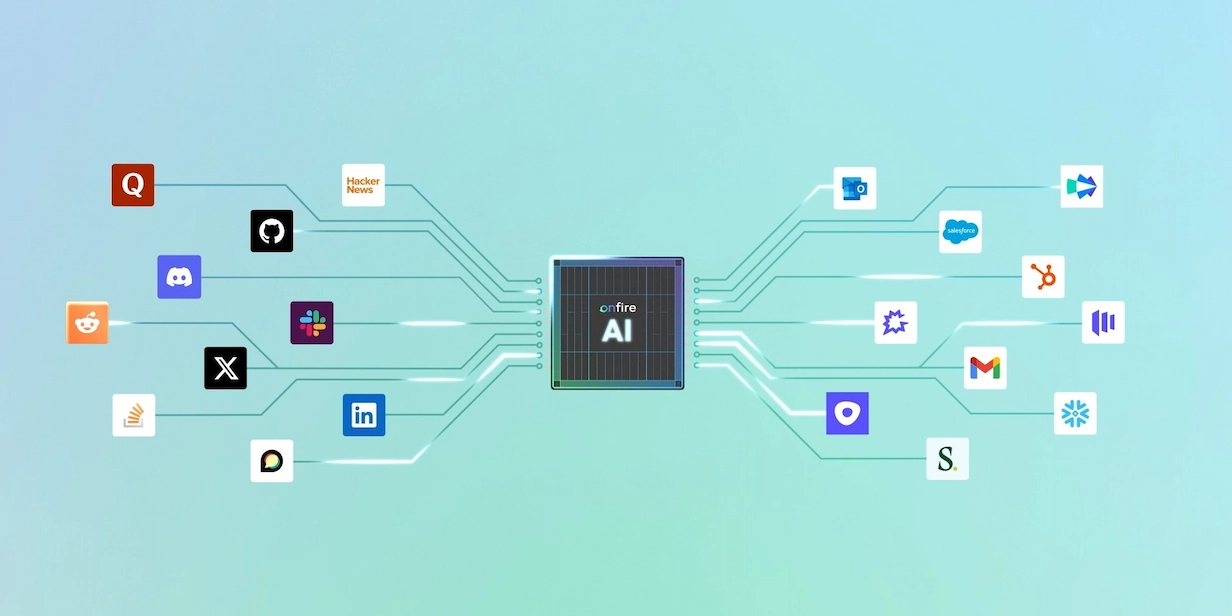
An AI assistant is only as useful as the data it can reach, and a general one pointed at the public web gives every rep the same account summary. Onfire is built for teams that sell to technical buyers. The Onfire connector brings an account's real stack, its teams and the people who'd own the decision into Claude, ChatGPT or whichever assistant you use, with evidence you can inspect. There's a library of agent skills for sales to start from, and you can get a demo to see it on your own accounts.